
Opening your dashboard
Class 10 Chemistry Chapter 1: Periodic Table, Periodic Properties and Variations of Properties Solutions
99 textbook questions with step-by-step answers, free to read, for ICSE 2026-27.
Get talked through Ch 1, not just shown the answer
Reading a finished solution is not the same as being able to do it. The AI tutor takes one question at a time and works it with you, in your own words, until you can.
- Ask it out loud, in your own words
- It gives you the next step, not the answer
- Stuck on part (ii)? Start there
99 questions with solutions
1–5 marks · Mixed difficulty
- 14 marks
Question 1
(i) State modern periodic law.
(ii) Name the scientist who stated the law.
(iii) How many groups and periods does modern periodic table have?
Solve with AIWritten solution
Solution:
Concept: The modern periodic law says that the physical and chemical properties of the elements are periodic functions of their atomic numbers. The modern periodic table arranges the elements in order of increasing atomic number in 18 vertical groups and 7 horizontal periods.
Step 1 — Part (i): state the modern periodic law.
The law links the properties of an element to its atomic number (the number of protons in its nucleus).
Modern periodic law: the physical and chemical properties of the elements are periodic functions of their atomic numbers.
This means that when the elements are arranged in order of increasing atomic number, elements with similar properties recur at regular intervals.
Step 2 — Part (ii): name the scientist.
The law was stated by Henry Moseley (1913). His X-ray experiments showed that the atomic number, not the atomic mass used by Mendeleev, is the fundamental property of an element.
Step 3 — Part (iii): count the groups and periods.
The vertical columns of the modern (long form) table are the groups and the horizontal rows are the periods. There are 18 groups and 7 periods.
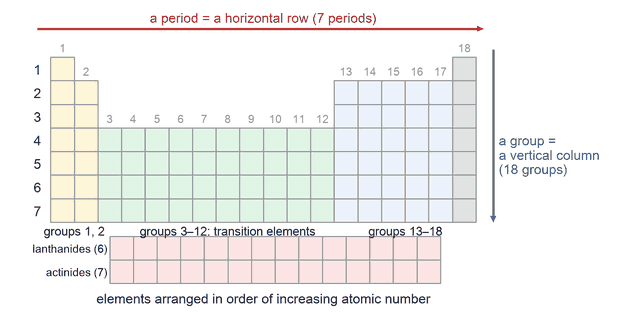
The seven periods hold 2, 8, 8, 18, 18, 32 and 32 elements. The lanthanides and actinides are written in two rows below the table so that it does not become too wide.
Watch out: Mendeleev's law was based on atomic mass; the modern law is based on atomic number. Do not mix the two.
Therefore, (i) properties are periodic functions of atomic number; (ii) Henry Moseley; (iii) 18 groups and 7 periods.
- 21 mark
Question 2
What are horizontal rows and vertical columns in a periodic table known as ?
Solve with AIWritten solution
Solution:
Concept: The modern periodic law says that the physical and chemical properties of the elements are periodic functions of their atomic numbers. The modern periodic table arranges the elements in order of increasing atomic number in 18 vertical groups and 7 horizontal periods.
Step 1 — Name the horizontal rows.
The rows that run across the table from left to right are called periods. There are 7 of them, and all the elements in one period have the same number of shells.
Step 2 — Name the vertical columns.
The columns that run down the table are called groups. There are 18 of them, and the elements in one group have the same number of valence electrons.
Watch out: A period is a row (across) and a group is a column (down); students often swap the two words.
Therefore, horizontal rows are called periods and vertical columns are called groups.
- 31 mark
Question 3
Periodicity is observed due to similar ................ (number of valence electrons/atomic number/electronic configuration).
Solve with AIWritten solution
Solution:
Concept: Periodicity is the recurrence of similar properties at regular intervals of atomic number. Properties depend on the arrangement of the outer electrons, so properties repeat whenever that arrangement repeats.
Step 1 — Find what repeats.
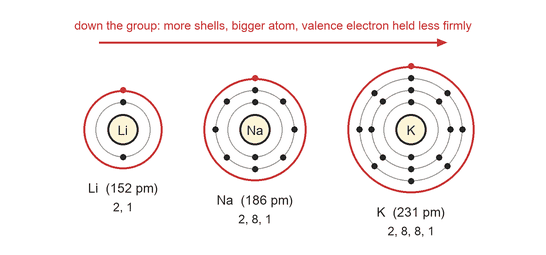
As the atomic number increases, the outer electron arrangement repeats after definite intervals. For example, Li (2, 1), Na (2, 8, 1) and K (2, 8, 8, 1) all end with one electron in the outer shell.
Step 2 — Choose the word.
The atomic number itself never repeats, and the number of valence electrons is only one part of the arrangement. The book's answer is the whole outer arrangement, the electronic configuration, which is why Li, Na and K behave alike even though their atomic numbers are far apart.
Watch out: The atomic number increases steadily and never repeats, so it cannot be the reason for repetition.
Therefore, periodicity is observed due to similar electronic configuration.
- 44 marks
Question 4
How does the electronic configuration in atoms change
(i) in a period from left to right ?
(ii) in a group from top to bottom ?
Solve with AIWritten solution
Solution:
Concept: For the first 20 elements, the number of shells in an atom gives its period, and the number of electrons in its outermost (valence) shell gives its group: 1 or 2 valence electrons → group 1 or 2; 3 to 8 valence electrons → group 13 to 18 (add 10).
Step 1 — Part (i): move across a period from left to right.
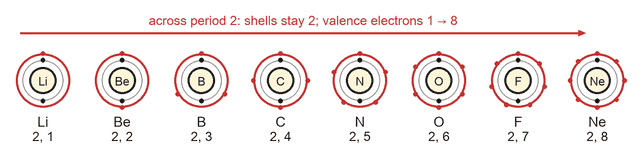
In one period every element has the same number of shells (equal to the period number). At each step one more electron is added to that outer shell, so the number of valence electrons increases by one, from 1 to 8 (from 1 to 2 in period 1).
Period 2 shows this: Li (2, 1), Be (2, 2), B (2, 3), C (2, 4), N (2, 5), O (2, 6), F (2, 7), Ne (2, 8).
Step 2 — Part (ii): move down a group from top to bottom.
Going down a group, one new shell is added at each step, while the number of valence electrons stays the same.
Group 1 shows this: Li (2, 1), Na (2, 8, 1) and K (2, 8, 8, 1) have two, three and four shells, but always one valence electron.
Watch out: Across a period the number of shells does not change; only the valence electrons change.
Therefore, (i) across a period the shells stay the same and the valence electrons increase from 1 to 8; (ii) down a group a shell is added at each step and the valence electrons stay the same.
- 54 marks
Question 5
Name two elements in each case :
(i) Alkali metals (ii) Alkaline earth metals
(iii) Halogens (iv) Inert gas
Solve with AIWritten solution
Solution:
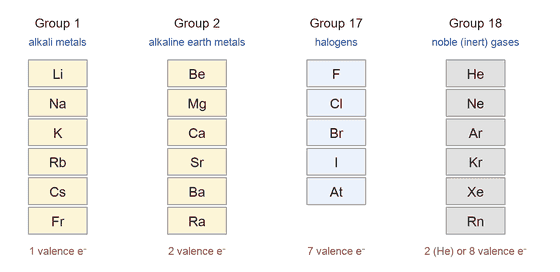
Concept: Four families of the periodic table have special names: the alkali metals (group 1), the alkaline earth metals (group 2), the halogens (group 17) and the inert or noble gases (group 18).
Step 1 — Part (i): alkali metals.
Group 1 metals have 1 valence electron and form strong alkalis with water. Two of them are lithium and sodium (potassium is also correct).
Step 2 — Part (ii): alkaline earth metals.
Group 2 metals have 2 valence electrons. Two of them are magnesium and calcium (beryllium is also correct).
Step 3 — Part (iii): halogens.
Group 17 elements have 7 valence electrons; the name means 'salt formers'. Two of them are fluorine and chlorine (bromine is also correct).
Step 4 — Part (iv): inert gases.
Group 18 elements have a completely filled outermost shell. Two of them are helium and neon (argon is also correct).
Watch out: Hydrogen sits at the top of group 1 but is not an alkali metal, so do not give it in part (i).
Therefore, (i) lithium, sodium; (ii) magnesium, calcium; (iii) fluorine, chlorine; (iv) helium, neon.
- 62 marks
Question 6
Elements of group 1 and elements of group 17 both have valency 1. Explain.
Solve with AIWritten solution
Solution:
Concept: Valency is the number of electrons an atom loses, gains or shares to reach a stable octet (a duplet for the first shell). Atoms with 1, 2 or 3 valence electrons lose them, so their valency equals the number of valence electrons; atoms with 5, 6 or 7 gain electrons, so their valency is 8 minus that number.
Step 1 — Group 1: count the electrons lost.
Group 1 elements have 1 valence electron. Losing this one electron is the easiest way to reach the stable configuration of the previous noble gas, so their valency is 1.
Step 2 — Group 17: count the electrons gained.
Group 17 elements have 7 valence electrons. Gaining one electron completes the octet, so their valency is 8 − 7 = 1.
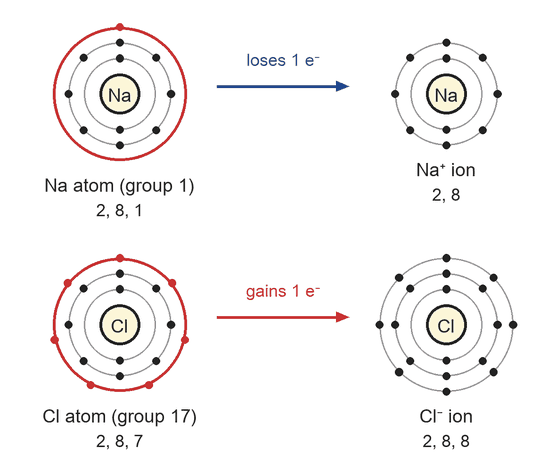
Step 3 — Compare the two.
In both groups exactly one electron changes hands: group 1 atoms lose one and group 17 atoms gain one. Valency counts the electrons that change hands, so it is 1 in both cases.
Watch out: Valency is not the number of valence electrons for group 17; it is 8 minus that number.
Therefore, group 1 elements lose one electron and group 17 elements gain one electron, so both have valency 1.
- 74 marks
Question 7
Correct the statements.
(i) Elements in the same period have the same valency.
(ii) Valency depends upon the number of shells in an atom.
(iii) Copper and zinc are representative elements.
(iv) Transition elements are placed at extreme right of the periodic table.
Solve with AIWritten solution
Solution:
Concept: Valency depends on the number of valence electrons, which is the same within a group but changes along a period. Transition elements (groups 3 to 12) fill the middle of the table; representative elements are in groups 1, 2 and 13 to 17.
Step 1 — Correct statement (i).
Across a period the valence electrons change from 1 to 8, so the valency changes too (period 3: 1, 2, 3, 4, 3, 2, 1, 0). It is the elements of one group that share a valency.
Correct: elements in the same group have the same valency.
Step 2 — Correct statement (ii).
The number of shells only tells the period: sodium (3 shells) and potassium (4 shells) both have valency 1. What decides valency is the outer shell.
Correct: valency depends upon the number of valence electrons (electrons in the outermost shell) of an atom.
Step 3 — Correct statement (iii).
Copper and zinc lie in groups 11 and 12, inside the block of groups 3 to 12, and their two outermost shells are incomplete.
Correct: copper and zinc are transition elements.
Step 4 — Correct statement (iv).
The extreme right of the table holds the noble gases of group 18, not the transition elements.
Correct: transition elements are placed in the middle of the periodic table (groups 3 to 12).
Watch out: The word 'period' and the word 'group' are easy to swap; elements of the same group, not period, share a valency.
Therefore, (i) same group, same valency; (ii) valency depends on the valence electrons; (iii) copper and zinc are transition elements; (iv) transition elements are in the middle (groups 3 to 12).
- 85 marks
Question 8
What do you understand by ?
(i) Periodicity (ii) Typical elements
(iii) Orbits
Solve with AIWritten solution
Solution:
Concept: These are three basic terms of the chapter. Each answer is a definition followed by an example.
Step 1 — Part (i): periodicity.
Properties that reappear at regular intervals, or change gradually (increase or decrease) at regular intervals, are called periodic properties, and this phenomenon is called periodicity.
It happens because a similar electronic configuration recurs after definite intervals of atomic number. For example, after 8 elements Na (2, 8, 1) repeats the outer arrangement of Li (2, 1).
Step 2 — Part (ii): typical elements.
The third-period elements Na, Mg, Al, Si, P, S and Cl are called typical elements, because each of them shows the typical properties of its own group.
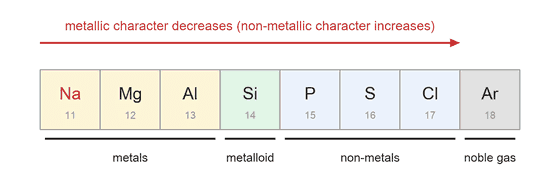
Step 3 — Part (iii): orbits.
Orbits (shells) are the definite circular paths in which the electrons revolve around the nucleus. They are named K, L, M, N … from the nucleus outwards, and can hold at most 2, 8, 18 and 32 electrons respectively.
Watch out: Argon is in period 3 but is a noble gas, so it is not counted among the typical elements.
Therefore, periodicity is the recurrence of properties at regular intervals; typical elements are the period 3 elements Na to Cl; orbits are the fixed circular paths (K, L, M, N …) of the electrons.
- 92 marks
Question 9
Name two elements that you would expect to show chemical reactions similar to calcium. What is the basis of your choice ?
Solve with AIWritten solution
Solution:
Concept: Elements of the same group have the same number of valence electrons, so they show similar chemical properties.
Step 1 — Place calcium.
Calcium (2, 8, 8, 2) has 2 valence electrons, so it is in group 2, the alkaline earth metals.
Step 2 — Choose two members of the same group.
Magnesium (2, 8, 2) and strontium (2, 8, 18, 8, 2) are also in group 2. Beryllium or barium would also be correct.
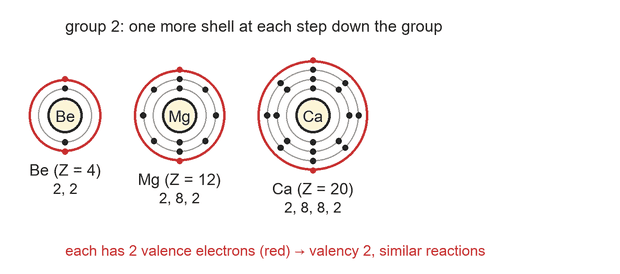
Step 3 — Give the basis.
Like calcium, these elements have 2 valence electrons and valency 2. They lose these two electrons to form ions, so they react in the same way; for example all of them form oxides MO and chlorides .
Watch out: Elements next to calcium in the same period (potassium, scandium) are not similar to it; similarity goes down a group.
Therefore, magnesium and strontium react like calcium, because all three are in group 2 with 2 valence electrons.
- 103 marks
Question 10
Name the (i) metals (ii) metalloids and (iii) non-metals in the first twenty elements.
Solve with AIWritten solution
Solution:
Concept: Metals lie on the left of the table (1 to 3 valence electrons), non-metals on the right, and the metalloids along the step-shaped line between them; metalloids show properties of both metals and non-metals.
Step 1 — Part (i): list the metals.
The metals among the first twenty elements are lithium, beryllium, sodium, magnesium, aluminium, potassium and calcium (7 elements).
Step 2 — Part (ii): list the metalloids.
The metalloids are boron and silicon (2 elements).
Step 3 — Part (iii): list the non-metals.
The non-metals are hydrogen, helium, carbon, nitrogen, oxygen, fluorine, neon, phosphorus, sulphur, chlorine and argon (11 elements, including the noble gases helium, neon and argon).
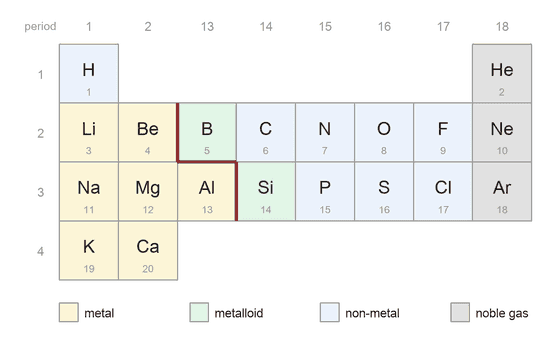
Check: The three lists together must account for all twenty elements.
Watch out: Boron and silicon are not metals; they are metalloids. Hydrogen, though placed in group 1, is a non-metal.
Therefore, the metals are Li, Be, Na, Mg, Al, K, Ca; the metalloids are B, Si; the non-metals are H, He, C, N, O, F, Ne, P, S, Cl, Ar.
- 113 marks
Question 11
Fluorine, Chlorine and Bromine are put in one group on the basis of their similar properties.
(i) What are those similar properties ?
(ii) What is the common name of this group or family ?
Solve with AIWritten solution
Solution:
Concept: Elements placed in one group have the same number of valence electrons, so they show similar properties. Fluorine, chlorine and bromine are in group 17.
Step 1 — Part (i): find the common electronic feature.
Each has 7 valence electrons: F (2, 7), Cl (2, 8, 7) and Br (2, 8, 18, 7). So each needs just one electron to complete its octet, and has valency 1.
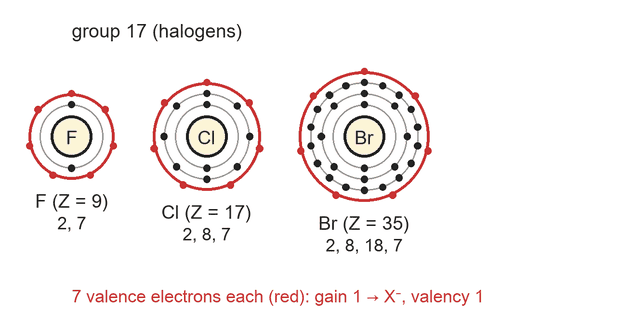
Step 2 — Part (i): list the similar properties.
- All are non-metals and strong oxidising agents: each gains one electron to form an ion .
- All exist as diatomic molecules: , , .
- All form salts with metals (for example NaCl) and acids HX with hydrogen (HF, HCl, HBr).
Step 3 — Part (ii): name the family.
This group (group 17) is called the halogens, which means 'salt formers'.
Watch out: The halogens gain electrons; they never lose their 7 valence electrons, so they are not metallic.
Therefore, (i) they have 7 valence electrons, valency 1, are diatomic non-metals that form X⁻ ions and salts; (ii) the family is called the halogens.
- 122 marks
Question 12
What is the main characteristic of the last element in each period of the Periodic Table ? What is the general name of such elements ?
Solve with AIWritten solution
Solution:
Concept: A period ends when the outermost shell that is being filled becomes complete.
Step 1 — Find the characteristic.
The last element of each period has a completely filled outermost shell: a duplet in helium (2) and an octet in the others, for example neon (2, 8) and argon (2, 8, 8).
Step 2 — Explain why it matters.
This configuration is very stable, so the element neither loses nor gains electrons easily. Its valency is zero and it hardly reacts.
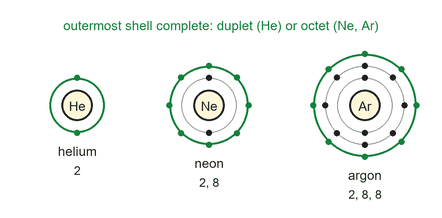
Step 3 — Name the family.
Such elements are called noble gases (inert gases); they form group 18.
Watch out: Helium has only 2 electrons, but its single shell is full, so it counts as complete (a duplet, not an octet).
Therefore, the last element of each period has a completely filled outermost shell, and such elements are called noble (inert) gases.
- 132 marks
Question 13
According to atomic structure, what determines which element will be the first and which will be the last in a period?
Solve with AIWritten solution
Solution:
Concept: Each period corresponds to the filling of one new shell: the period starts when that shell receives its first electron and ends when the shell is full.
Step 1 — Decide the first element.
The element with one electron in a new outermost shell begins the period. It is an alkali metal; for example Na (2, 8, 1) starts period 3.
Step 2 — Decide the last element.
The element in which that outermost shell becomes complete ends the period. It is a noble gas; for example Ar (2, 8, 8) ends period 3.
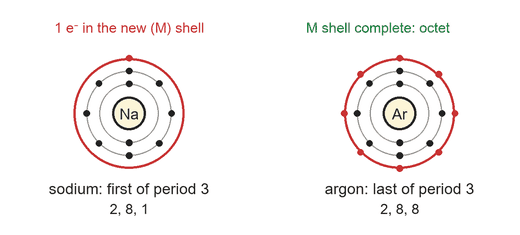
Step 3 — State the rule.
So the number of electrons in the valence shell decides the place: one electron makes the first element, and a full shell makes the last.
Watch out: The first element of period 1 is hydrogen, not an alkali metal, and period 1 ends at helium with only 2 electrons.
Therefore, the element with one electron in a new shell is first, and the element whose outermost shell is completely filled is last.
- 144 marks
Question 14
How do the following vary on moving from left to right in the third period of the periodic table ?
(i) valence electrons and
(ii) valency
Solve with AIWritten solution
Solution:
Concept: Period 3 runs Na, Mg, Al, Si, P, S, Cl, Ar. All eight have three shells, and one more electron is added to the outer shell at each step. Valency is the number of electrons an atom loses, gains or shares to reach a stable octet (a duplet for the first shell). Atoms with 1, 2 or 3 valence electrons lose them, so their valency equals the number of valence electrons; atoms with 5, 6 or 7 gain electrons, so their valency is 8 minus that number.
Step 1 — Part (i): count the valence electrons.
The valence electrons increase from 1 to 8: Na 1, Mg 2, Al 3, Si 4, P 5, S 6, Cl 7, Ar 8.
Step 2 — Part (ii): find the valency of the first four.
Na, Mg, Al and Si lose (or share) all their valence electrons, so their valency equals the number of valence electrons: Na 1, Mg 2, Al 3, Si 4.
Step 3 — Part (ii): find the valency of the rest.
P, S and Cl gain (or share) electrons to complete the octet, so their valency is 8 minus the valence electrons: P 3, S 2, Cl 1. Argon already has a complete octet, so its valency is 0.
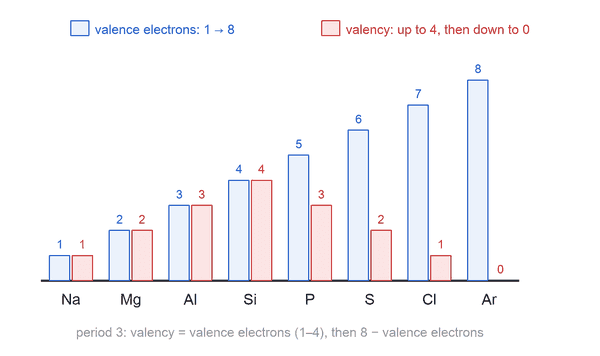
Watch out: Valency does not keep rising with the valence electrons; it rises to 4 and then falls.
Therefore, (i) valence electrons increase from 1 to 8; (ii) valency increases from 1 to 4 and then decreases to 0.
- 155 marks
Question 15
Name the type of elements which have their
(i) outermost shell complete
(ii) outermost shell incomplete
(iii) two outermost shell incomplete
(iv) one electron short of octet
(v) two electrons in the outermost orbit.
Solve with AIWritten solution
Solution:
Concept: The state of the outermost shell (or of the two outermost shells) decides which family an element belongs to.
Step 1 — Part (i): outermost shell complete.
Elements with a complete outer shell are the noble (inert) gases of group 18, for example Ne (2, 8).
Step 2 — Part (ii): outermost shell incomplete.
Elements with only the outermost shell incomplete are the normal (representative) elements of groups 1, 2 and 13 to 17, for example Na (2, 8, 1).
Step 3 — Part (iii): two outermost shells incomplete.
Elements with the two outermost shells incomplete are the transition elements of groups 3 to 12, for example iron and copper.
Step 4 — Part (iv): one electron short of an octet.
Elements with 7 valence electrons are the halogens of group 17, for example Cl (2, 8, 7).
Step 5 — Part (v): two electrons in the outermost orbit.
Elements with 2 valence electrons are the alkaline earth metals of group 2, for example Mg (2, 8, 2).
Watch out: Helium also has two electrons in its outermost shell, but that shell is full, so helium is a noble gas, not an alkaline earth metal.
Therefore, (i) noble gases; (ii) normal (representative) elements; (iii) transition elements; (iv) halogens; (v) alkaline earth metals.
- 165 marks
Question 16
An element has 2 electrons in its N shell.
(i) What is its atomic number ?
(ii) State its position in the periodic table.
(iii) Is it a metal or a non-metal ?
(iv) State the name assigned to this group.
(v) What is the valency of this element ?
Solve with AIWritten solution
Solution:
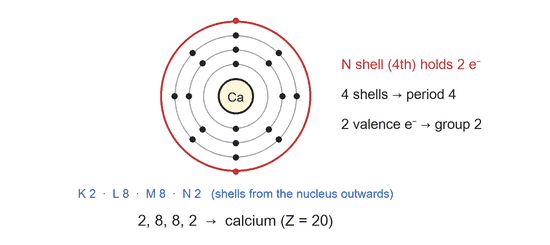
Concept: The shells from the nucleus outwards are K, L, M and N. In the first twenty elements the K shell holds 2 electrons and the L and M shells hold 8 each before the N shell starts. For the first 20 elements, the number of shells in an atom gives its period, and the number of electrons in its outermost (valence) shell gives its group: 1 or 2 valence electrons → group 1 or 2; 3 to 8 valence electrons → group 13 to 18 (add 10).
Step 1 — Write the configuration.
The N shell is the fourth shell. If it has 2 electrons, the K, L and M shells before it are full for this element, so the configuration is 2, 8, 8, 2.
Step 2 — Part (i): add the electrons.
The atomic number equals the total number of electrons in the neutral atom.
So the element is calcium.
Step 3 — Part (ii): find its position.
It has four shells, so it is in period 4; it has two valence electrons, so it is in group 2 (IIA).
Step 4 — Parts (iii) and (iv): metal or non-metal, and the group name.
It loses its 2 valence electrons easily, so it is a metal. Group 2 is called the alkaline earth metals.
Step 5 — Part (v): valency.
It loses 2 electrons to form , so its valency is 2.
Watch out: The N shell is the fourth shell (K, L, M, N), not the third.
Therefore, (i) 20; (ii) period 4, group 2; (iii) metal; (iv) alkaline earth metals; (v) valency 2.
- 175 marks
Question 17
Answer the following in respect of element .
(i) Give its electronic configuration.
(ii) To which group and period does it belong ?
(iii) What is its valency ?
(iv) Is it a metal or a non-metal ?
(v) Is it a reducing agent or an oxidising agent ?
(vi) Give its formula with hydrogen.
Solve with AIWritten solution
Solution:
Concept: In the symbol the lower number, 16, is the atomic number and the upper number, 32, is the mass number. A neutral atom has as many electrons as its atomic number. For the first 20 elements, the number of shells in an atom gives its period, and the number of electrons in its outermost (valence) shell gives its group: 1 or 2 valence electrons → group 1 or 2; 3 to 8 valence electrons → group 13 to 18 (add 10).
Step 1 — Part (i): write the configuration.
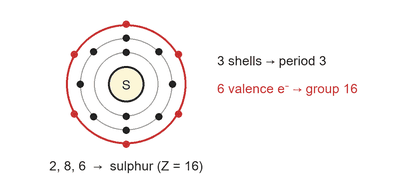
Sixteen electrons fill the shells as K 2, L 8, M 6, so the configuration is 2, 8, 6.
Step 2 — Part (ii): find the group and period.
It has six valence electrons, so it is in group 16 (VIA); it has three shells, so it is in period 3.
Step 3 — Part (iii): find the valency.
It needs 2 more electrons to complete its octet, so its valency is 8 − 6 = 2.
Step 4 — Parts (iv) and (v): metal or non-metal, oxidising or reducing.
It gains electrons to complete its octet, so it is a non-metal. A substance that accepts electrons from others is an oxidising agent.
Step 5 — Part (vi): write the formula with hydrogen.
Sulphur has valency 2 and hydrogen valency 1, so two hydrogen atoms join one sulphur atom: (hydrogen sulphide).
Watch out: The upper number, 32, is the mass number; it is not used for the configuration.
Therefore, (i) 2, 8, 6; (ii) group 16, period 3; (iii) valency 2; (iv) non-metal; (v) oxidising agent; (vi) H₂S.
- 185 marks
Question 18
Name
(a) An alkali metal in period 3 and halogen in period 2.
(b) The noble gas with 3 shells.
(c) The non-metals present in period 2 and metals in period 3.
(d) The element of period 3 with valency 4.
(e) The element in period 3 which does not form oxide.
(f) The element of lower nuclear charge out of Be and Mg.
Solve with AIWritten solution
Solution:
Concept: Period 2 runs from lithium to neon and period 3 from sodium to argon. Write each configuration and use its position in the table.
Step 1 — Part (a): alkali metal in period 3 and halogen in period 2.
The alkali metal of period 3 is sodium (2, 8, 1). The halogen of period 2 is fluorine (2, 7).
Step 2 — Part (b): noble gas with 3 shells.
The noble gas with three shells is argon (2, 8, 8).
Step 3 — Part (c): non-metals of period 2 and metals of period 3.
The non-metals of period 2 are carbon, nitrogen, oxygen and fluorine (neon, a noble gas, is also a non-metal; boron is a metalloid). The metals of period 3 are sodium, magnesium and aluminium.
Step 4 — Part (d): element of period 3 with valency 4.
Silicon (2, 8, 4) has 4 valence electrons, which it shares, so its valency is 4.
Step 5 — Part (e): element of period 3 that does not form an oxide.
Argon has a complete octet and does not combine with oxygen.
Step 6 — Part (f): lower nuclear charge out of Be and Mg.
Nuclear charge equals the atomic number: Be is +4 and Mg is +12. So beryllium has the lower nuclear charge.
Watch out: Boron in period 2 is a metalloid, not a non-metal, and silicon in period 3 is a metalloid, not a metal.
Therefore, (a) sodium, fluorine; (b) argon; (c) C, N, O, F and Na, Mg, Al; (d) silicon; (e) argon; (f) beryllium.
- 195 marks
Question 19
The electronic configuration of an element T is 2, 8, 8, 1.
(i) What is the group number of T ?
(ii) What is the period number of T ?
(iii) How many valence electrons are there in an atom of T ?
(iv) What is the valency of T ?
(v) Is it a metal or a non-metal ?
Solve with AIWritten solution
Solution:
Concept: For the first 20 elements, the number of shells in an atom gives its period, and the number of electrons in its outermost (valence) shell gives its group: 1 or 2 valence electrons → group 1 or 2; 3 to 8 valence electrons → group 13 to 18 (add 10).
Step 1 — Read the configuration.
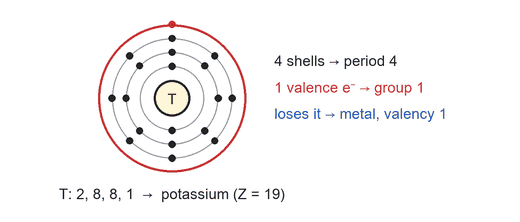
T has 2 + 8 + 8 + 1 = 19 electrons arranged in four shells, with one electron in the outermost shell. So T is potassium (atomic number 19).
Step 2 — Parts (i) and (ii): group and period.
One valence electron puts T in group 1 (IA). Four shells put it in period 4.
Step 3 — Parts (iii) and (iv): valence electrons and valency.
T has 1 valence electron. It loses this electron to form , so its valency is 1.
Step 4 — Part (v): metal or non-metal.
It loses an electron easily, so it is a metal.
Watch out: The period is the number of shells (4), not the number of valence electrons.
Therefore, (i) group 1; (ii) period 4; (iii) 1 valence electron; (iv) valency 1; (v) metal.
- 205 marks
Question 20
Match the atomic number 19, 15, 8, 4 and 2 with each of the following :
(i) A metal of valency one.
(ii) A solid non-metal of period 3.
(iii) A rare gas.
(iv) A gaseous element with valency 2.
(v) An element of group 2. (2017)
Solve with AIWritten solution
Solution:
Concept: Write the electronic configuration of each atomic number, then read off its group, period and type.
Step 1 — Identify the five elements.
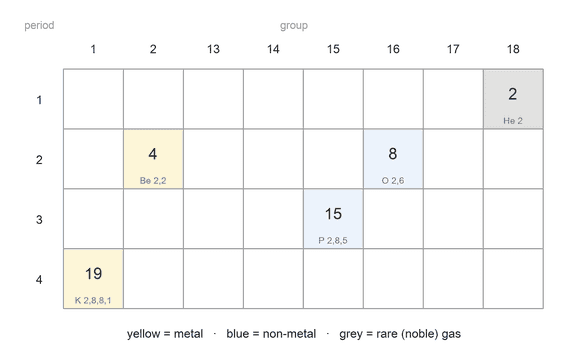
19 = potassium (2, 8, 8, 1), 15 = phosphorus (2, 8, 5), 8 = oxygen (2, 6), 4 = beryllium (2, 2) and 2 = helium (2).
Step 2 — Parts (i) and (ii): metal of valency one, solid non-metal of period 3.
19 (potassium) has one valence electron, which it loses, so it is a metal of valency one. 15 (phosphorus) has three shells and five valence electrons, so it is a solid non-metal of period 3.
Step 3 — Parts (iii) and (iv): rare gas, gaseous element with valency 2.
2 (helium) has a complete duplet, so it is a rare gas. 8 (oxygen) is a gas that gains 8 − 6 = 2 electrons, so its valency is 2.
Step 4 — Part (v): element of group 2.
4 (beryllium) has two valence electrons, so it is in group 2.
Watch out: Helium has 2 electrons like the group 2 elements, but its only shell is full, so it is a noble gas, not a group 2 element.
Therefore, (i) 19; (ii) 15; (iii) 2; (iv) 8; (v) 4.
- 212 marks
Question 21
What do you understand by atomic size ? State its unit.
Solve with AIWritten solution
Solution:
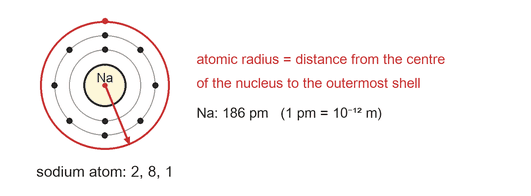
Concept: An atom has no sharp edge, so its size is described by its atomic radius, measured from the centre of the nucleus.
Step 1 — Define atomic size.
Atomic size (atomic radius) is the distance between the centre of the nucleus of an atom and its outermost shell.
Step 2 — State the unit.
Atoms are extremely small, so the radius is given in picometres (pm) or angstroms (Å).
So 1 Å is the same as 100 pm.
For example, the atomic radius of sodium is 186 pm.
Watch out: The radius is measured to the outermost shell, not to the first shell around the nucleus.
Therefore, atomic size is the distance from the centre of the nucleus to the outermost shell, measured in picometres (pm) or angstroms (Å).
- 222 marks
Question 22
Give the trends in atomic size on moving :
(i) down the group,
(ii) across the period left to right.
Solve with AIWritten solution
Solution:
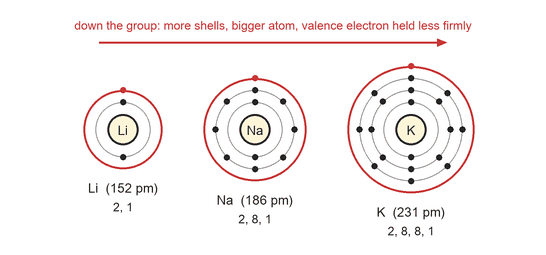
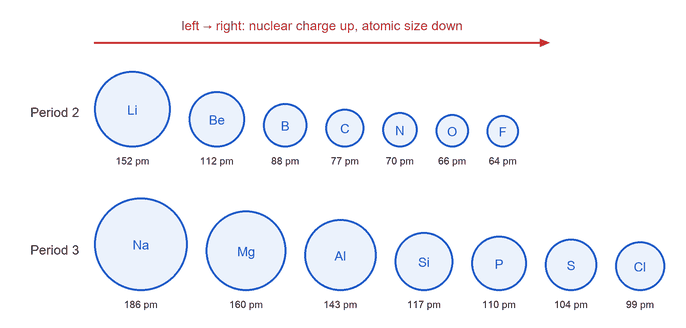
Concept: Atomic size (atomic radius) depends on the number of shells and on the nuclear charge. Down a group a new shell is added at each step, so atoms get bigger; across a period the shells stay the same while the nuclear charge rises, so atoms get smaller.
Step 1 — Part (i): go down a group.
Going down a group, a new shell is added at each step, so the outermost electrons are farther from the nucleus. The nuclear charge also rises, but the effect of the extra shell is greater. So atomic size increases: Li 152, Na 186, K 231 pm.
Step 2 — Part (ii): go across a period from left to right.
Across a period the number of shells stays the same, while the nuclear charge increases by one at each step. The stronger pull draws the outer shell closer to the nucleus, so atomic size decreases: Na 186 pm down to Cl 99 pm in period 3.
Watch out: Across a period the atomic number rises, yet the atoms get smaller; more electrons do not mean a bigger atom when no new shell is added.
Therefore, (i) atomic size increases down a group; (ii) it decreases across a period from left to right.
- 232 marks
Question 23
Arrange the elements of second and third period in increasing order of their atomic size (excluding noble gases).
Solve with AIWritten solution
Solution:
Concept: Atomic size (atomic radius) depends on the number of shells and on the nuclear charge. Down a group a new shell is added at each step, so atoms get bigger; across a period the shells stay the same while the nuclear charge rises, so atoms get smaller. So the increasing order of size runs from right to left.
Step 1 — Arrange period 2.
Leaving out neon, the smallest atom is fluorine at the right end and the largest is lithium at the left end. With the book's radii (pm):
F < O < N < C < B < Be < Li
(64 < 66 < 70 < 77 < 88 < 112 < 152 pm)
Step 2 — Arrange period 3.
In the same way, leaving out argon, chlorine is the smallest and sodium the largest:
Cl < S < P < Si < Al < Mg < Na
(99 < 104 < 110 < 117 < 143 < 160 < 186 pm)
Watch out: The question asks for increasing size, so start with the smallest atom (at the right end of the period).
Therefore, period 2: F < O < N < C < B < Be < Li; period 3: Cl < S < P < Si < Al < Mg < Na.
- 244 marks
Question 24
Why is the size of (i) neon greater than fluorine? (ii) sodium greater than magnesium ?
Solve with AIWritten solution
Solution:
Concept: Atomic size depends on the number of shells, the nuclear charge, and the repulsion between the electrons in the outer shell.
Step 1 — Part (i): compare neon and fluorine.
Neon (2, 8) has a completely filled octet, while fluorine (2, 7) has one electron less. With the outer shell full, the repulsion between its electrons is at its greatest, which outweighs the pull of the nucleus, so the outer shell spreads out.
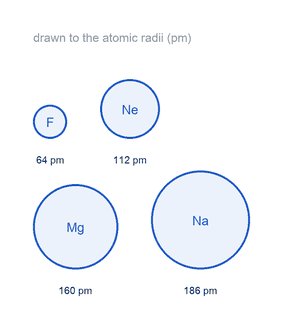
So the neon atom (112 pm) is bigger than the fluorine atom (64 pm), even though neon has the greater nuclear charge.
Step 2 — Part (ii): compare sodium and magnesium.
Both have three shells (Na 2, 8, 1; Mg 2, 8, 2). Magnesium has the greater nuclear charge (+12 against +11), so its electrons are pulled closer to the nucleus.
So magnesium is smaller (160 pm) and sodium is larger (186 pm).
Watch out: A noble gas is bigger than the halogen just before it, but it is still smaller than the alkali metal at the start of its period.
Therefore, (i) neon's full octet has maximum electron repulsion, so it is bigger than fluorine; (ii) sodium has a smaller nuclear charge on the same three shells, so it is bigger than magnesium.
- 255 marks
Question 25
(i) Which is greater in size ?
(a) an atom or a cation
(b) an atom or an anion
(c) or
(d) Fluorine or oxygen
(ii) Which has the maximum metallic character – Na, Li or K ?
Solve with AIWritten solution
Solution:
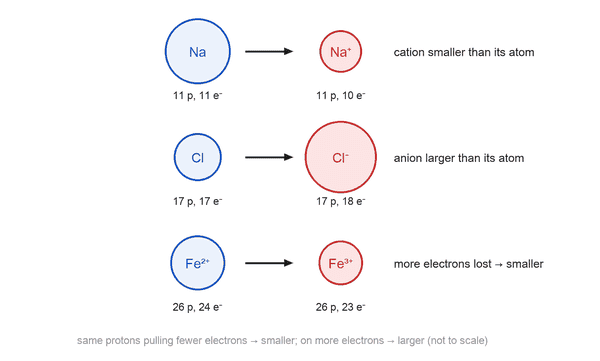
Concept: An ion has the same number of protons as its atom. A cation has lost electrons, so the same nuclear pull acts on fewer electrons and the particle is smaller than its atom; an anion has gained electrons, so the repulsion between electrons grows and the particle is larger than its atom.
Step 1 — Part (i)(a): atom or cation.
Sodium (11 protons, 11 electrons) loses one electron to form (11 protons, 10 electrons). The same nuclear charge now pulls on fewer electrons, and here a whole shell is lost, so the atom is bigger.
Step 2 — Part (i)(b): atom or anion.
Chlorine (17 electrons) gains one electron to form (18 electrons) with the same 17 protons. The extra electron increases the repulsion and the pull per electron falls, so the anion is bigger.
Step 3 — Part (i)(c): Fe²⁺ or Fe³⁺.
Both ions have 26 protons, but has 24 electrons and only 23. The ion with fewer electrons is pulled in more tightly, so is bigger.
Step 4 — Part (i)(d): fluorine or oxygen.
O and F are both in period 2, with two shells. Oxygen has the smaller nuclear charge (+8 against +9), so oxygen is bigger (O 66 pm, F 64 pm).
Step 5 — Part (ii): maximum metallic character among Na, Li and K.
Li, Na and K are all in group 1, and metallic character increases down a group. K is the lowest of the three, so it has the largest atom and loses its valence electron most easily: potassium.
Watch out: The number of protons does not change when an ion forms; only the number of electrons changes.
Therefore, (i) (a) the atom, (b) the anion, (c) Fe²⁺, (d) oxygen; (ii) potassium.
- 264 marks
Question 26
Arrange :
(i) Be, Li, C, B, N, O, F (in increasing metallic character).
(ii) Si, Na, Al, Mg, Cl, P, S (in decreasing non-metallic character).
Solve with AIWritten solution
Solution:
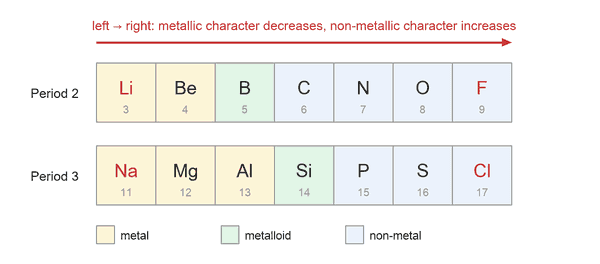
Concept: Metallic character is the tendency of an atom to lose electrons; non-metallic character is the tendency to gain them. Big atoms with few valence electrons lose electrons easily, so metallic character decreases across a period and increases down a group; non-metallic character does the opposite.
Step 1 — Part (i): increasing metallic character in period 2.
All seven are in period 2. Metallic character falls from left to right, so the increasing order runs from right to left: fluorine has the least tendency to lose electrons, lithium the greatest.
F < O < N < C < B < Be < Li
Step 2 — Part (ii): decreasing non-metallic character in period 3.
All seven are in period 3. Non-metallic character rises from left to right, so the decreasing order runs from right to left: chlorine gains an electron most readily, sodium least.
Cl > S > P > Si > Al > Mg > Na
Watch out: Read each question's direction carefully: (i) asks for increasing, (ii) for decreasing order.
Therefore, (i) F < O < N < C < B < Be < Li; (ii) Cl > S > P > Si > Al > Mg > Na.
- 274 marks
Question 27
State the trend in chemical reactivity :
(i) across the third period from left to right,
(ii) down the group.
a. in group IA (1) b. in group VIIA (17)
Solve with AIWritten solution
Solution:
Concept: Metals react by losing electrons and non-metals by gaining them, so the reactivity of an element follows how easily it does this.
Step 1 — Part (i): Na to Si across period 3.
From sodium to silicon the nuclear charge rises and the atoms get smaller, so the tendency to lose electrons falls. Reactivity decreases: sodium is the most reactive metal and silicon the least reactive element of the period.
Step 2 — Part (i): P to Cl, and argon.
From phosphorus to chlorine the tendency to gain electrons rises, so reactivity increases again; chlorine is the most reactive non-metal of the period. Argon, with a complete octet, is unreactive.
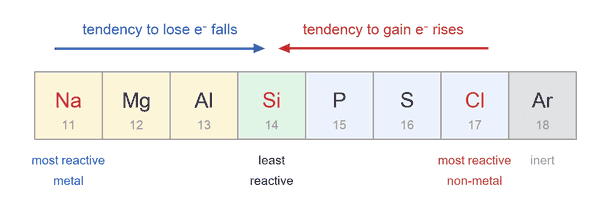
Step 3 — Part (ii)(a): down group IA (1).
The atoms get bigger down the group, so the single valence electron is lost more easily. Reactivity increases: Li < Na < K < Rb < Cs.
Step 4 — Part (ii)(b): down group VIIA (17).
The atoms get bigger down the group, so an extra electron is attracted less strongly. Reactivity decreases: F > Cl > Br > I.
Watch out: The two groups go opposite ways: metals get more reactive down a group, non-metals less reactive.
Therefore, (i) across period 3 reactivity first decreases (Na to Si) and then increases (P to Cl); (ii) (a) it increases down group 1, (b) it decreases down group 17.
- 282 marks
Question 28
A metal M forms an oxide having the formula . It belongs to third period. Write the atomic number and valency of the metal.
Solve with AIWritten solution
Solution:
Concept: In a formula the total valency of each part must be equal. In an oxide, oxygen has valency 2. For the first 20 elements, the number of shells in an atom gives its period, and the number of electrons in its outermost (valence) shell gives its group: 1 or 2 valence electrons → group 1 or 2; 3 to 8 valence electrons → group 13 to 18 (add 10).
Step 1 — Find the valency of M.
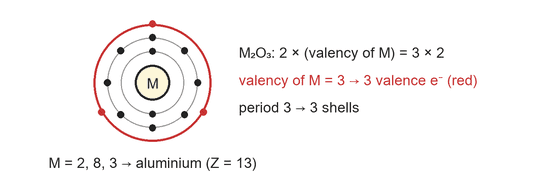
In , two M atoms balance three O atoms, so the total valencies must be equal.
Step 2 — Write the configuration.
A period 3 element has three shells, and a metal of valency 3 has 3 valence electrons. So M is 2, 8, 3.
Step 3 — Find the atomic number.
The atomic number equals the number of electrons.
The element is aluminium, and its oxide is .
Watch out: The subscript 3 in M₂O₃ belongs to oxygen; the valency of M comes from the cross-over, not from the subscript next to M.
Therefore, the metal has atomic number 13 (aluminium) and valency 3.
- 295 marks
Question 29
An element X belongs to 3rd period and 17th group, state
(i) no. of valence electrons in it.
(ii) name of the element.
(iii) name the family to which it belongs.
(iv) write the formula of the compound formed when X reacts with .
Solve with AIWritten solution
Solution:
Concept: For the first 20 elements, the number of shells in an atom gives its period, and the number of electrons in its outermost (valence) shell gives its group: 1 or 2 valence electrons → group 1 or 2; 3 to 8 valence electrons → group 13 to 18 (add 10). Valency is the number of electrons an atom loses, gains or shares to reach a stable octet (a duplet for the first shell). Atoms with 1, 2 or 3 valence electrons lose them, so their valency equals the number of valence electrons; atoms with 5, 6 or 7 gain electrons, so their valency is 8 minus that number.
Step 1 — Parts (i) and (ii): identify X.
Period 3 means three shells, and group 17 means 7 valence electrons. So X is 2, 8, 7: it has 7 valence electrons, and with 17 electrons it is chlorine.
Step 2 — Part (iii): name the family.
Group 17 is the halogen family.
Step 3 — Part (iv): identify Y.
In the atomic number is 13, so Y is 2, 8, 3, which is aluminium. It loses 3 electrons, so its valency is 3.
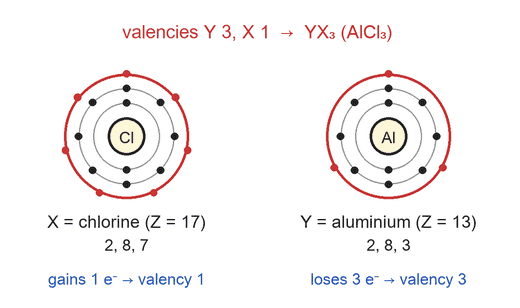
Step 4 — Part (iv): write the formula.
X gains 1 electron (valency 1). One Y atom gives away 3 electrons, so it needs three X atoms to take them. The formula is . With the real symbols this is (aluminium chloride).
Watch out: Use the atomic number 13 (lower number) for Y's configuration, not the mass number 27.
Therefore, (i) 7 valence electrons; (ii) chlorine; (iii) halogens; (iv) YX₃ (AlCl₃).
- 304 marks
Question 30
The given table shows elements with same number of electrons in its valence shell.
Elements A B C m.p. 63·0 180·0 97·0 State :
(i) Whether these elements belong to the same group or period.
(ii) Arrange them in order of increasing metallic character.
Solve with AIWritten solution
Solution:
Concept: Elements with the same number of valence electrons lie in the same group. In group 1 the melting point falls down the group (book: Li 180.5 °C, Na 94.5 °C, K 63.5 °C), while metallic character rises down the group.
Step 1 — Part (i): group or period.
A period never contains two elements with the same number of valence electrons, because the number rises by one at each step. So A, B and C belong to the same group.
Step 2 — Part (ii): place them in the group.
The melting points fall down the group, so the element with the highest melting point (B, 180.0 °C) is at the top and the one with the lowest (A, 63.0 °C) is at the bottom. From top to bottom the order is B, C, A.
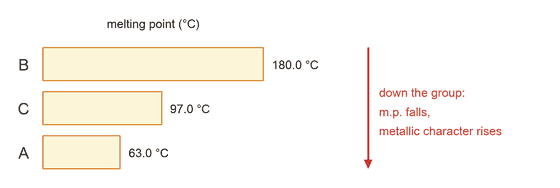
Step 3 — Part (ii): order the metallic character.
Metallic character increases down a group, because bigger atoms lose electrons more easily. So the increasing order follows the top-to-bottom order.
Watch out: A higher melting point here means higher up the group, so it means less metallic.
Therefore, (i) they are in the same group; (ii) increasing metallic character: B < C < A.
- 311 mark
Question 31
Which one of the following has the largest atomic radius ?
Solve with AIAnswer
(A) Sodium
- Correct
(B) Potassium
(C) Magnesium
(D) Aluminium
Answer: (B) Potassium
Concept: Atomic size (atomic radius) depends on the number of shells and on the nuclear charge. Down a group a new shell is added at each step, so atoms get bigger; across a period the shells stay the same while the nuclear charge rises, so atoms get smaller.
Step 1 — Count the shells.
Potassium (2, 8, 8, 1) is in period 4, so it has four shells. Sodium, magnesium and aluminium are in period 3 and have only three.
Step 2 — Compare the sizes.
The atom with an extra shell is the largest. The book's radii confirm it: K 231 pm, Na 186 pm, Mg 160 pm, Al 143 pm.
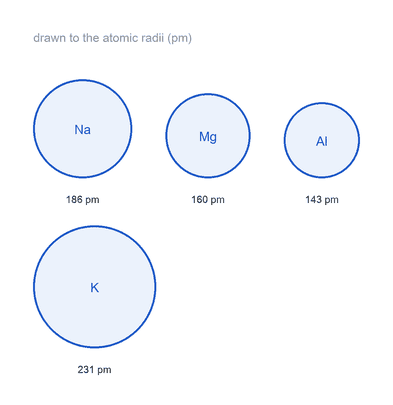
Watch out: Do not pick sodium just because it is the largest atom of period 3; potassium has a whole extra shell.
Why the other options are wrong:
- (A) Sodium: Sodium (186 pm) is directly above potassium in group 1 and has one shell fewer.
- (C) Magnesium: Magnesium (160 pm) is smaller than sodium: same three shells, greater nuclear charge.
- (D) Aluminium: Aluminium (143 pm) is smaller still, further right in period 3.
Therefore, potassium has the largest atomic radius, option (B).
- 321 mark
Question 32
Which one has the largest size ?
Solve with AIAnswer
(A) Br
(B) I
- Correct
(C)
(D) Cl
Answer: (C)
Concept: Atomic size (atomic radius) depends on the number of shells and on the nuclear charge. Down a group a new shell is added at each step, so atoms get bigger; across a period the shells stay the same while the nuclear charge rises, so atoms get smaller. An ion has the same number of protons as its atom. A cation has lost electrons, so the same nuclear pull acts on fewer electrons and the particle is smaller than its atom; an anion has gained electrons, so the repulsion between electrons grows and the particle is larger than its atom.
Step 1 — Compare the atoms.
Cl, Br and I are in group 17, and iodine is the lowest of them, so the I atom is the largest atom: Cl 99, Br 114, I 133 pm.
Step 2 — Compare the iodide ion with the iodine atom.
has the same 53 protons as the I atom but one electron more. The extra electron increases the repulsion, so is larger than the I atom, and so the largest of the four.
Watch out: An anion is always bigger than its own atom, so I⁻ beats I.
Why the other options are wrong:
- (A) Br: Br has one shell fewer than I, so it is smaller than both I and I⁻.
- (B) I: The neutral I atom has one electron fewer than I⁻, so it is smaller than the ion.
- (D) Cl: Cl is the highest of these halogens and the smallest particle of the four.
Therefore, the iodide ion I⁻ has the largest size, option (C).
- 334 marks
Question 33
The metals of group 2 from top to bottom are Be, Mg, Ca, Sr and Ba
(i) Which one of these elements will form ions most readily and why ?
(ii) State the common feature in their electronic configuration.
Solve with AIWritten solution
Solution:
Concept: Down a group the atomic size increases and the ionisation potential decreases, so the valence electrons are lost more easily.
Step 1 — Part (i): pick the element.
Barium is the lowest member of the list, so it has the most shells and the largest atom. Its two valence electrons are farthest from the nucleus and held least firmly; its ionisation potential is the lowest of the five.
Step 2 — Part (i): show the ion formation.
So barium loses its two valence electrons most easily, forming :
Step 3 — Part (ii): find the common feature.
All five have two electrons in the outermost shell (valency 2), for example Be 2, 2, Mg 2, 8, 2 and Ca 2, 8, 8, 2.
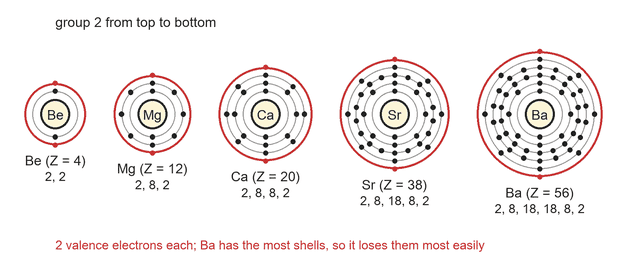
Watch out: 'forms ions most readily' means loses electrons most easily, which happens for the biggest atom, not the smallest.
Therefore, (i) barium forms ions most readily, because its large atom holds its valence electrons least firmly; (ii) all have two valence electrons.
- 342 marks
Question 34
Write the number of protons, neutrons and electronic configuration of , . Also state their position in the periodic table.
Solve with AIWritten solution
Solution:
Concept: In , the lower number Z is the atomic number, which equals the number of protons (and of electrons in the neutral atom); the upper number A is the mass number. Neutrons = mass number − atomic number. For the first 20 elements, the number of shells in an atom gives its period, and the number of electrons in its outermost (valence) shell gives its group: 1 or 2 valence electrons → group 1 or 2; 3 to 8 valence electrons → group 13 to 18 (add 10).
Step 1 — Count the particles in potassium.
For there are 19 protons, and the neutrons are found by subtraction.
Its 19 electrons are arranged 2, 8, 8, 1: four shells and one valence electron, so K is in group 1, period 4.
Step 2 — Count the particles in phosphorus.
For there are 15 protons.
Its 15 electrons are arranged 2, 8, 5: three shells and five valence electrons, so P is in group 15, period 3.
Step 3 — Summarise.
Protons 19 15 Neutrons 20 16 Electronic configuration 2, 8, 8, 1 2, 8, 5 Position group 1, period 4 group 15, period 3 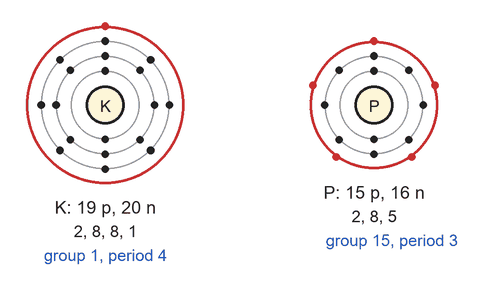
Watch out: For 5 valence electrons the group is 15 (5 + 10), not group 5.
Therefore, K: 19 protons, 20 neutrons, 2, 8, 8, 1, group 1, period 4; P: 15 protons, 16 neutrons, 2, 8, 5, group 15, period 3.
- 355 marks
Question 35
Name the element which has :
(i) two shells, both of which are completely filled with electrons ?
(ii) the electronic configuration 2, 8, 3 ?
(iii) a total of three shells with five electrons in its valence shell ?
(iv) a total of four shells with two electrons in its valence shell ?
(v) twice as many electrons in its second shell as in its first shell ?
Solve with AIWritten solution
Solution:
Concept: Build each configuration shell by shell (K holds 2, L holds 8, and M holds 8 before the N shell starts in these elements). The total number of electrons is the atomic number, which names the element.
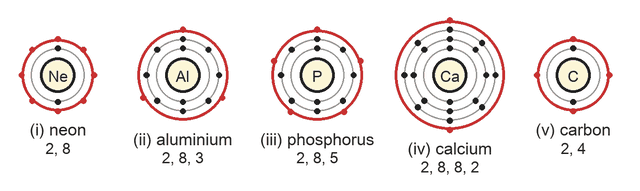
Step 1 — Parts (i) and (ii).
(i) Two shells, both full, is 2, 8: 10 electrons, so the element is neon. (ii) 2, 8, 3 has 13 electrons, so the element is aluminium.
Step 2 — Parts (iii) and (iv).
(iii) Three shells with five valence electrons is 2, 8, 5: 15 electrons, so the element is phosphorus. (iv) Four shells with two valence electrons is 2, 8, 8, 2: 20 electrons, so the element is calcium.
Step 3 — Part (v).
The first shell holds 2 electrons, so twice as many in the second shell means 4: the configuration is 2, 4 with 6 electrons, so the element is carbon.
Watch out: In part (v) the second shell is not full, so the element has only two shells.
Therefore, (i) neon; (ii) aluminium; (iii) phosphorus; (iv) calcium; (v) carbon.
- 365 marks
Question 36
An element Barium has atomic number 56. Look up its position in the Periodic Table and answer the following questions.
(i) Is it a metal or a non-metal ?
(ii) Is it more or less reactive than calcium ?
(iii) What is its valency ?
(iv) What will be the formula of its phosphate ?
(v) Is it larger or smaller than caesium (Cs) in size ?
Solve with AIWritten solution
Solution:
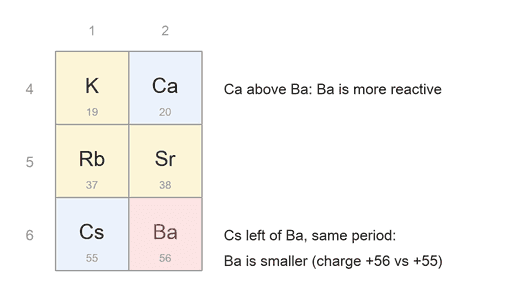
Concept: Barium (Z = 56) is in group 2, period 6: below calcium in its group, and just to the right of caesium (group 1) in its period.
Step 1 — Parts (i) and (iii): metal or non-metal, and valency.
Barium (2, 8, 18, 18, 8, 2) is an alkaline earth element with two valence electrons to lose, so it is a metal with valency 2 (it forms ).
Step 2 — Part (ii): compare with calcium.
Barium is lower in group 2, so its atom is larger and it loses its valence electrons more easily. It is more reactive than calcium.
Step 3 — Part (iv): write the phosphate formula.
The phosphate ion is (valency 3) and barium has valency 2. Cross the valencies: three ions carry +6 and two ions carry −6, so the charges balance.
The formula is .
Step 4 — Part (v): compare with caesium.
Cs and Ba are in the same period, with the same number of shells. Barium has the greater nuclear charge (+56 against +55), which pulls its shells closer, so barium is smaller than caesium.
Watch out: In the phosphate, write the brackets: Ba₃(PO₄)₂, not Ba₃PO₄₂.
Therefore, (i) metal; (ii) more reactive than calcium; (iii) valency 2; (iv) Ba₃(PO₄)₂; (v) smaller than caesium.
- 372 marks
Question 37
In group I of the Periodic Table, three elements X, Y and Z have ionic radii 1.33 Å, 0.95 Å and 0.60 Å respectively. Giving a reason, arrange them in the order of increasing atomic numbers in the group.
Solve with AIWritten solution
Solution:
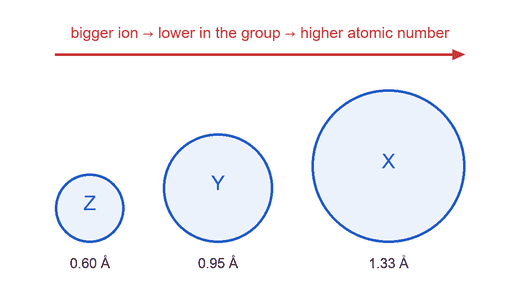
Concept: Down a group a new shell is added at each step, so atoms, and the ions they form, get bigger as the atomic number increases.
Step 1 — Compare like with like.
All three are group I elements forming ions, each with one shell fewer than its atom. So the ion sizes follow the same order as their places in the group.
Step 2 — Order the ions.
The smallest ion (Z, 0.60 Å) belongs to the element of lowest atomic number, and the largest (X, 1.33 Å) to the element of highest atomic number.
These radii match , and .
Watch out: A bigger ion means a higher atomic number here, so X comes last, not first.
Therefore, the order of increasing atomic number is Z < Y < X, because ionic size increases down the group.
- 385 marks
Question 38
Explain why are the following statements not correct:
(i) All groups contain metals and non metals.
(ii) Atoms of elements in the same group have the same number of electron(s).
(iii) Non-metallic character decreases across a period with increase in atomic number.
(iv) Reactivity increases with atomic number in a group as well as in a period.
Solve with AIWritten solution
Solution:
Concept: Test each statement against the facts of the periodic table and its trends, and give a counter-example.
Step 1 — Statement (i): all groups contain metals and non-metals.
This is not correct. Group 1 (apart from hydrogen) and group 2 contain only metals, and groups 17 and 18 contain only non-metals. Only some groups, such as 14 and 15, contain both.
Step 2 — Statement (ii): same group, same number of electrons.
This is not correct. Atoms of one group have the same number of valence electrons, not the same total. Li has 3 electrons (2, 1) and Na has 11 (2, 8, 1), but each has 1 valence electron.
Step 3 — Statement (iii): non-metallic character decreases across a period.
This is not correct. Non-metallic character increases across a period, because the atoms get smaller and gain electrons more easily: sodium is a metal, chlorine a strong non-metal.
Step 4 — Statement (iv): reactivity increases with atomic number in a group and a period.
This is not correct. In a group, reactivity increases only for metals (Li to Cs); for non-metals it decreases (F to I). In a period it first decreases (Na to Si) and then increases (P to Cl).
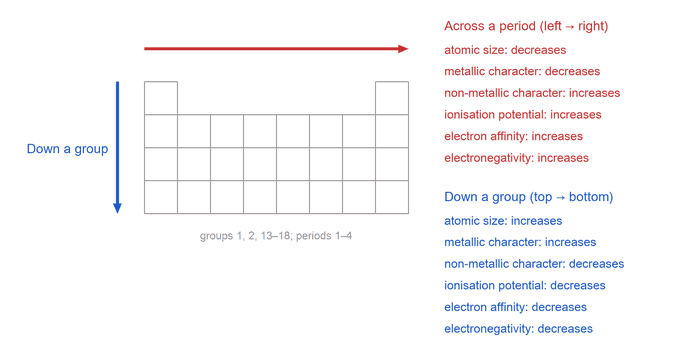
Therefore, each statement fails: groups 1, 2, 17, 18 are not mixed; only valence electrons are equal; non-metallic character increases across a period; reactivity does not simply rise with atomic number.
- 395 marks
Question 39
(i) State the number of elements in Period 1, Period 2, and Period 3 of the periodic table. Name them.
(ii) What is the common feature of the electronic configuration of the elements at the end of Period 2 and Period 3 ?
(iii) If an element is in Group 17, it is likely to be ______ [metallic/non-metallic] in character, while with one electron in its outermost energy level (shell), then it is likely to be ______ [metallic/non-metallic].
(iv) In Period 3, the most metallic element is ______ (sodium/magnesium/aluminium).
Solve with AIWritten solution
Solution:
Concept: Periods 1, 2 and 3 fill the K, L and M shells (the M shell up to 8 electrons here), so they hold 2, 8 and 8 elements.
Step 1 — Part (i): count and name the elements.
- Period 1, 2 elements: hydrogen, helium.
- Period 2, 8 elements: lithium, beryllium, boron, carbon, nitrogen, oxygen, fluorine, neon.
- Period 3, 8 elements: sodium, magnesium, aluminium, silicon, phosphorus, sulphur, chlorine, argon.
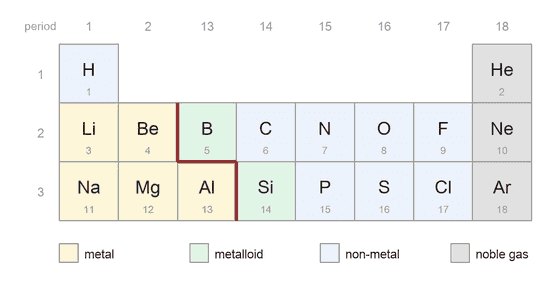
Step 2 — Part (ii): the end of periods 2 and 3.
Neon (2, 8) and argon (2, 8, 8) both have a completely filled outermost shell with 8 electrons (a stable octet).
Step 3 — Part (iii): fill the blanks.
A group 17 element has 7 valence electrons and gains one, so it is likely to be non-metallic. An element with one electron in its outermost shell loses it, so it is likely to be metallic.
Step 4 — Part (iv): most metallic element of period 3.
Sodium is the largest atom of the period and loses its single valence electron most easily, so the most metallic element is sodium.
Watch out: Period 1 has only 2 elements, because its single shell holds only 2 electrons.
Therefore, (i) 2, 8 and 8 elements as listed; (ii) a complete octet in the outermost shell; (iii) non-metallic, metallic; (iv) sodium.
- 404 marks
Question 40
Complete the following sentences choosing the correct word or words from those given in brackets at the end of each sentence :
(i) The properties of the elements are a periodic function of their ______ (atomic number, mass number, relative atomic mass).
(ii) Moving across a ______ of the Periodic Table the elements show increasing ______ character (group, period, metallic, non-metallic).
(iii) The elements at the bottom of a group would be expected to show ______ metallic character than the element at the top (less, more).
(iv) The similarities in the properties of a group of elements are because they have the same ______ (electronic configuration, number of outer electrons, atomic numbers).
Solve with AIWritten solution
Solution:
Concept: The modern periodic law says that the physical and chemical properties of the elements are periodic functions of their atomic numbers. The modern periodic table arranges the elements in order of increasing atomic number in 18 vertical groups and 7 horizontal periods. Across a period atoms get smaller and gain electrons more easily; down a group they get bigger and lose electrons more easily.
Step 1 — Part (i).
By the modern periodic law, the properties of the elements are a periodic function of their atomic number.
Step 2 — Part (ii).
Moving across a period the atoms get smaller and gain electrons more easily, so the elements show increasing non-metallic character.
Step 3 — Part (iii).
Elements at the bottom of a group have bigger atoms that lose electrons more easily, so they show more metallic character than the element at the top.
Step 4 — Part (iv).
Members of a group behave alike because they have the same number of outer electrons.
Watch out: In (iv), 'electronic configuration' is not the best choice: members of a group have different total configurations; only the number of outer electrons is the same.
Therefore, (i) atomic number; (ii) period, non-metallic; (iii) more; (iv) number of outer electrons.
- 415 marks
Question 41
Give reasons for the following :
(i) The size of a ion is greater than the size of a Cl atom.
(ii) Argon atom is bigger than chlorine atom.
(iii) Chlorine is less reactive than fluorine.
(iv) Inert gases do not form ion. (2018)
Solve with AIWritten solution
Solution:
Concept: Size and reactivity depend on how strongly the nucleus pulls on the outer electrons, against the repulsion between the electrons themselves.
Step 1 — Part (i): Cl⁻ ion is bigger than the Cl atom.
has 18 electrons but still only 17 protons. The extra electron increases the repulsion between electrons, and the pull of the nucleus on each electron falls, so the ion expands.
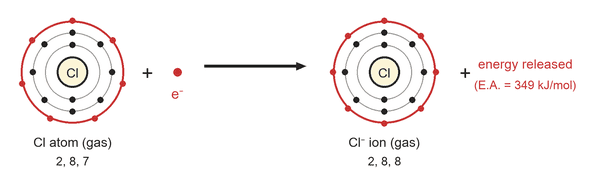
Step 2 — Part (ii): argon atom is bigger than chlorine atom.
Argon (2, 8, 8) has a complete octet. With its outer shell full, the repulsion between the electrons is at its greatest and the shell expands, so argon is bigger than chlorine (2, 8, 7) even though it lies to its right.
Step 3 — Part (iii): chlorine is less reactive than fluorine.
Chlorine has three shells and fluorine only two. Chlorine's outer shell is farther from the nucleus, so it attracts an extra electron less strongly, and its tendency to gain an electron (its reactivity) is smaller.
Step 4 — Part (iv): inert gases do not form ions.
Their outer shell is stable and completely filled (a duplet for helium, an octet for the rest). They have very high ionisation energies and practically zero electron affinity, so they neither lose nor gain electrons.
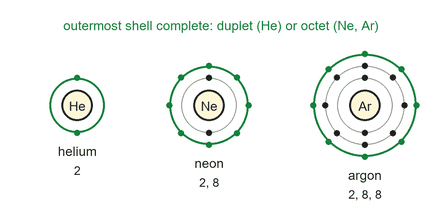
Watch out: In (iii), fluorine is more reactive even though chlorine releases slightly more energy on gaining an electron (349 against 328 kJ mol⁻¹); reactivity is judged by the small size and strong pull of fluorine.
Therefore, (i) the extra electron in Cl⁻ increases repulsion; (ii) argon's full octet expands its shell; (iii) chlorine's larger atom attracts electrons less strongly; (iv) inert gases have a stable full outer shell.
- 424 marks
Question 42
(a) Define the term 'ionisation potential'. (2010)
(b) Represent it in the form of an equation. In which unit is it measured?
Solve with AIWritten solution
Solution:
Concept: An electron is held in an atom by the attraction of the nucleus, so energy must be supplied to pull it out.
Step 1 — Part (a): define the term.
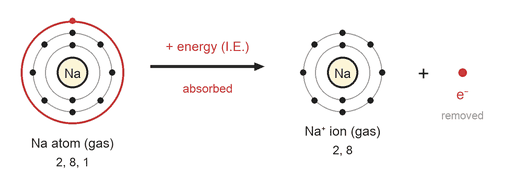
Ionisation potential is the energy required to remove an electron from a neutral isolated gaseous atom and convert it into a positively charged gaseous ion. It is also called ionisation energy (I.E.) or first ionisation energy.
Step 2 — Part (b): write it as an equation.
For any element M, the energy is taken in on the left and the electron leaves on the right.
For sodium, for example:
Step 3 — Part (b): state the unit.
It is measured in electron volts per atom (eV/atom); its S.I. unit is kilojoule per mole (kJ mol⁻¹). Sodium's value is 496 kJ mol⁻¹.
Watch out: The atom must be isolated and gaseous; energy for removing an electron from a solid metal is a different quantity.
Therefore, ionisation potential is the energy needed to remove an electron from a neutral isolated gaseous atom, M(g) + I.E. → M⁺(g) + e⁻, measured in eV/atom or kJ mol⁻¹.
- 434 marks
Question 43
Ionisation Potential values depend on (a) atomic size (b) nuclear pull. Explain.
Solve with AIWritten solution
Solution:
Concept: The more firmly an outer electron is held, the more energy is needed to remove it. Two things decide how firmly it is held: the distance from the nucleus (atomic size) and the charge of the nucleus.
Step 1 — Part (a): atomic size.
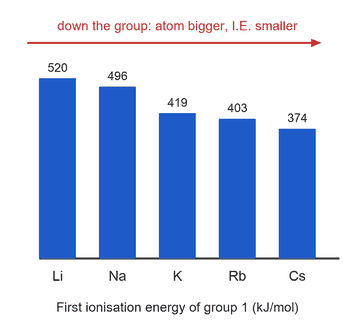
The larger the atom, the farther its outer electrons are from the nucleus and the weaker the attraction on them. So they are removed more easily: a larger atom has a lower ionisation potential.
Down group 1 the atoms grow and the ionisation energy falls: Li 520, Na 496, K 419 kJ mol⁻¹.
Step 2 — Part (b): nuclear pull (nuclear charge).
The greater the nuclear charge, the more strongly the outer electrons are attracted, so more energy is needed to remove one: a greater nuclear pull gives a higher ionisation potential.
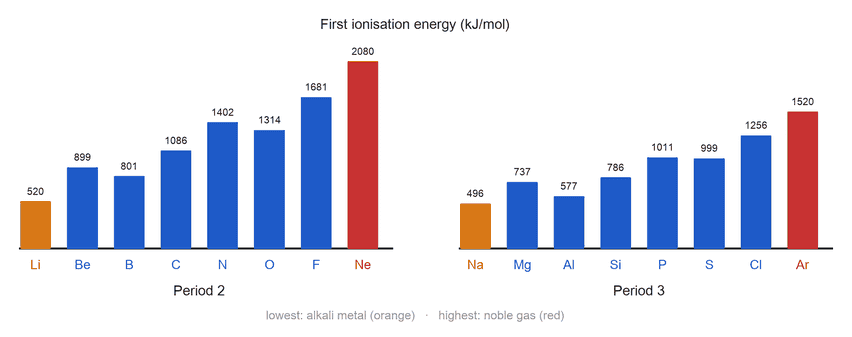
Across period 3 the nuclear charge rises from +11 to +18 and the ionisation energy rises from Na 496 to Ar 1520 kJ mol⁻¹.
Watch out: The two effects act in opposite directions: size lowers the ionisation potential, nuclear charge raises it.
Therefore, ionisation potential decreases as atomic size increases, and increases as the nuclear pull increases.
- 442 marks
Question 44
State the trends in ionisation energy :
(a) across the period, (b) down the group.
Solve with AIWritten solution
Solution:
Concept: Ionisation energy (ionisation potential) is the energy needed to remove an electron from a neutral isolated gaseous atom. It is higher when the atom is small and the nuclear charge is large, so it increases across a period and decreases down a group.
Step 1 — Part (a): across the period.
From left to right the nuclear charge increases and the atomic size decreases, so the outer electrons are held more firmly. Ionisation energy increases: Li 520 to Ne 2080 kJ mol⁻¹, with a few exceptions.
Step 2 — Part (b): down the group.
Going down, a new shell is added at each step, so the outer electron is farther away and held less firmly. Ionisation energy decreases: Li 520 to Cs 374 kJ mol⁻¹.
Watch out: The trend across a period has small exceptions (B is lower than Be, O lower than N), but the general trend is an increase.
Therefore, (a) ionisation energy increases across a period; (b) it decreases down a group.
- 452 marks
Question 45
Name the elements with highest and lowest ionisation energies in first three periods.
Solve with AIWritten solution
Solution:
Concept: Ionisation energy is highest at the top right of the table (the noble gases) and lowest at the bottom left (the alkali metals). In the first three periods the top right is helium and the bottom left is sodium.
Step 1 — Find the highest.
Helium has the highest value (2372 kJ mol⁻¹). It is the smallest noble gas, with a stable duplet held very close to the nucleus.
Step 2 — Find the lowest.
Sodium has the lowest value (496 kJ mol⁻¹). It is the alkali metal of period 3, the largest atom among the first 18 elements, with a single valence electron far from the nucleus.
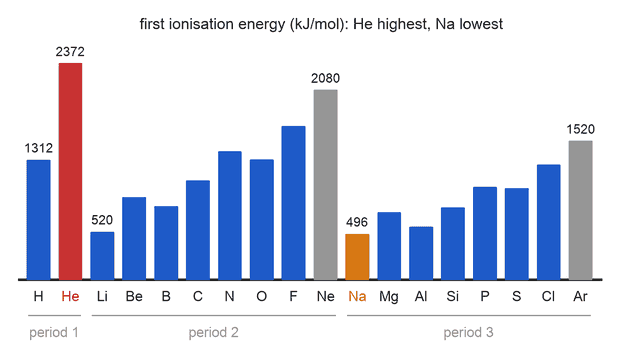
Watch out: Neon (2080) and argon (1520) are high, but helium is higher still; lithium (520) is low, but sodium is lower.
Therefore, helium has the highest and sodium the lowest ionisation energy in the first three periods.
- 463 marks
Question 46
(a) Arrange the elements of second and third periods in increasing order of their ionisation energy.
(b) The element with the highest ionisation potential is :
A. Hydrogen B. Caesium
C. Radon D. Helium (2020)
Solve with AIWritten solution
Solution:
Concept: Ionisation energy (ionisation potential) is the energy needed to remove an electron from a neutral isolated gaseous atom. It is higher when the atom is small and the nuclear charge is large, so it increases across a period and decreases down a group. The book's first ionisation energies (kJ mol⁻¹) give the exact order.
Step 1 — Part (a): arrange period 2.
Li < B < Be < C < O < N < F < Ne
(520 < 801 < 899 < 1086 < 1314 < 1402 < 1681 < 2080)
Step 2 — Part (a): arrange period 3.
Na < Al < Mg < Si < S < P < Cl < Ar
(496 < 577 < 737 < 786 < 999 < 1011 < 1256 < 1520)
Step 3 — Part (a): explain the exceptions.
The general trend is a rise from left to right. Be and N have higher values than B and O, and Mg and P higher than Al and S, because their configurations are extra stable (fully filled or half-filled sub-shells), so their electrons are harder to remove.
Step 4 — Part (b): choose the highest ionisation potential.
Helium is the smallest noble gas, with a stable duplet held close to the nucleus, so it has the highest ionisation potential of all elements (2372 kJ mol⁻¹). Hydrogen has a single electron in an incomplete shell (1312 kJ mol⁻¹), and caesium and radon are much larger atoms.
Watch out: Do not simply list the elements in table order; Be/B, N/O, Mg/Al and P/S are swapped in the true order.
Therefore, (a) period 2: Li < B < Be < C < O < N < F < Ne; period 3: Na < Al < Mg < Si < S < P < Cl < Ar; (b) D. Helium.
- 475 marks
Question 47
(a) Define the term 'electron affinity'. State its unit. (2010)
(b) Arrange the elements of second period in increasing order of their electron affinity. Name the elements which do not follow the trend in this period.
(c) Which has higher E.A., Fluorine or Neon ?
Solve with AIWritten solution
Solution:
Concept: Electron affinity is the energy released when a neutral isolated gaseous atom accepts an electron to form an anion. A small atom with a large nuclear charge attracts the extra electron strongly, so electron affinity increases across a period and decreases down a group.
Step 1 — Part (a): define the term and give the unit.
Electron affinity is the amount of energy released when a neutral isolated gaseous atom accepts an electron to form a gaseous anion.
It is measured in eV/atom or kJ mol⁻¹; for chlorine 349 kJ mol⁻¹ is released.
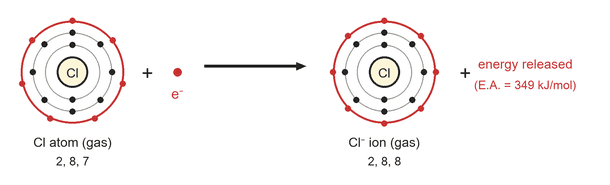
Step 2 — Part (b): arrange period 2.
Using the book's table (energy released, kJ mol⁻¹), the elements that accept an electron, in increasing order, are:
Li < B < C < O < F
(60 < 88 < 122 < 141 < 328)
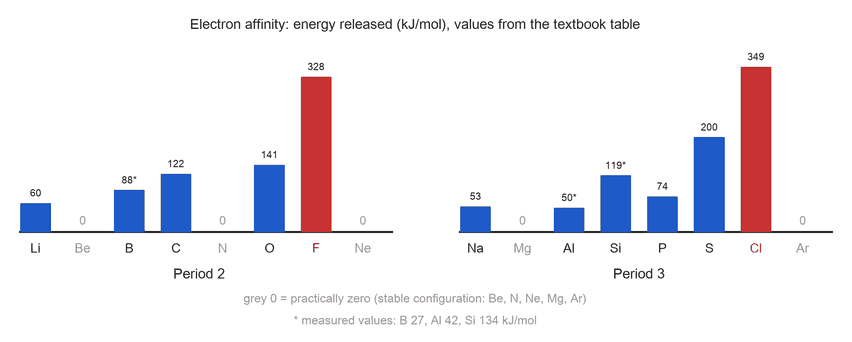
Step 3 — Part (b): name the exceptions.
Beryllium, nitrogen and neon do not follow the trend. Their configurations are stable (Be 2, 2; N 2, 5 with a half-filled sub-shell; Ne 2, 8 with a full octet), so they have practically zero electron affinity and come first in any increasing order.
Step 4 — Part (c): fluorine or neon.
Neon already has a complete octet and no tendency to accept an electron, so its electron affinity is zero. Fluorine needs just one electron to complete its octet, so fluorine has the higher E.A.
Watch out: Electron affinity is energy released; do not confuse it with ionisation energy, which is energy absorbed.
Note: the order Li < B uses the book's value for boron (88 kJ mol⁻¹). Measured data give boron only about 27 kJ mol⁻¹, which would put B before Li; the book's order is the one expected in the exam.
Therefore, (a) E.A. is the energy released when a gaseous atom gains an electron (kJ mol⁻¹); (b) Be, N, Ne (≈ 0) < Li < B < C < O < F, with Be, N and Ne as the exceptions; (c) fluorine.
- 481 mark
Question 48
Electron affinity values generally ................ across the period left to right and ................ down the group top to bottom.
Solve with AIWritten solution
Solution:
Concept: Electron affinity is the energy released when a neutral isolated gaseous atom accepts an electron to form an anion. A small atom with a large nuclear charge attracts the extra electron strongly, so electron affinity increases across a period and decreases down a group.
Step 1 — Across the period.
From left to right the atoms get smaller and the nuclear charge increases, so an extra electron is attracted more strongly and more energy is released. Electron affinity increases; across period 3 the energy released rises from Na (53) to Cl (349 kJ mol⁻¹).
Step 2 — Down the group.
From top to bottom a new shell is added at each step, so the extra electron is farther from the nucleus and is attracted less strongly. Electron affinity decreases.
Watch out: Fluorine is an exception: its E.A. (328) is a little less than chlorine's (349) because its tiny atom is crowded with electrons.
Therefore, electron affinity values generally increase across the period and decrease down the group.
- 494 marks
Question 49
(a) Define the term 'Electronegativity'. State its unit.
(b) Among the elements given below, the element with least Electronegativity is :
(i) Lithium (ii) Boron
(iii) Carbon (iv) Fluorine
(c) The most electronegative element from the following element is :
(i) Magnesium (ii) Chlorine
(iii) Aluminium (iv) Sulphur. (2019)
Solve with AIWritten solution
Solution:
Concept: Electronegativity is the tendency of an atom in a molecule to attract the shared pair of electrons towards itself (Pauling scale, fluorine 4.0 the highest). It increases across a period and decreases down a group, for the same reasons as electron affinity.
Step 1 — Part (a): define the term and state its unit.
Electronegativity is the tendency of an atom in a molecule to attract the shared pair of electrons towards itself.
It is only a tendency, compared on a scale (Pauling, fluorine 4.0 the highest), so it is a dimensionless quantity and has no unit.
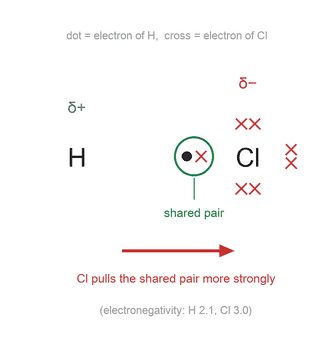
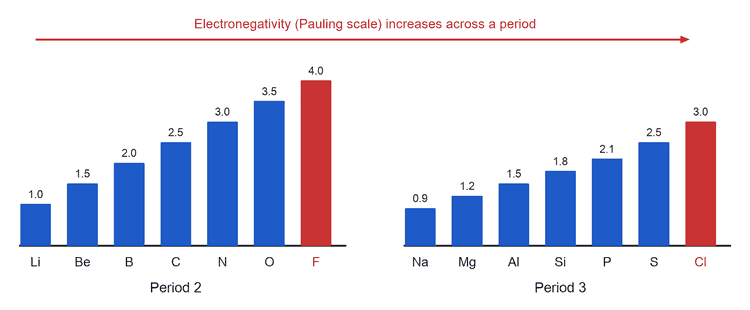
Step 2 — Part (b): least electronegative of Li, B, C, F.
All four are period 2 elements, and electronegativity increases from left to right (Li 1.0, B 2.0, C 2.5, F 4.0). Lithium is the left-most, so it is the least electronegative: (i) Lithium.
Step 3 — Part (c): most electronegative of Mg, Cl, Al, S.
All four are period 3 elements (Mg 1.2, Al 1.5, S 2.5, Cl 3.0). Chlorine is the right-most, so it is the most electronegative: (ii) Chlorine.
Watch out: Electronegativity is about a shared pair in a molecule; electron affinity is about a free atom gaining an electron. They are different properties.
Therefore, (a) electronegativity is the tendency of an atom in a molecule to attract the shared pair; it has no unit; (b) (i) lithium; (c) (ii) chlorine.
- 505 marks
Question 50
Explain the following :
(a) Group 17 elements are strong non-metals, while group 1 elements are strong metals.
(b) Metallic character of elements decreases from left to right in a period while it increases in moving down a group.
(c) Halogens have a high electron affinity.
(d) The reducing power of an element increases down a group while decreases along a period.
(e) Size of atoms progressively becomes smaller when we move from sodium (Na) to chlorine (Cl) in the third period of the Periodic Table.
Solve with AIWritten solution
Solution:
Concept: Metallic character is the tendency of an atom to lose electrons; non-metallic character is the tendency to gain them. Big atoms with few valence electrons lose electrons easily, so metallic character decreases across a period and increases down a group; non-metallic character does the opposite. A reducing agent is an electron donor (it loses electrons and is itself oxidised); an oxidising agent is an electron acceptor (it gains electrons and is itself reduced).
Step 1 — Part (a): group 17 strong non-metals, group 1 strong metals.
Group 17 elements have 7 valence electrons and small atoms, so they very readily gain one electron to complete the octet: they are strong non-metals. Group 1 elements have 1 valence electron and large atoms, so they very readily lose it: they are strong metals.
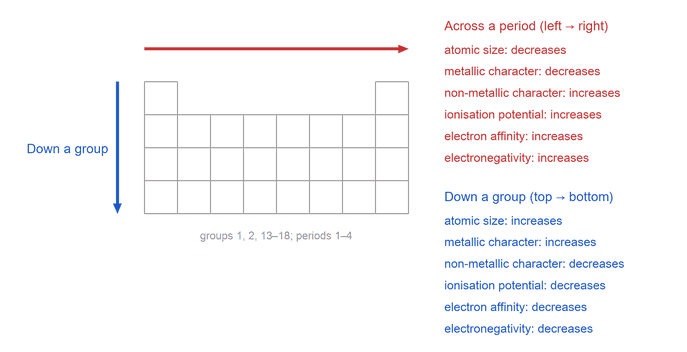
Step 2 — Part (b): metallic character across a period and down a group.
From left to right the nuclear charge increases and the size decreases, so electrons are held more firmly and lost less easily: metallic character falls. Down a group a new shell is added, the size increases and the outer electrons are lost more easily: metallic character rises.
Step 3 — Part (c): halogens have a high electron affinity.
Halogens are small atoms that need only one electron to reach a stable octet. An extra electron is strongly attracted by the nucleus, so a large amount of energy is released (Cl 349, F 328 kJ mol⁻¹).
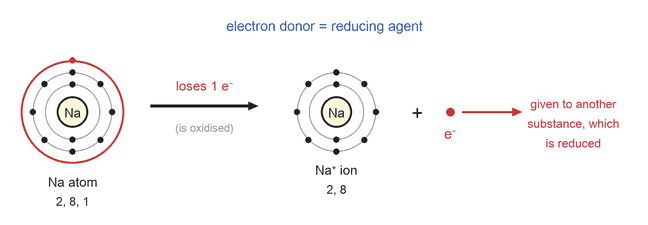
Step 4 — Part (d): reducing power down a group and along a period.
Reducing power is the tendency to lose electrons. Down a group the size increases and the ionisation potential decreases, so electrons are lost more easily and reducing power increases. Along a period the size decreases and the nuclear charge increases, so reducing power decreases.
Step 5 — Part (e): atoms get smaller from Na to Cl.
From Na to Cl the number of shells stays three, while the nuclear charge rises from +11 to +17. The greater pull draws the outer shell closer to the nucleus, so the atoms get smaller (Na 186 pm to Cl 99 pm).
Watch out: A strong reducing agent is a substance that loses electrons easily, so it is a metal, not a non-metal.
Therefore, each property follows from atomic size and nuclear charge: big atoms with few valence electrons lose electrons (metallic, reducing), and small atoms with many valence electrons gain them (non-metallic, high electron affinity).
- 513 marks
Question 51
Name the periodic property which relates to the :
(a) amount of energy required to remove an electron from an isolated gaseous atom,
(b) character of element which loses one or more electrons when supplied with energy,
(c) tendency of an atom in a molecule to attract the shared pair of electrons.
Solve with AIWritten solution
Solution:
Concept: Each description is the definition of one periodic property: match the words 'remove', 'loses' and 'shared pair' with the property they define.
Step 1 — Part (a).
The energy required to remove an electron from an isolated gaseous atom is the ionisation potential (ionisation energy).
Step 2 — Part (b).
The character of an element that loses one or more electrons when supplied with energy is metallic character (electropositive character).
Step 3 — Part (c).
The tendency of an atom in a molecule to attract the shared pair of electrons is electronegativity.
Watch out: (a) is about removing an electron, so it is not electron affinity, which is about adding one.
Therefore, (a) ionisation potential; (b) metallic (electropositive) character; (c) electronegativity.
- 525 marks
Question 52
This question refers to the elements of the Periodic Table with atomic numbers from 3 to 18. Some of the elements are shown by letters, but the letters are not the usual symbols of the elements.
3 4 5 6 7 8 9 10 A B C D E F G H 11 12 13 14 15 16 17 18 I J K L M N O P Which of these :
(a) is the most electronegative element ?
(b) is a halogen ?
(c) is an alkali metal ?
(d) is an element with valency 4 ?
(e) has the least Ionisation Energy ?
(f) has the least atomic size in period 3 ?
Solve with AIWritten solution
Solution:
Concept: Atomic numbers 3 to 10 are period 2 (lithium to neon) and 11 to 18 are period 3 (sodium to argon). Decoding the letters first makes every part a question about known elements.
Step 1 — Decode the letters.
Place each atomic number in its period and write the real element under each letter.
Letter A B C D E F G H Element (period 2) Li Be B C N O F Ne Letter I J K L M N O P Element (period 3) Na Mg Al Si P S Cl Ar 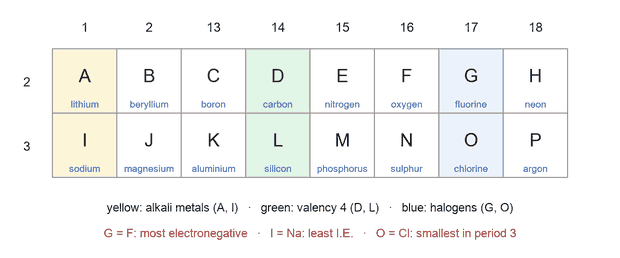
Step 2 — Parts (a) and (b): most electronegative, and the halogens.
Electronegativity is highest at the top right (noble gases left out), so the most electronegative is G (fluorine). The halogens have 7 valence electrons: G and O (fluorine and chlorine).
Step 3 — Parts (c) and (d): alkali metals, and valency 4.
The alkali metals have 1 valence electron: A and I (lithium and sodium). The elements with valency 4 have 4 valence electrons: D and L (carbon and silicon).
Step 4 — Parts (e) and (f): least ionisation energy, least size in period 3.
The least ionisation energy belongs to the lowest, left-most alkali metal: I (sodium, 496 kJ mol⁻¹). Size falls across period 3, so the smallest atom (noble gas left out) is O (chlorine, 99 pm).
Watch out: The letters are not chemical symbols: 'O' here is chlorine, not oxygen, and 'F' is oxygen.
Therefore, (a) G; (b) G and O; (c) A and I; (d) D and L; (e) I; (f) O.
- 535 marks
Question 53
A group of elements in the Periodic Table are given ahead (boron is the first member of the group and Thallium is the last).
Boron, Aluminium, Gallium, Indium, Thallium
Answer the following questions in relation to the above group of elements :
(a) Which element has the most metallic character ?
(b) Which element would be expected to have the highest electronegativity ?
(c) If the electronic configuration of aluminium is 2, 8, 3, how many electrons are there in the outer shell of thallium ?
(d) The atomic number of boron is 5. Write the chemical formula of the compound formed when boron reacts with chlorine.
(e) Will the elements in the group to the right of this boron group be more metallic or less metallic in character ? Justify your answer.
Solve with AIWritten solution
Solution:
Concept: Boron, aluminium, gallium, indium and thallium form group 13. Members of a group have the same number of valence electrons; metallic character increases down a group and decreases across a period.
Step 1 — Part (a): most metallic.
Thallium is the lowest member, with the largest atom, so it loses electrons most easily: thallium.
Step 2 — Part (b): highest electronegativity.
Boron is the top member, with the smallest atom, so it attracts a shared pair most strongly: boron (Pauling value 2.0).
Step 3 — Part (c): outer electrons of thallium.
Aluminium (2, 8, 3) has 3 valence electrons, and every member of a group has the same number, so thallium has 3 electrons in its outer shell.
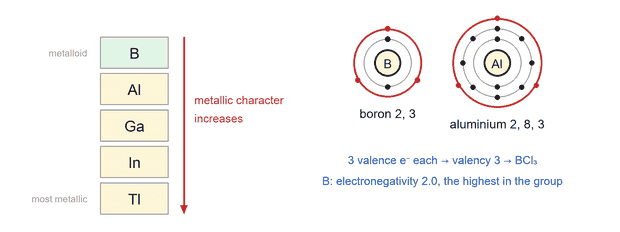
Step 4 — Part (d): boron chloride.
Boron (Z = 5) is 2, 3, so its valency is 3; chlorine has valency 1. Three chlorine atoms join one boron atom: .
Step 5 — Part (e): the group to the right.
In each period, the group-14 element to the right has a greater nuclear charge and a smaller atom, so it loses electrons less easily. Its elements are less metallic.
Watch out: Boron is at the top of the group but is a metalloid; do not call it the most metallic.
Therefore, (a) thallium; (b) boron; (c) 3; (d) BCl₃; (e) less metallic, because metallic character falls from left to right.
- 541 mark
Question 54
In the periodic table, alkali metals are placed in group :
Solve with AIAnswer
- Correct
(A) 1
(B) 11
(C) 17
(D) 18
Answer: (A) 1
Concept: The alkali metals (Li, Na, K, Rb, Cs, Fr) have one electron in their valence shell. For the first two groups the group number equals the number of valence electrons.
Step 1 — Count the valence electrons.
Each alkali metal begins a new period with one electron in a new shell: Li (2, 1), Na (2, 8, 1), K (2, 8, 8, 1).
Step 2 — Place them in the table.
One valence electron means group 1 (IA). The family is named after the strong alkalis (hydroxides such as sodium hydroxide) these metals form with water.
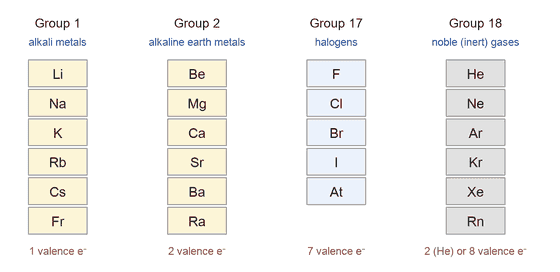
Watch out: Group 11 also contains metals (copper, silver, gold), but they are transition metals, not alkali metals.
Why the other options are wrong:
- (B) 11: Group 11 holds the transition metals copper, silver and gold.
- (C) 17: Group 17 holds the halogens, which are non-metals with 7 valence electrons.
- (D) 18: Group 18 holds the noble (inert) gases, with a complete outer shell.
Therefore, the alkali metals are placed in group 1, option (A).
- 551 mark
Question 55
Which of the following properties does not match with the elements of the halogen family ?
Solve with AIAnswer
(A) They have seven electrons in their valence shell.
(B) They are highly reactive chemically.
- Correct
(C) They are metallic in nature.
(D) They are diatomic in their molecular form.
Answer: (C) They are metallic in nature.
Concept: Halogens (group 17) are typical non-metals: each needs only one electron to complete its octet, so it gains electrons rather than losing them.
Step 1 — Recall what makes an element metallic.
A metal is an element that loses electrons easily. Halogens do the opposite: they gain an electron.
Step 2 — Pick the property that does not match.
So 'metallic in nature' is the property that does not describe the halogens.
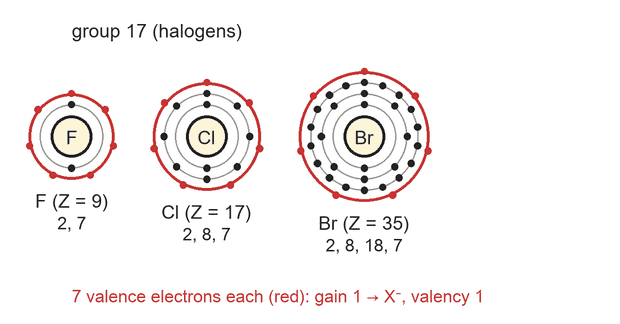
Watch out: The question asks for the property that does NOT match, so the three true statements are the wrong answers.
Why the other options are wrong:
- (A) They have seven electrons in their valence shell: This matches: halogens have 7 valence electrons (F 2, 7; Cl 2, 8, 7).
- (B) They are highly reactive chemically: This matches: they are very reactive non-metals, fluorine most of all.
- (D) They are diatomic in their molecular form: This matches: they exist as diatomic molecules (, , , ).
Therefore, the property that does not match the halogens is 'metallic in nature', option (C).
- 561 mark
Question 56
With reference to the variation of properties in the Periodic Table, which of the following is generally true?
Solve with AIAnswer
(A) Atomic size increases from left to right across a period.
- Correct
(B) Ionization potential increases from left to right across a period.
(C) Electron affinity increases going down a group.
(D) Electronegativity increases going down a group.
Answer: (B) Ionization potential increases from left to right across a period.
Concept: Ionisation energy (ionisation potential) is the energy needed to remove an electron from a neutral isolated gaseous atom. It is higher when the atom is small and the nuclear charge is large, so it increases across a period and decreases down a group.
Step 1 — Test the ionisation potential across a period.
Across a period the nuclear charge increases and the atomic size decreases, so the outer electrons are held more firmly and more energy is needed to remove one. In period 3 the value rises from Na 496 to Ar 1520 kJ mol⁻¹, so statement (B) is true.
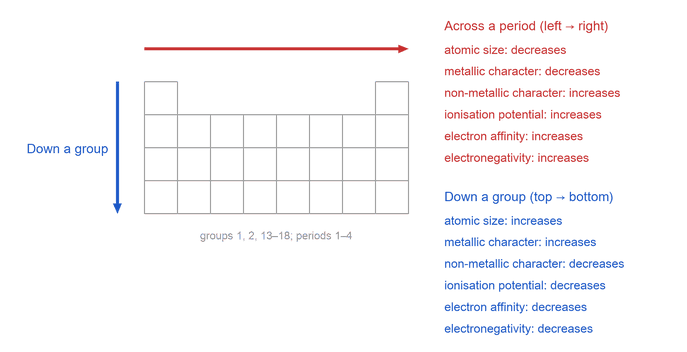
Step 2 — Check the other three statements.
Size, electron affinity and electronegativity are tested against the same two causes (size and nuclear charge) in the bullets below; each statement has its trend the wrong way round.
Watch out: Electron affinity and electronegativity both fall down a group, because the atom gets bigger.
Why the other options are wrong:
- (A) Atomic size increases from left to right across a period: Atomic size decreases from left to right across a period, as the nuclear charge pulls the same shells closer.
- (C) Electron affinity increases going down a group: Electron affinity decreases down a group, because the bigger atom attracts an extra electron less strongly.
- (D) Electronegativity increases going down a group: Electronegativity decreases down a group, for the same reason (F 4.0 down to I 2.5).
Therefore, ionisation potential increases from left to right across a period, option (B).
- 571 mark
Question 57
An element in period 3 whose electron affinity is zero is:
Solve with AIAnswer
(A) Neon
(B) Sulphur
(C) Sodium
- Correct
(D) Argon
Answer: (D) Argon
Concept: Noble gases have a stable, completely filled outer shell, so they have no tendency to accept an extra electron; their electron affinity is taken as zero.
Step 1 — List period 3.
Period 3 runs from sodium to argon, and its noble gas is argon (2, 8, 8).
Step 2 — Apply the rule.
Argon's octet is already complete, so it has zero electron affinity.
Watch out: Zero electron affinity goes with a stable configuration (the noble gas); metals such as sodium still release a little energy when they gain an electron.
Why the other options are wrong:
- (A) Neon: Neon also has zero electron affinity, but it is in period 2, not period 3.
- (B) Sulphur: Sulphur readily gains electrons; its electron affinity is high (200 kJ mol⁻¹ released).
- (C) Sodium: Sodium has a small but non-zero electron affinity (53 kJ mol⁻¹ released).
Therefore, the period 3 element with zero electron affinity is argon, option (D).
- 581 mark
Question 58
The number of electrons in the valence shell of a halogen is :
Solve with AIAnswer
(A) 1
(B) 3
(C) 5
- Correct
(D) 7
Answer: (D) 7
Concept: For the first 20 elements, the number of shells in an atom gives its period, and the number of electrons in its outermost (valence) shell gives its group: 1 or 2 valence electrons → group 1 or 2; 3 to 8 valence electrons → group 13 to 18 (add 10).
Step 1 — Use the group number.
Halogens are in group 17, and for groups 13 to 17 the valence electrons are the group number minus 10.
Step 2 — Check with an example.
Chlorine is 2, 8, 7: seven electrons in the outer shell. One more electron completes the octet, so halogens have valency 1.
Watch out: Valency (1) and valence electrons (7) are different numbers for the halogens.
Why the other options are wrong:
- (A) 1: One valence electron belongs to the alkali metals of group 1.
- (B) 3: Three valence electrons belong to group 13, the boron family.
- (C) 5: Five valence electrons belong to group 15, the nitrogen family.
Therefore, a halogen has 7 electrons in its valence shell, option (D).
- 591 mark
Question 59
Among period 2 elements, the element which has the highest electron affinity is :
Solve with AIAnswer
(A) Lithium
(B) Carbon
(C) Chlorine
- Correct
(D) Fluorine
Answer: (D) Fluorine
Concept: Electron affinity is the energy released when a neutral isolated gaseous atom accepts an electron to form an anion. A small atom with a large nuclear charge attracts the extra electron strongly, so electron affinity increases across a period and decreases down a group.
Step 1 — Find the end of period 2.
Electron affinity increases across a period, so the halogen at the right end of period 2, fluorine, has the highest value in that period.
Step 2 — Check with the book's values.
The energy released (kJ mol⁻¹) is Li 60, B 88, C 122, O 141 and F 328.
Watch out: Chlorine (349) has a higher value than fluorine, but chlorine is in period 3, so it is not an answer here.
Why the other options are wrong:
- (A) Lithium: Lithium is at the start of period 2, so its electron affinity is low (60).
- (B) Carbon: Carbon's electron affinity (122) is far less than fluorine's.
- (C) Chlorine: Chlorine has an even higher electron affinity (349), but it belongs to period 3, not period 2.
Therefore, fluorine has the highest electron affinity among the period 2 elements, option (D).
- 601 mark
Question 60
Ionisation potential increases over a period from left to right because :
Solve with AIAnswer
(A) Atomic radius and nuclear charge increase
(B) Atomic radius and nuclear charge decrease
(C) Atomic radius increases and nuclear charge decreases
- Correct
(D) Atomic radius decreases and nuclear charge increases
Answer: (D) Atomic radius decreases and nuclear charge increases
Concept: Ionisation energy (ionisation potential) is the energy needed to remove an electron from a neutral isolated gaseous atom. It is higher when the atom is small and the nuclear charge is large, so it increases across a period and decreases down a group.
Step 1 — See what changes across a period.
Across a period the nuclear charge rises by one at each step while the shells stay the same, so the atom shrinks.
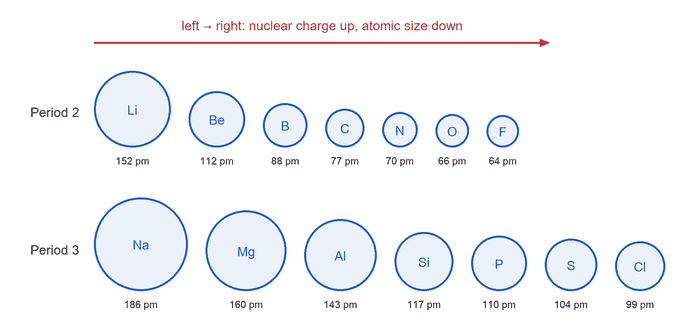
Step 2 — Link both changes to the ionisation potential.
A smaller radius puts the outer electrons nearer the nucleus, and a larger charge pulls on them harder. Both make an electron harder to remove, so the ionisation potential rises.
Watch out: The nuclear charge does increase across a period; it is the radius that decreases.
Why the other options are wrong:
- (A) Atomic radius and nuclear charge increase: The nuclear charge increases, but the atomic radius decreases across a period; it does not increase.
- (B) Atomic radius and nuclear charge decrease: The atomic radius decreases, but the nuclear charge increases; it does not decrease.
- (C) Atomic radius increases and nuclear charge decreases: Both changes are the wrong way round: the radius decreases and the nuclear charge increases.
Therefore, the ionisation potential increases because the atomic radius decreases and the nuclear charge increases, option (D).
- 611 mark
Question 61
An element A belonging to period 3 and group II will have :
Solve with AIAnswer
- Correct
(A) 3 shells and 2 valence electrons
(B) 2 shells and 3 valence electrons
(C) 3 shells and 3 valence electrons
(D) 2 shells and 2 valence electrons
Answer: (A) 3 shells and 2 valence electrons
Concept: For the first 20 elements, the number of shells in an atom gives its period, and the number of electrons in its outermost (valence) shell gives its group: 1 or 2 valence electrons → group 1 or 2; 3 to 8 valence electrons → group 13 to 18 (add 10).
Step 1 — Read the period.
Period 3 means the atom has 3 shells.
Step 2 — Read the group.
Group II means 2 valence electrons. So the configuration is 2, 8, 2, which is magnesium.
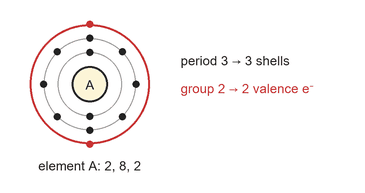
Watch out: Do not mix the two numbers: the period gives the shells, the group gives the valence electrons.
Why the other options are wrong:
- (B) 2 shells and 3 valence electrons: The shells and valence electrons are swapped; period 3 gives 3 shells and group II gives 2 valence electrons.
- (C) 3 shells and 3 valence electrons: Group II elements have 2 valence electrons, not 3.
- (D) 2 shells and 2 valence electrons: Period 3 elements have 3 shells, not 2.
Therefore, element A has 3 shells and 2 valence electrons, option (A).
- 621 mark
Question 62
Among the elements given below, the element with the least electronegativity is :
Solve with AIAnswer
- Correct
(A) Lithium
(B) Carbon
(C) Boron
(D) Fluorine
Answer: (A) Lithium
Concept: Electronegativity is the tendency of an atom in a molecule to attract the shared pair of electrons towards itself (Pauling scale, fluorine 4.0 the highest). It increases across a period and decreases down a group, for the same reasons as electron affinity.
Step 1 — Place the four elements.
Lithium, carbon, boron and fluorine are all in period 2, where electronegativity increases from left to right.
Step 2 — Compare the values.
The Pauling values are Li 1.0 < B 2.0 < C 2.5 < F 4.0, so lithium, the left-most, is the least electronegative.
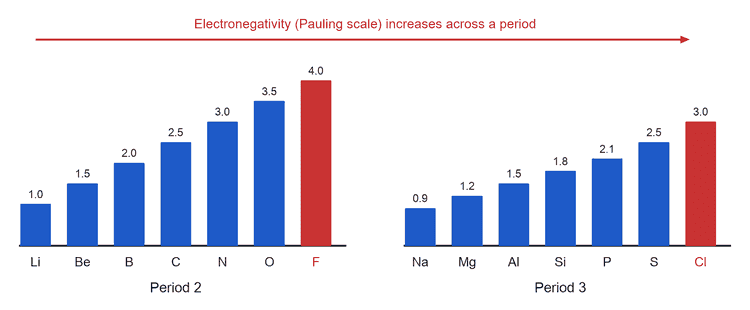
Watch out: The question asks for the least electronegative, not the most.
Why the other options are wrong:
- (B) Carbon: Carbon (2.5) is to the right of lithium, so it is more electronegative.
- (C) Boron: Boron (2.0) is to the right of lithium, so it is more electronegative.
- (D) Fluorine: Fluorine (4.0) is the most electronegative element of all.
Therefore, lithium has the least electronegativity, option (A).
- 631 mark
Question 63
An element with atomic number 19 will most likely combine chemically with the elements whose atomic number is :
Solve with AIAnswer
- Correct
(A) 17
(B) 11
(C) 28
(D) 20
Answer: (A) 17
Concept: Valency is the number of electrons an atom loses, gains or shares to reach a stable octet (a duplet for the first shell). Atoms with 1, 2 or 3 valence electrons lose them, so their valency equals the number of valence electrons; atoms with 5, 6 or 7 gain electrons, so their valency is 8 minus that number.
Step 1 — Identify the element with atomic number 19.
Atomic number 19 is potassium (2, 8, 8, 1), a reactive metal that loses one electron.
Step 2 — Find the partner that needs one electron.
Atomic number 17 is chlorine (2, 8, 7), a non-metal that needs one electron. Potassium gives its electron to chlorine and both reach 2, 8, 8, forming potassium chloride.
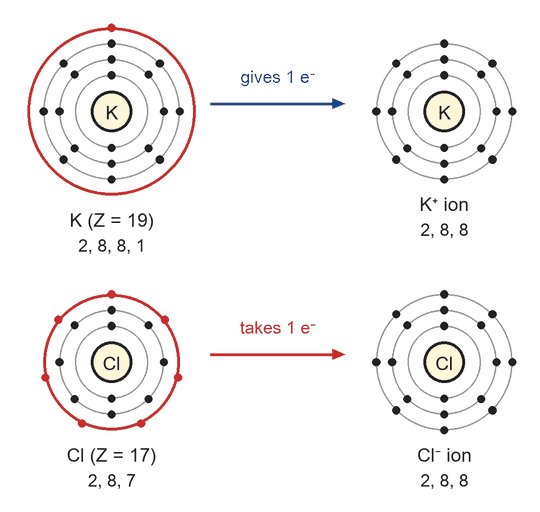
Watch out: Elements combine most readily when one loses exactly the number of electrons the other needs.
Why the other options are wrong:
- (B) 11: 11 is sodium, another alkali metal; two metals do not combine by electron transfer like this.
- (C) 28: 28 is nickel, a transition metal, which does not accept an electron from potassium.
- (D) 20: 20 is calcium, also a metal that loses electrons, so it cannot take potassium's electron.
Therefore, the element with atomic number 19 combines most readily with the element of atomic number 17, option (A).
- 641 mark
Question 64
Parts (i) to (iv) refer to changes in the properties of elements on moving from left to right across a period of the Periodic Table. For each property, choose the correct answer.
(i) The non-metallic character of the elements :
Solve with AIAnswer
(A) decreases,
- Correct
(B) increases,
(C) remains the same,
(D) depends on the period
Answer: (B) increases,
Concept: Metallic character is the tendency of an atom to lose electrons; non-metallic character is the tendency to gain them. Big atoms with few valence electrons lose electrons easily, so metallic character decreases across a period and increases down a group; non-metallic character does the opposite.
Step 1 — Apply the trend.
Across a period the atomic size decreases and the nuclear charge increases, so the tendency to gain electrons, the non-metallic character, increases.
Step 2 — Check with period 3.
Period 3 goes from the metals Na, Mg and Al, through the metalloid Si, to the non-metals P, S and Cl.
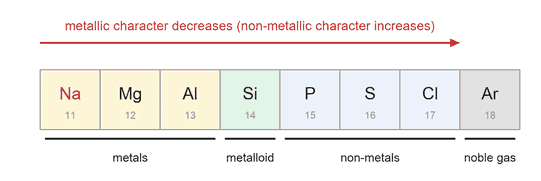
Watch out: Metallic and non-metallic character change in opposite directions; this part asks about non-metallic character.
Why the other options are wrong:
- (A) decreases,: It is the metallic character that decreases across a period.
- (C) remains the same,: The character changes steadily from metal to non-metal; it does not stay the same.
- (D) depends on the period: The same trend is seen in every period, so it does not depend on the period.
Therefore, the non-metallic character increases across a period, option (B).
- 651 mark
Question 65
Parts (i) to (iv) refer to changes in the properties of elements on moving from left to right across a period of the Periodic Table. For each property, choose the correct answer.
(ii) The electronegativity :
Solve with AIAnswer
(A) depends on the number of valence electrons,
(B) remains the same,
(C) decreases,
- Correct
(D) increases
Answer: (D) increases
Concept: Electronegativity is the tendency of an atom in a molecule to attract the shared pair of electrons towards itself (Pauling scale, fluorine 4.0 the highest). It increases across a period and decreases down a group, for the same reasons as electron affinity.
Step 1 — Apply the trend.
A smaller atom with a larger nuclear charge attracts the shared pair of electrons more strongly, so electronegativity increases across a period.
Step 2 — Check with period 2.
The Pauling values rise steadily: Li 1.0, Be 1.5, B 2.0, C 2.5, N 3.0, O 3.5, F 4.0.
Watch out: Electronegativity decreases down a group but increases across a period.
Why the other options are wrong:
- (A) depends on the number of valence electrons,: Electronegativity depends on atomic size and nuclear charge; the count of valence electrons alone does not decide it.
- (B) remains the same,: It changes regularly across a period, from 1.0 to 4.0 in period 2, so it does not remain the same.
- (C) decreases,: It decreases down a group, not across a period.
Therefore, the electronegativity increases across a period, option (D).
- 661 mark
Question 66
Parts (i) to (iv) refer to changes in the properties of elements on moving from left to right across a period of the Periodic Table. For each property, choose the correct answer.
(iii) The ionization potential :
Solve with AIAnswer
(A) goes up and down
(B) decreases
- Correct
(C) increases
(D) remains the same
Answer: (C) increases
Concept: Ionisation energy (ionisation potential) is the energy needed to remove an electron from a neutral isolated gaseous atom. It is higher when the atom is small and the nuclear charge is large, so it increases across a period and decreases down a group.
Step 1 — Apply the trend.
Across a period the atoms get smaller and the nuclear charge increases, so the outer electrons are held more firmly and more energy is needed to remove one.
Step 2 — Check with period 2.
The value rises from Li 520 to Ne 2080 kJ mol⁻¹. The small dips at B and O (and Al and S in period 3) are exceptions to an overall rise.
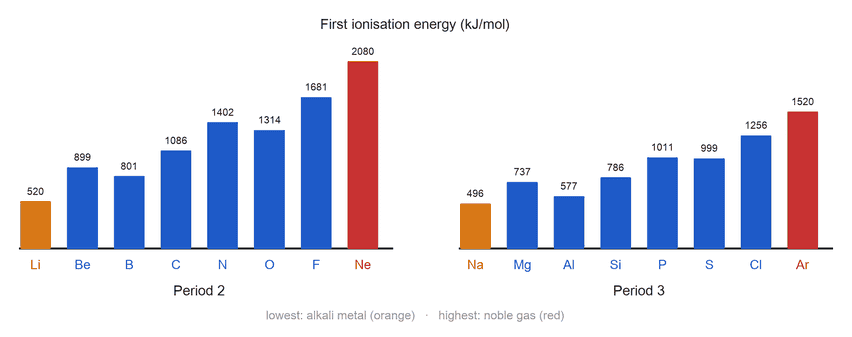
Watch out: The small dips do not change the answer; the general trend is an increase.
Why the other options are wrong:
- (A) goes up and down: There are a few small exceptions, but the general trend is a steady increase, not up and down.
- (B) decreases: Ionisation potential decreases down a group, not across a period.
- (D) remains the same: It changes from 520 to 2080 kJ mol⁻¹ across period 2, so it does not remain the same.
Therefore, the ionisation potential increases across a period, option (C).
- 671 mark
Question 67
Parts (i) to (iv) refer to changes in the properties of elements on moving from left to right across a period of the Periodic Table. For each property, choose the correct answer.
(iv) The atomic size :
Solve with AIAnswer
- Correct
(A) decreases,
(B) increases,
(C) remains the same,
(D) sometimes increases and sometimes decreases
Answer: (A) decreases,
Concept: Atomic size (atomic radius) depends on the number of shells and on the nuclear charge. Down a group a new shell is added at each step, so atoms get bigger; across a period the shells stay the same while the nuclear charge rises, so atoms get smaller.
Step 1 — Apply the trend.
Across a period the number of shells stays the same while the nuclear charge increases, so the outer shell is pulled closer to the nucleus and the atom gets smaller.
Step 2 — Check with period 3.
The radii fall steadily: Na 186, Mg 160, Al 143, Si 117, P 110, S 104, Cl 99 pm.
Watch out: It is the number of shells that stays the same across a period, not the size.
Note: the book's printed answer key gives (c) 'remains the same'; that is a misprint, because atomic size decreases across a period.
Why the other options are wrong:
- (B) increases,: Atomic size increases down a group, not across a period.
- (C) remains the same,: It is the number of shells that remains the same; the size itself falls from 186 to 99 pm in period 3.
- (D) sometimes increases and sometimes decreases: Leaving out the noble gases, the decrease is steady; the size does not go up and down.
Therefore, the atomic size decreases across a period, option (A).
- 681 mark
Question 68
In the periodic table while going down in the halogen group :
Solve with AIAnswer
(A) reactivity will increase
(B) electronegativity will increase
- Correct
(C) ionic radius will increase
(D) ionisation potential will increase
Answer: (C) ionic radius will increase
Concept: Atomic size (atomic radius) depends on the number of shells and on the nuclear charge. Down a group a new shell is added at each step, so atoms get bigger; across a period the shells stay the same while the nuclear charge rises, so atoms get smaller. An ion has the same number of protons as its atom. A cation has lost electrons, so the same nuclear pull acts on fewer electrons and the particle is smaller than its atom; an anion has gained electrons, so the repulsion between electrons grows and the particle is larger than its atom.
Step 1 — Follow the atoms down group 17.
Down the group a new shell is added at each step, so the atoms grow: F 64, Cl 99, Br 114, I 133 pm.
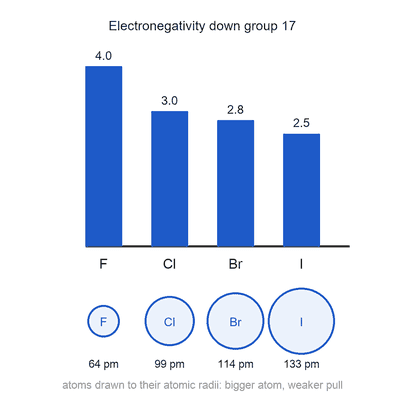
Step 2 — Follow the ions.
Each halide ion is larger than its own atom, and the ions grow in the same order: < < < . So the ionic radius increases.
Watch out: For metals reactivity rises down a group, but for the halogens it falls.
Why the other options are wrong:
- (A) reactivity will increase: Halogen reactivity decreases down the group; fluorine is the most reactive.
- (B) electronegativity will increase: Electronegativity decreases down the group, from F 4.0 to I 2.5.
- (D) ionisation potential will increase: Ionisation potential decreases down the group, as the outer electrons get farther from the nucleus.
Therefore, going down the halogen group the ionic radius increases, option (C).
- 691 mark
Question 69
Electron affinity is the :
Solve with AIAnswer
(A) Power of an atom to attract an electron to itself.
- Correct
(B) Energy released when an electron is added to an isolated atom in the gaseous state.
(C) Energy absorbed when an electron is added to an isolated atom in the gaseous state.
(D) Energy required to remove an electron from an isolated gaseous atom.
Answer: (B) Energy released when an electron is added to an isolated atom in the gaseous state.
Concept: Electron affinity is the energy released when a neutral isolated gaseous atom accepts an electron to form an anion. A small atom with a large nuclear charge attracts the extra electron strongly, so electron affinity increases across a period and decreases down a group.
Step 1 — Recall the definition.
Electron affinity is the energy released when a neutral isolated gaseous atom accepts an electron to form an anion.
Step 2 — Match it with the options.
Option (B) says exactly this: energy released when an electron is added to an isolated gaseous atom.
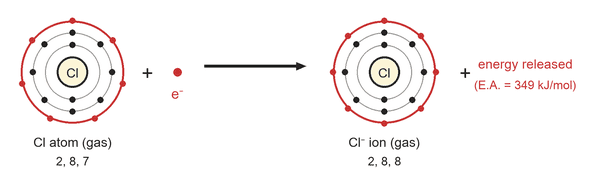
Watch out: Electron affinity is energy given out; the energy taken in to remove an electron is ionisation energy.
Why the other options are wrong:
- (A) Power of an atom to attract an electron to itself: This describes electronegativity, which is about an atom in a molecule attracting a shared pair.
- (C) Energy absorbed when an electron is added to an isolated atom in the gaseous state: Energy is released when the electron is added, not absorbed.
- (D) Energy required to remove an electron from an isolated gaseous atom: This is the definition of ionisation energy, which is about removing an electron.
Therefore, electron affinity is the energy released when an electron is added to an isolated gaseous atom, option (B).
- 701 mark
Question 70
Which of these statements gives the correct picture regarding halogens and alkali metals with respect to an increase in the atomic number ?
Solve with AIAnswer
(A) Reactivity decreases in alkali metals but increases in halogens.
(B) Reactivity increases in both.
(C) Reactivity decreases in both.
- Correct
(D) Reactivity increases in alkali metals but decreases in halogens.
Answer: (D) Reactivity increases in alkali metals but decreases in halogens.
Concept: Down a group the atomic size increases. Metals react by losing electrons and non-metals by gaining them, so the bigger size affects the two families in opposite ways.
Step 1 — Alkali metals.
They react by losing their one valence electron. A bigger atom loses it more easily, so reactivity increases down the group (Li < Na < K < Rb < Cs).
Step 2 — Halogens.
They react by gaining one electron. A bigger atom attracts it less strongly, so reactivity decreases down the group (F > Cl > Br > I).
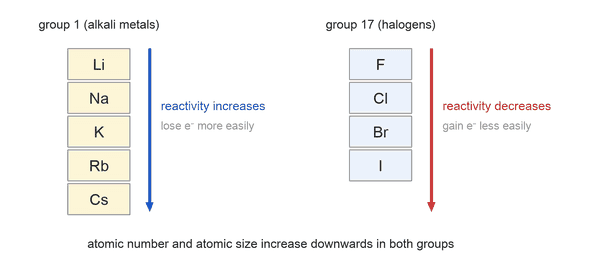
Watch out: The same increase in size raises metal reactivity but lowers non-metal reactivity.
Why the other options are wrong:
- (A) Reactivity decreases in alkali metals but increases in halogens: The trends are the wrong way round: alkali metals become more reactive and halogens less reactive.
- (B) Reactivity increases in both: Halogen reactivity does not increase down the group; it decreases.
- (C) Reactivity decreases in both: Alkali-metal reactivity does not decrease down the group; it increases.
Therefore, reactivity increases in the alkali metals but decreases in the halogens, option (D).
- 711 mark
Question 71
The correct order of increasing ionisation energy of Be, Mg, Ca, Sr is :
Solve with AIAnswer
(A) Be, Mg, Ca, Sr
(B) Ca, Mg, Be, Sr
- Correct
(C) Sr, Ca, Mg, Be
(D) Mg, Ca, Sr, Be
Answer: (C) Sr, Ca, Mg, Be
Concept: Ionisation energy (ionisation potential) is the energy needed to remove an electron from a neutral isolated gaseous atom. It is higher when the atom is small and the nuclear charge is large, so it increases across a period and decreases down a group.
Step 1 — Place the elements.
Be, Mg, Ca and Sr are group 2 elements listed from top to bottom.
Step 2 — Apply the trend down the group.
Each step down adds a shell, so the valence electrons are farther out and easier to remove: ionisation energy decreases from Be to Sr (book values Be 899, Mg 737 kJ mol⁻¹).
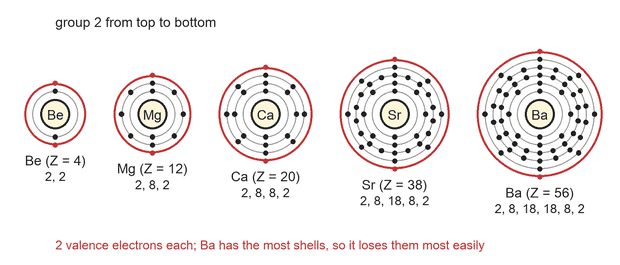
Step 3 — Write the increasing order.
The increasing order therefore runs from bottom to top: Sr < Ca < Mg < Be.
Watch out: The question asks for increasing ionisation energy, which is the reverse of the order in which the group is listed.
Why the other options are wrong:
- (A) Be, Mg, Ca, Sr: Be, Mg, Ca, Sr is the decreasing order, the reverse of what is asked.
- (B) Ca, Mg, Be, Sr: Sr has the lowest value, so it must come first; this order puts it last.
- (D) Mg, Ca, Sr, Be: Be has the highest value and is rightly last, but Mg, Ca, Sr are placed in decreasing order.
Therefore, the increasing order of ionisation energy is Sr, Ca, Mg, Be, option (C).
- 721 mark
Question 72
An element combines with to form a compound. Which of the following is true ?
P X is a metal, Y is a metal.
Q X is a metal, Y is a non metal.
R X looses electron(s), Y gains electron(s).
Solve with AIAnswer
(A) Only P
(B) Only Q
(C) Both P and Q
- Correct
(D) Both Q and R
Answer: (D) Both Q and R
Concept: Valency is the number of electrons an atom loses, gains or shares to reach a stable octet (a duplet for the first shell). Atoms with 1, 2 or 3 valence electrons lose them, so their valency equals the number of valence electrons; atoms with 5, 6 or 7 gain electrons, so their valency is 8 minus that number.
Step 1 — Identify X and Y.
X (Z = 13) is 2, 8, 3, aluminium, a metal that loses 3 electrons. Y (Z = 17) is 2, 8, 7, chlorine, a non-metal that gains 1 electron.
Step 2 — Test each statement.
P says both are metals, which is false. Q says X is a metal and Y a non-metal, which is true. R says X loses and Y gains electrons, which is true.
Step 3 — Show the compound.
Three Y atoms take the three electrons of one X atom, giving .
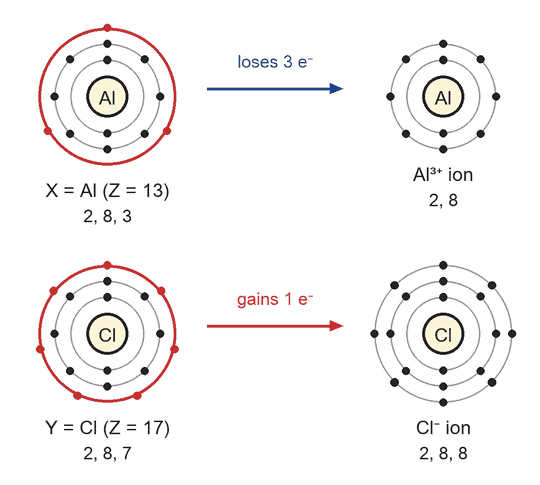
Watch out: A metal and a non-metal combine by transferring electrons; the metal loses them and the non-metal gains them.
Why the other options are wrong:
- (A) Only P: P is false, because Y (chlorine) is a non-metal.
- (B) Only Q: Q is true, but R is also true, so 'only Q' is incomplete.
- (C) Both P and Q: P is false, so any option that includes P is wrong.
Therefore, both Q and R are true, option (D).
- 731 mark
Question 73
The following questions are Assertion-Reason based questions. Choose the answer based on the codes given below.
(1) Both A and R are true and R is the correct explanation of A.
(2) Both A and R are true but R is not the correct explanation of A.
(3) A is true but R is false.
(4) A is false but R is true.
Assertion (A) : Second period consists of 8 elements.
Reason (R) : Number of elements in each period is four times the number of atomic orbitals available in the energy level that is being filled.
Solve with AIAnswer
(A) (1)
(B) (2)
- Correct
(C) (3)
(D) (4)
Answer: (C) (3)
Concept: In an assertion–reason item, judge the assertion (A) and the reason (R) separately as true or false, and only then decide whether R correctly explains A.
Step 1 — Judge the assertion.
Period 2 runs from lithium to neon, which is 8 elements. A is true.
Step 2 — Judge the reason.
Each orbital holds 2 electrons, so the number of elements in a period is two times the number of orbitals being filled, not four times. In period 2, four orbitals (2s and three 2p) are filled.
So R is false.
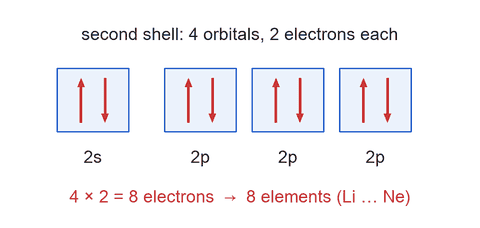
Step 3 — Choose the code.
A is true and R is false, so the answer is code (3).
Watch out: The reason uses 'four times'; with four orbitals that would give 16 elements, which is wrong.
Why the other options are wrong:
- (A) (1): R is false, so it cannot be the correct explanation of A.
- (B) (2): R is false, so 'both A and R are true' is wrong.
- (D) (4): A is true: period 2 has 8 elements.
Therefore, A is true but R is false, code (3), option (C).
- 741 mark
Question 74
The following questions are Assertion-Reason based questions. Choose the answer based on the codes given below.
(1) Both A and R are true and R is the correct explanation of A.
(2) Both A and R are true but R is not the correct explanation of A.
(3) A is true but R is false.
(4) A is false but R is true.
Assertion (A) : In a Dobereiner's triad, the three elements present have the same difference of atomic masses.
Reason (R) : Elements in a triad have similar properties.
Solve with AIAnswer
(A) (1)
- Correct
(B) (2)
(C) (3)
(D) (4)
Answer: (B) (2)
Concept: In an assertion–reason item, judge the assertion (A) and the reason (R) separately as true or false, and only then decide whether R correctly explains A.
Step 1 — Judge the assertion.
In the triad lithium (7), sodium (23) and potassium (39) the two differences of atomic mass are equal.
Equal differences mean the middle mass is the mean of the other two, which is Dobereiner's rule.
So A is true (approximately, as Dobereiner's rule itself is).

Step 2 — Judge the reason.
The three elements of a triad are chemically similar; that is how Dobereiner grouped them. R is true.
Step 3 — Decide whether R explains A.
Similar properties do not explain why the masses are equally spaced, so R is not the explanation of A. The answer is code (2).
Watch out: Two true statements are not automatically linked; ask whether R gives the cause of A before choosing code (1).
Note: the book's printed key gives (d), code (4), which treats A as false. As Step 1 shows, 'equal differences' and 'the middle mass is the mean' are the same statement, so A is true and (B) is kept.
Why the other options are wrong:
- (A) (1): R is true, but similar properties do not explain the equal mass differences.
- (C) (3): R is a true statement, so code (3) is wrong.
- (D) (4): A is true for the triads Dobereiner listed, so code (4) is wrong.
Therefore, both A and R are true but R does not explain A, code (2), option (B).
- 751 mark
Question 75
The following questions are Assertion-Reason based questions. Choose the answer based on the codes given below.
(1) Both A and R are true and R is the correct explanation of A.
(2) Both A and R are true but R is not the correct explanation of A.
(3) A is true but R is false.
(4) A is false but R is true.
Assertion (A) : Smaller the size of an atom greater is its electronegativity.
Reason (R) : Electronegativity is the tendency of an atom to attract shared pair of electrons towards itself in a molecule.
Solve with AIAnswer
(A) (1)
- Correct
(B) (2)
(C) (3)
(D) (4)
Answer: (B) (2)
Concept: In an assertion–reason item, judge the assertion (A) and the reason (R) separately as true or false, and only then decide whether R correctly explains A.
Step 1 — Judge the assertion.
In a smaller atom the shared pair is closer to the nucleus and is attracted more strongly, so the electronegativity is greater: F (64 pm) has 4.0 against Cl (99 pm) with 3.0. A is true.
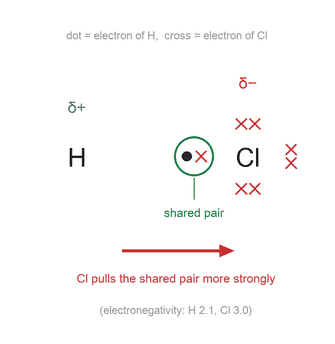
Step 2 — Judge the reason.
R is the definition of electronegativity, so R is true.
Step 3 — Decide whether R explains A.
A definition says what electronegativity is; it does not say why size affects it. So R is not the correct explanation of A, and the answer is code (2).
Watch out: A true definition is not automatically the explanation; ask whether R gives the cause of A.
Why the other options are wrong:
- (A) (1): R only defines electronegativity; it does not explain the effect of size.
- (C) (3): R is true, because it is the definition of electronegativity.
- (D) (4): A is true, because a smaller atom pulls the shared pair more strongly.
Therefore, both A and R are true but R does not explain A, code (2), option (B).
- 761 mark
Question 76
The following questions are Assertion-Reason based questions. Choose the answer based on the codes given below.
(1) Both A and R are true and R is the correct explanation of A.
(2) Both A and R are true but R is not the correct explanation of A.
(3) A is true but R is false.
(4) A is false but R is true.
Assertion (A) : Hydrogen is placed in group I.
Reason (R) : Hydrogen can gain an electron to achieve noble gas configuration.
Solve with AIAnswer
(A) (1)
- Correct
(B) (2)
(C) (3)
(D) (4)
Answer: (B) (2)
Concept: In an assertion–reason item, judge the assertion (A) and the reason (R) separately as true or false, and only then decide whether R correctly explains A.
Step 1 — Judge the assertion.
Hydrogen (1 electron) is placed in group 1 because, like the alkali metals, it has one valence electron and valency 1, and it can lose that electron to form . A is true.
Step 2 — Judge the reason.
Hydrogen can also gain an electron to reach the helium configuration, so R is true.
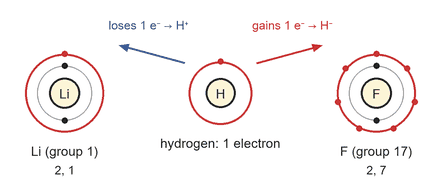
Step 3 — Decide whether R explains A.
Gaining an electron is a halogen-like property; it is not the reason hydrogen is placed in group I. So R does not explain A, and the answer is code (2).
Watch out: R is true but describes how hydrogen resembles the halogens of group 17, not group 1.
Why the other options are wrong:
- (A) (1): R explains a resemblance to the halogens, not the placing in group I.
- (C) (3): R is a true statement: hydrogen does form the hydride ion H⁻.
- (D) (4): A is true: hydrogen is placed in group 1 for its single valence electron.
Therefore, both A and R are true but R does not explain A, code (2), option (B).
- 771 mark
Question 77
The following questions are Assertion-Reason based questions. Choose the answer based on the codes given below.
(1) Both A and R are true and R is the correct explanation of A.
(2) Both A and R are true but R is not the correct explanation of A.
(3) A is true but R is false.
(4) A is false but R is true.
Assertion (A) : Atomic size increases along a period.
Reason (R) : Effective nuclear charge increases with atomic number.
Solve with AIAnswer
(A) (1)
(B) (2)
(C) (3)
- Correct
(D) (4)
Answer: (D) (4)
Concept: In an assertion–reason item, judge the assertion (A) and the reason (R) separately as true or false, and only then decide whether R correctly explains A.
Step 1 — Judge the assertion.
Atomic size decreases along a period (Li 152 pm down to F 64 pm). A is false.
Step 2 — Judge the reason.
The effective nuclear charge does increase with atomic number across a period. R is true, and it is exactly this that pulls the shells in and makes the atoms smaller.
Step 3 — Choose the code.
A is false and R is true, so the answer is code (4).
Watch out: R is true but it supports the opposite of A: a rising nuclear charge makes atoms smaller.
Why the other options are wrong:
- (A) (1): A is false, so code (1), which needs both to be true, is wrong.
- (B) (2): A is false, so code (2), which needs both to be true, is wrong.
- (C) (3): Code (3) says A true and R false; here it is the other way round.
Therefore, A is false but R is true, code (4), option (D).
- 781 mark
Question 78
The following questions are Assertion-Reason based questions. Choose the answer based on the codes given below.
(1) Both A and R are true and R is the correct explanation of A.
(2) Both A and R are true but R is not the correct explanation of A.
(3) A is true but R is false.
(4) A is false but R is true.
Assertion (A) : Elements in the same vertical column have similar properties.
Reason (R) : Properties depend upon the number of electrons in the valence shell.
Solve with AIAnswer
- Correct
(A) (1)
(B) (2)
(C) (3)
(D) (4)
Answer: (A) (1)
Concept: In an assertion–reason item, judge the assertion (A) and the reason (R) separately as true or false, and only then decide whether R correctly explains A.
Step 1 — Judge the assertion.
Elements in the same group (vertical column) show similar properties; for example Li, Na and K all react with water to form alkalis. A is true.
Step 2 — Judge the reason.
Chemical properties depend on the number of valence electrons. R is true.
Step 3 — Decide whether R explains A.
Elements of one group have the same number of valence electrons (Li 2, 1; Na 2, 8, 1; K 2, 8, 8, 1), so R correctly explains A, and the answer is code (1).
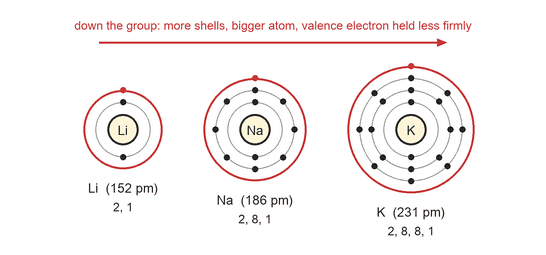
Watch out: Here R does give the cause of A, unlike a bare definition.
Why the other options are wrong:
- (B) (2): R is the correct explanation of A, so code (2) is wrong.
- (C) (3): R is true, so code (3) is wrong.
- (D) (4): A is true, so code (4) is wrong.
Therefore, both A and R are true and R explains A, code (1), option (A).
- 795 marks
Question 79
Fill in the blanks by selecting the correct word from the brackets :
(a) The element below sodium in the same group would be expected to have a ................ (lower/higher) electro-negativity than sodium and the element above chlorine would be expected to have a ............ (lower/higher) ionization potential than chlorine.
(b) On moving down a group, the number of valence electrons ................ (remains the same/increases/decreases).
(c) Metals are good ................ (oxidising agents/reducing agents) because they are electron ................ (acceptors/donors).
(d) Down a group, electron affinity ................ [increases, decreases, remains same].
(e) Electronegativity across the period ............ [increases/decreases].
(f) Non-metallic character down the group .............. [increases/decreases].
(g) In a period, increase in electron affinity increases .................... (oxidation/reduction).
(h) On descending a group, ............. (increase/decrease) in ionisation potential as well as electron affinity .................. (increases/decreases) oxidising capacity.
(i) If an element has a low ionization energy then it is likely to be ............... (metallic/non metallic).
(j) If an element has seven electrons in its outermost shell then it is likely to have the .................... (largest/smallest) atomic size among all the elements in the same period.
Solve with AIWritten solution
Solution:
Concept: Down a group atoms get bigger, so they hold electrons less firmly; across a period they get smaller, so they hold electrons more firmly. A reducing agent is an electron donor (it loses electrons and is itself oxidised); an oxidising agent is an electron acceptor (it gains electrons and is itself reduced).
Step 1 — Part (a).
The element below sodium is potassium, a bigger atom, so it has a lower electronegativity (K 0.8 against Na 0.9). The element above chlorine is fluorine, a smaller atom, so it has a higher ionization potential (F 1681 against Cl 1256 kJ mol⁻¹).
Step 2 — Parts (b) and (c).
(b) Down a group only the number of shells increases, so the number of valence electrons remains the same. (c) Metals give away electrons, so they are good reducing agents because they are electron donors.
Step 3 — Parts (d), (e) and (f).
(d) Down a group the bigger atom attracts an extra electron less strongly, so electron affinity decreases. (e) Across the period electronegativity increases (Na 0.9 to Cl 3.0). (f) Down the group non-metallic character decreases (fluorine is the most reactive non-metal of group 17).
Step 4 — Parts (g) and (h).
(g) A higher electron affinity means the element gains electrons more readily, which increases oxidation (its power to oxidise other substances). (h) On descending a group, the decrease in ionisation potential as well as electron affinity decreases the oxidising capacity, because the atoms gain electrons less readily.
Step 5 — Parts (i) and (j).
(i) A low ionization energy means the element loses electrons easily, so it is likely to be metallic. (j) An element with seven valence electrons (a halogen) has the greatest nuclear charge on the same shells, so it has the smallest atomic size in its period (the noble gas excepted).
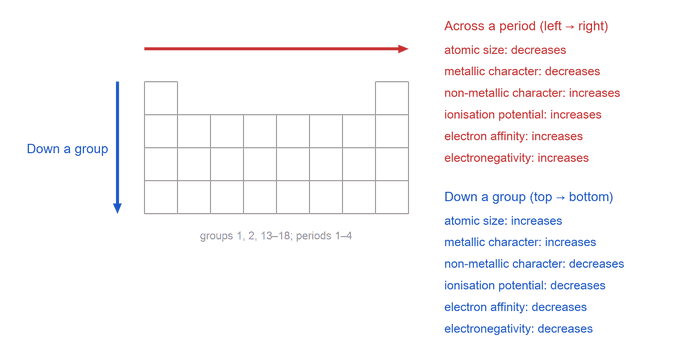
Watch out: In (c) metals are oxidised themselves, but as reagents they are reducing agents, because they donate electrons.
Therefore, (a) lower, higher; (b) remains the same; (c) reducing agents, donors; (d) decreases; (e) increases; (f) decreases; (g) oxidation; (h) decrease, decreases; (i) metallic; (j) smallest.
- 802 marks
Question 80
Rewrite the following sentences by using the correct symbol > (greater than) or < (less than) in the blanks given :
(a) The ionization potential of Potassium is ................ that of Sodium.
(b) The electronegativity of Iodine is .................... that of Chlorine.
Solve with AIWritten solution
Solution:
Concept: Both pairs lie in the same group, and both ionization potential and electronegativity decrease down a group as the atoms get bigger.
Step 1 — Part (a): potassium and sodium.
Potassium is below sodium in group 1, so its valence electron is farther from the nucleus and easier to remove (K 419, Na 496 kJ mol⁻¹). The ionization potential of potassium is < that of sodium.
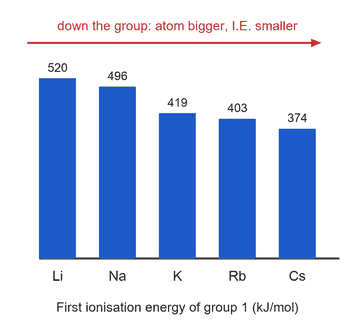
Step 2 — Part (b): iodine and chlorine.
Iodine is below chlorine in group 17; its bigger atom pulls the shared pair less strongly (I 2.5, Cl 3.0). The electronegativity of iodine is < that of chlorine.
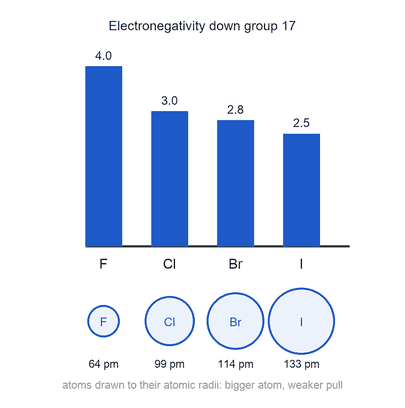
Watch out: Both blanks take '<' because in both pairs the first element is the lower one in its group.
Therefore, (a) the ionization potential of potassium is < that of sodium; (b) the electronegativity of iodine is < that of chlorine.
- 813 marks
Question 81
In Period 3 of the Periodic Table, element B is placed to the left of element A. On the basis of this information, choose the correct word from the brackets to complete the following statements :
(a) The element B would have (lower/higher) metallic character than A.
(b) The element A would probably have (lesser/higher) electron affinity than B.
(c) The element A would have (greater/smaller) atomic size than B.
Solve with AIWritten solution
Solution:
Concept: A lies to the right of B in the same period. So A has a greater nuclear charge pulling on the same three shells, which makes A's atom smaller and its hold on electrons stronger.
Step 1 — Part (a): metallic character.
Metallic character falls from left to right, so B, on the left, has higher metallic character than A.
Step 2 — Part (b): electron affinity.
The smaller atom A attracts an extra electron more strongly, so A would probably have higher electron affinity than B.
Step 3 — Part (c): atomic size.
Size falls from left to right, so A has a smaller atomic size than B.
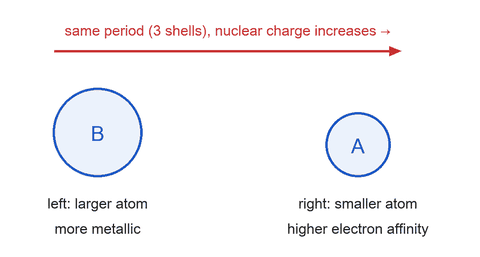
Watch out: Note which element each part names first: (a) asks about B, but (b) and (c) ask about A.
Therefore, (a) higher; (b) higher; (c) smaller.
- 821 mark
Question 82
There are three elements E, F, G with atomic numbers 19, 8 and 17 respectively.
Classify the above elements as metals and non-metals.
Solve with AIWritten solution
Solution:
Concept: Write each electronic configuration. Elements with 1, 2 or 3 valence electrons lose them (metals); elements with 5, 6 or 7 gain electrons (non-metals).
Step 1 — Classify E (atomic number 19).
E is 2, 8, 8, 1: one valence electron, which it loses. E is potassium, a metal.
Step 2 — Classify F (atomic number 8).
F is 2, 6: six valence electrons, so it gains two. F is oxygen, a non-metal.
Step 3 — Classify G (atomic number 17).
G is 2, 8, 7: seven valence electrons, so it gains one. G is chlorine, a non-metal.
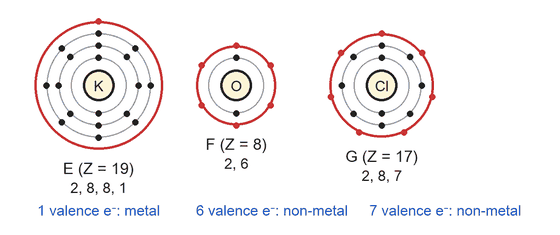
Watch out: The letter F here is not fluorine; with atomic number 8 it is oxygen.
Therefore, E is a metal, and F and G are non-metals.
- 835 marks
Question 83
Arrange the following as per instructions given in the brackets.
(a) Mg, Cl, Na, S, Si (decreasing order of atomic size)
(b) Cs, Na, Li, K, Rb (increasing metallic character)
(c) Na, Mg, Cl, S, Si (increasing ionisation potential)
(d) Cl, F, Br, I (increasing electron affinity)
(e) Cs, Na, Li, K, Rb (decreasing electronegativity)
(f) K, Pb, Ca, Zn (increasing reactivity)
(g) Li, K, Na, H (decreasing order of their potential ionisation) (2019)
Solve with AIWritten solution
Solution:
Concept: Across a period, size and metallic character fall while ionisation potential rises. Down a group, size and metallic character rise while ionisation potential, electron affinity and electronegativity fall.
Step 1 — Part (a): decreasing atomic size.
All five are in period 3, where size falls from left to right, so the decreasing order is the table order.
Na > Mg > Si > S > Cl
(186 > 160 > 117 > 104 > 99 pm)
Step 2 — Part (b): increasing metallic character.
All five are in group 1, where metallic character rises down the group as the atoms get bigger.
Li < Na < K < Rb < Cs
Step 3 — Part (c): increasing ionisation potential.
All five are in period 3, where ionisation potential rises from left to right.
Na < Mg < Si < S < Cl
(496 < 737 < 786 < 999 < 1256 kJ mol⁻¹)
Step 4 — Part (d): increasing electron affinity.
Electron affinity falls down group 17, but fluorine is an exception: its atom is so small that the electrons already present repel an incoming electron strongly, so its value (328) is lower than chlorine's (349 kJ mol⁻¹).
I < Br < F < Cl
Step 5 — Part (e): decreasing electronegativity.
Electronegativity falls down group 1 (Li 1.0, Na 0.9, K 0.8, Rb 0.8, Cs 0.7 on the Pauling table; K and Rb round to the same value there).
Li > Na > K > Rb > Cs
Step 6 — Part (f): increasing reactivity.
These metals are placed by their order in the metal activity series (K above Ca above Zn above Pb).
Pb < Zn < Ca < K
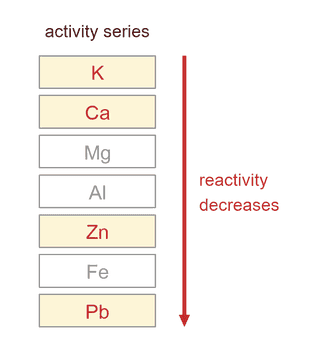
Step 7 — Part (g): decreasing ionisation potential.
Hydrogen, with the smallest atom, has the highest value (about 1312 kJ mol⁻¹); after it the value falls down group 1 (Li 520, Na 496, K 419).
H > Li > Na > K
Watch out: In (d) do not simply reverse the group order; fluorine sits below chlorine because of its tiny, crowded atom.
Therefore, (a) Na > Mg > Si > S > Cl; (b) Li < Na < K < Rb < Cs; (c) Na < Mg < Si < S < Cl; (d) I < Br < F < Cl; (e) Li > Na > K > Rb > Cs; (f) Pb < Zn < Ca < K; (g) H > Li > Na > K.
- 841 mark
Question 84
The electronegativities (according to Pauling) of the elements in Period 3 of the Periodic Table are as follows with the elements arranged in alphabetical order:
Al Cl Mg Na P S Si 1·5 3·0 1·2 0·9 2·1 2·5 1·8 Arrange the elements in the order in which they occur in the Periodic Table from left to right.
(The group 1 element first, followed by the group 2 element and so on, up to group 7).
Solve with AIWritten solution
Solution:
Concept: Electronegativity increases from left to right across a period, so arranging the values in increasing order gives the order of the elements in the period.
Step 1 — Sort the values.
Write the seven values from the smallest to the largest.
0·9 < 1·2 < 1·5 < 1·8 < 2·1 < 2·5 < 3·0
Step 2 — Read off the elements.
Put each element under its value: 0·9 is Na, 1·2 is Mg, 1·5 is Al, 1·8 is Si, 2·1 is P, 2·5 is S and 3·0 is Cl.
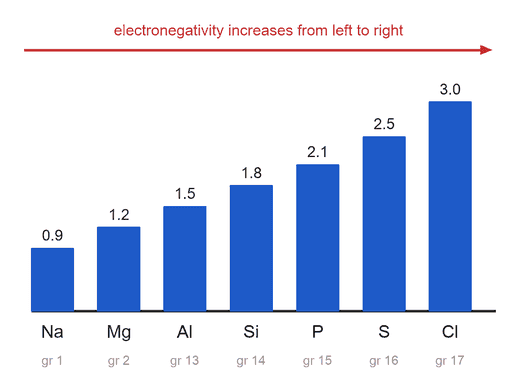
Watch out: The table in the question is in alphabetical order, which is not the order in the periodic table.
Therefore, the order from left to right is Na, Mg, Al, Si, P, S, Cl.
- 851 mark
Question 85
Name the metal present in period 3 and group I of the periodic table.
Solve with AIWritten solution
Solution:
Concept: For the first 20 elements, the number of shells in an atom gives its period, and the number of electrons in its outermost (valence) shell gives its group: 1 or 2 valence electrons → group 1 or 2; 3 to 8 valence electrons → group 13 to 18 (add 10).
Step 1 — Build the configuration.
Period 3 means three shells, and group I means one valence electron, so the configuration is 2, 8, 1.
Step 2 — Name the element.
2 + 8 + 1 = 11 electrons, so the atomic number is 11 and the metal is sodium.
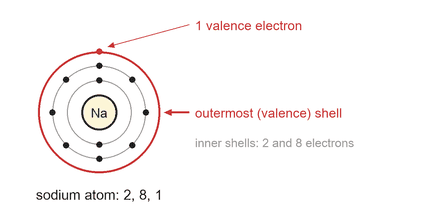
Watch out: Lithium is also in group I, but it is in period 2.
Therefore, the metal is sodium (Na), atomic number 11.
- 861 mark
Question 86
Give one word or phrase for — the amount of energy released when an atom in the gaseous state accepts an electron to form an anion.
Solve with AIWritten solution
Solution:
Concept: Electron affinity is the energy released when a neutral isolated gaseous atom accepts an electron to form an anion. A small atom with a large nuclear charge attracts the extra electron strongly, so electron affinity increases across a period and decreases down a group.
Step 1 — Picture the process.
A neutral gaseous atom takes in an extra electron to become an anion, and energy is given out.
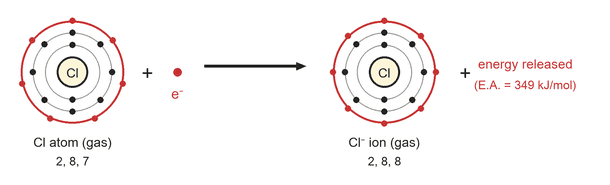
Step 2 — Name it.
The energy released in this process is called the electron affinity.
Watch out: Energy needed to remove an electron is ionisation energy; energy released on adding one is electron affinity.
Therefore, the term is electron affinity.
- 871 mark
Question 87
The formula of an ion of an element A is . Element A probably belongs to which group ?
Solve with AIWritten solution
Solution:
Concept: Valency is the number of electrons an atom loses, gains or shares to reach a stable octet (a duplet for the first shell). Atoms with 1, 2 or 3 valence electrons lose them, so their valency equals the number of valence electrons; atoms with 5, 6 or 7 gain electrons, so their valency is 8 minus that number.
Step 1 — Read the charge.
A forms by losing 2 electrons, so it has 2 valence electrons.
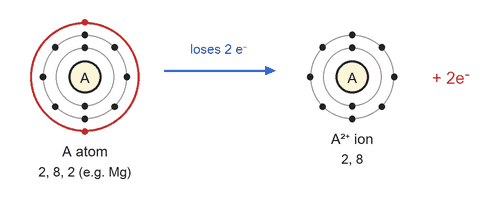
Step 2 — Place it in the table.
An element with 2 valence electrons belongs to group 2 (IIA), the alkaline earth metals.
Watch out: A 2+ charge means two electrons lost, not two gained.
Therefore, element A probably belongs to group 2 (IIA).
- 881 mark
Question 88
State the group and period of the element having three shells with three electrons in its valence shell.
Solve with AIWritten solution
Solution:
Concept: For the first 20 elements, the number of shells in an atom gives its period, and the number of electrons in its outermost (valence) shell gives its group: 1 or 2 valence electrons → group 1 or 2; 3 to 8 valence electrons → group 13 to 18 (add 10).
Step 1 — Find the period.
Three shells means period 3.
Step 2 — Find the group.
Three valence electrons means group 13 (IIIA) (3 + 10). The configuration 2, 8, 3 is aluminium.
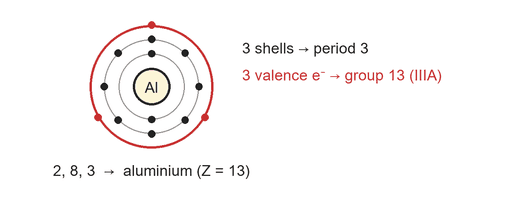
Watch out: For 3 valence electrons the modern group number is 13, not 3.
Therefore, the element is in group 13 (IIIA) and period 3.
- 892 marks
Question 89
What is the significance of atomic number in the modern periodic table ?
Solve with AIWritten solution
Solution:
Concept: The modern periodic law says that the physical and chemical properties of the elements are periodic functions of their atomic numbers. The modern periodic table arranges the elements in order of increasing atomic number in 18 vertical groups and 7 horizontal periods.
Step 1 — It fixes the order of the elements.
The elements are arranged in order of increasing atomic number, as the modern periodic law requires.
Step 2 — It fixes the position of each element.
The atomic number decides the electronic configuration, and so the number of shells (the period) and the number of valence electrons (the group) of each element.
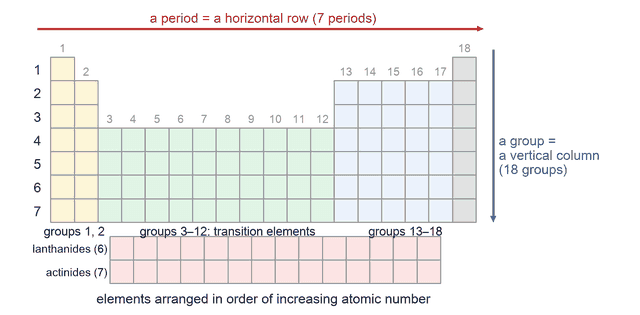
Step 3 — It explains periodicity.
Properties depend on the valence electrons, so elements with similar properties fall in the same group, and properties recur at regular intervals of atomic number.
Step 4 — It removes the anomalies of Mendeleev's table.
Isotopes, with the same atomic number, take a single place. Pairs such as argon and potassium fall in their correct order: argon, atomic number 18, comes before potassium, atomic number 19, although its atomic mass (39.9) is greater than that of potassium (39.1).
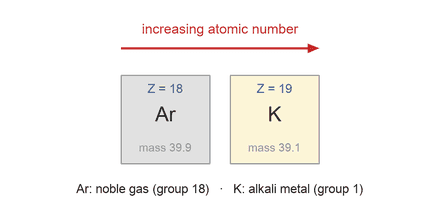
Watch out: The modern table is ordered by atomic number, not atomic mass; Ar and K would be swapped by mass.
Therefore, the atomic number is the basis of the modern periodic table: it decides the order, the period and group of each element, and removes Mendeleev's anomalies.
- 904 marks
Question 90
Arrange the following in order of :
(i) increasing radii.
(a) , Cl (b) , Mg, (c) N, O, P
(ii) increasing ionisation energy.
(a) P, Na, Cl (b) F, O, Ne (c) Ne, He, Ar
Explain your choice.
Solve with AIWritten solution
Solution:
Concept: An ion has the same number of protons as its atom. A cation has lost electrons, so the same nuclear pull acts on fewer electrons and the particle is smaller than its atom; an anion has gained electrons, so the repulsion between electrons grows and the particle is larger than its atom. Atomic size (atomic radius) depends on the number of shells and on the nuclear charge. Down a group a new shell is added at each step, so atoms get bigger; across a period the shells stay the same while the nuclear charge rises, so atoms get smaller. Ionisation energy follows the opposite trend to size.
Step 1 — Part (i)(a): Cl and Cl⁻.
has 18 electrons and 17 protons. The extra electron increases the repulsion and reduces the pull on each electron, so the ion expands.
Cl <
Step 2 — Part (i)(b): Mg²⁺, Mg and Mg⁺.
Every electron lost leaves the same 12 protons pulling on fewer electrons, so the particle shrinks; (2, 8) has also lost its third shell.
< < Mg
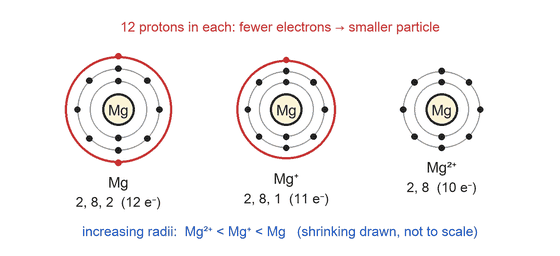
Step 3 — Part (i)(c): N, O and P.
O is to the right of N in period 2, with a greater nuclear charge, so it is smaller (66 against 70 pm). P is in period 3 and has an extra shell (110 pm).
O < N < P
Step 4 — Part (ii)(a) and (b): P, Na, Cl and F, O, Ne.
Within a period, ionisation energy rises from left to right as the size falls and the nuclear charge rises.
Na < P < Cl (496 < 1011 < 1256 kJ mol⁻¹)
O < F < Ne (1314 < 1681 < 2080 kJ mol⁻¹; neon's stable octet gives the highest value)
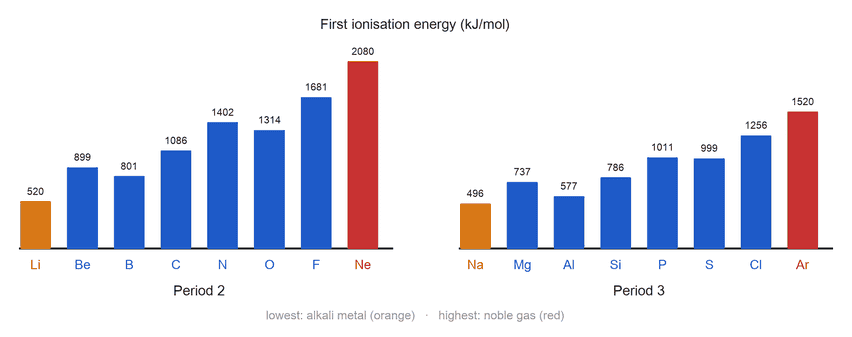
Step 5 — Part (ii)(c): Ne, He and Ar.
In group 18 ionisation energy falls down the group as the atoms get bigger (one more shell at each step), so helium has the highest value.
Ar < Ne < He (1520 < 2080 < 2372 kJ mol⁻¹)
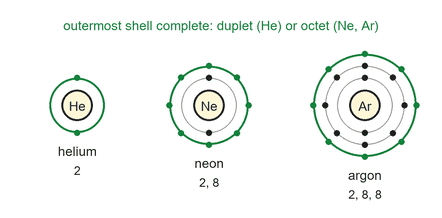
Watch out: In (i)(c) compare O and N first (same period, O smaller); P, below N in group 15, has an extra shell and is the largest.
Therefore, (i) (a) Cl < Cl⁻, (b) Mg²⁺ < Mg⁺ < Mg, (c) O < N < P; (ii) (a) Na < P < Cl, (b) O < F < Ne, (c) Ar < Ne < He.
- 912 marks
Question 91
Atomic numbers of elements A, B, C, D, E, F are 8, 7, 11, 12, 13 and 9 respectively. State the type of ions they form.
Solve with AIWritten solution
Solution:
Concept: Metals (1 to 3 valence electrons) lose electrons to form cations; non-metals (5 to 7 valence electrons) gain electrons to form anions. The charge equals the number of electrons lost or gained.
Step 1 — Write each configuration and read off the ion.
Each atomic number gives the configuration, and the valence electrons tell whether electrons are lost or gained.
Element Configuration Ion formed A (8) 2, 6 anion (gains 2) B (7) 2, 5 anion (gains 3) C (11) 2, 8, 1 cation (loses 1) D (12) 2, 8, 2 cation (loses 2) E (13) 2, 8, 3 cation (loses 3) F (9) 2, 7 anion (gains 1) 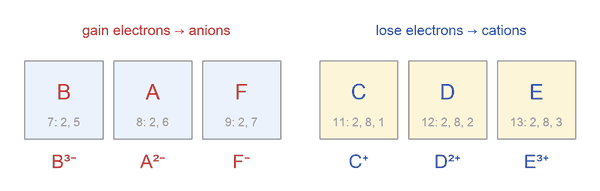
Step 2 — Group the answers.
A, B and F have 6, 5 and 7 valence electrons, so they gain electrons; C, D and E have 1, 2 and 3, so they lose them.
Watch out: For a non-metal the charge is 8 minus the valence electrons (B with 5 forms B³⁻), not the valence electrons themselves.
Therefore, A, B and F form anions (A²⁻, B³⁻, F⁻), and C, D and E form cations (C⁺, D²⁺, E³⁺).
- 925 marks
Question 92
Give reasons :
(a) The oxidising power of elements increases from left to right along a period.
(b) Ionisation potential of elements increases across a period from left to right.
(c) Alkali metals are good reducing agents.
Solve with AIWritten solution
Solution:
Concept: Across a period the nuclear charge increases and the atomic size decreases. Alkali metals have the largest atoms and the lowest ionisation potentials of their periods. A reducing agent is an electron donor (it loses electrons and is itself oxidised); an oxidising agent is an electron acceptor (it gains electrons and is itself reduced).
Step 1 — Part (a): oxidising power across a period.
Oxidising power is the tendency to gain electrons. As the atoms get smaller and the nuclear charge increases from left to right, an incoming electron is attracted more strongly, so the oxidising power increases; chlorine is the strongest oxidising agent of period 3.
Step 2 — Part (b): ionisation potential across a period.
From left to right the nuclear charge increases while the number of shells stays the same, so the atomic size decreases. The valence electrons are held more firmly, so more energy is needed to remove one (Na 496 to Ar 1520 kJ mol⁻¹).
Step 3 — Part (c): alkali metals are good reducing agents.
Alkali metals have only one valence electron, a large atomic size and a low ionisation potential, so they lose that electron very easily.
A substance that donates electrons is a reducing agent, so alkali metals are good reducing agents.
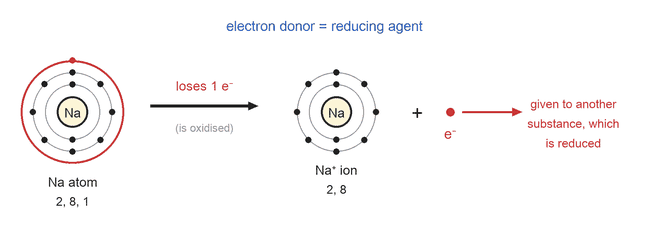
Watch out: A reducing agent is itself oxidised: sodium is oxidised to Na⁺ while it reduces something else.
Therefore, (a) smaller atoms with more nuclear charge gain electrons more readily; (b) electrons are held more firmly across a period; (c) alkali metals lose their single valence electron very easily.
- 935 marks
Question 93
Chlorine in the Periodic Table is surrounded by the elements with atomic number 9, 16, 18 and 35.
(a) Which of these have Physical and Chemical properties resembling chlorine ?
(b) Which is more electronegative than chlorine ?
Solve with AIWritten solution
Solution:
Concept: Elements of the same group resemble each other, because they have the same number of valence electrons; neighbours in the same period do not.
Step 1 — Identify the four neighbours.
9 is fluorine (2, 7), 16 is sulphur (2, 8, 6), 18 is argon (2, 8, 8) and 35 is bromine (2, 8, 18, 7).
Step 2 — Part (a): find the elements like chlorine.
Fluorine (9) and bromine (35) lie above and below chlorine in group 17 and, like chlorine, have 7 valence electrons. So they are reactive non-metals that form ions and diatomic molecules.
Sulphur and argon are only in the same period as chlorine; with 6 and 8 valence electrons they behave differently.
Step 3 — Part (b): find the more electronegative element.
Fluorine (9) is above chlorine in the same group, so its atom is smaller and it attracts the shared pair more strongly (F 4.0 against Cl 3.0).
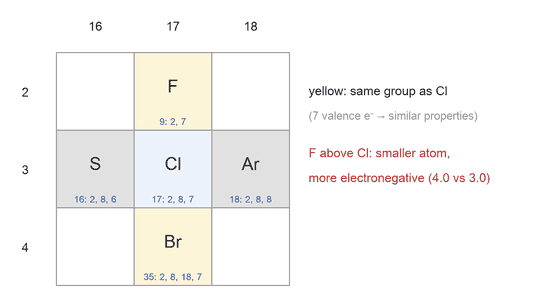
Watch out: Being next to chlorine in the table is not enough; only elements of the same group are similar.
Therefore, (a) fluorine (9) and bromine (35) resemble chlorine; (b) fluorine (9) is more electronegative than chlorine.
- 943 marks
Question 94
First ionisation enthalpy of two elements X and Y are 500 and 375 respectively. Comment about their relative position in a group as well as in a period.
Solve with AIWritten solution
Solution:
Concept: Ionisation energy (ionisation potential) is the energy needed to remove an electron from a neutral isolated gaseous atom. It is higher when the atom is small and the nuclear charge is large, so it increases across a period and decreases down a group.
Step 1 — Compare the values.
Y has the lower first ionisation enthalpy (375 against 500 kJ mol⁻¹), so Y loses its electron more easily than X.
Step 2 — Place them in a group.
Down a group a shell is added at each step, so lower elements have bigger atoms and lower values. So Y must lie below X in the group.
Step 3 — Place them in a period.
Across a period the value rises from left to right. So Y must lie to the left of X in the period.
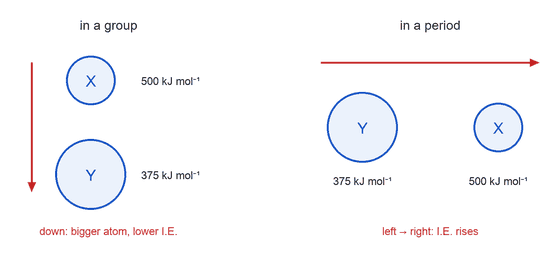
The values are close to those of sodium (496 kJ mol⁻¹) and caesium (374 kJ mol⁻¹), two group 1 elements with caesium far below sodium.
Watch out: A lower ionisation enthalpy means lower down a group but further left in a period, not further right.
Therefore, in a group Y lies below X, and in a period Y lies to the left of X.
- 955 marks
Question 95
The elements of one short period of the Periodic Table are given below in order from left to right :
Li Be B C O F Ne
(a) To which period do these elements belong ?
(b) One element of this period is missing. Which is the missing element and where should it be placed ?
(c) Place the three elements fluorine, beryllium and nitrogen in the order of increasing electronegativity.
(d) Which one of the above elements belongs to the halogen series ?
Solve with AIWritten solution
Solution:
Concept: Lithium (atomic number 3) to neon (atomic number 10) all have two shells, and a period of two shells holds 8 elements; only 7 are listed.
Step 1 — Part (a): name the period.
Two shells means these elements belong to period 2 (the second period).
Step 2 — Part (b): find the missing element.
The listed atomic numbers jump from carbon (6) to oxygen (8), so nitrogen (N, Z = 7) is missing. It should be placed between carbon and oxygen, in group 15.
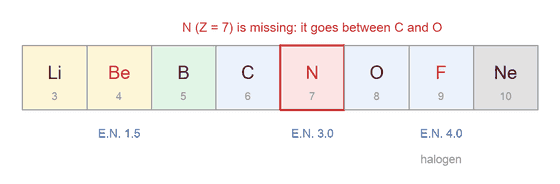
Step 3 — Part (c): order the electronegativity.
Electronegativity increases from left to right across the period, so the order is Be < N < F (1.5 < 3.0 < 4.0).
Step 4 — Part (d): find the halogen.
Fluorine (F) belongs to the halogen series: it is in group 17 with 7 valence electrons.
Watch out: Neon is the noble gas at the end of the period, not a halogen.
Therefore, (a) period 2; (b) nitrogen, between carbon and oxygen; (c) Be < N < F; (d) fluorine.
- 965 marks
Question 96
The atomic number of an element Z is 16. State
(a) the period to which it belongs.
(b) the number of valence electron(s) in the element.
(c) whether the element is a metal or a non-metal.
(d) State the formula of the compound between Z and hydrogen.
Solve with AIWritten solution
Solution:
Concept: For the first 20 elements, the number of shells in an atom gives its period, and the number of electrons in its outermost (valence) shell gives its group: 1 or 2 valence electrons → group 1 or 2; 3 to 8 valence electrons → group 13 to 18 (add 10). Valency is the number of electrons an atom loses, gains or shares to reach a stable octet (a duplet for the first shell). Atoms with 1, 2 or 3 valence electrons lose them, so their valency equals the number of valence electrons; atoms with 5, 6 or 7 gain electrons, so their valency is 8 minus that number.
Step 1 — Write the configuration.
Atomic number 16 means 16 electrons: 2, 8, 6, which is sulphur.
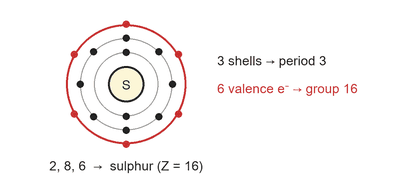
Step 2 — Parts (a) and (b): period and valence electrons.
It has three shells, so it is in period 3, and it has 6 valence electrons (in the M shell).
Step 3 — Part (c): metal or non-metal.
It needs only 2 more electrons to complete its octet, so it gains electrons: it is a non-metal.
Step 4 — Part (d): formula with hydrogen.
The valency of Z is 8 − 6 = 2 and hydrogen has valency 1, so two hydrogen atoms join one Z atom: (with the real symbol, , hydrogen sulphide).
Watch out: The letter Z here names the element; it is not the atomic number symbol.
Therefore, (a) period 3; (b) 6 valence electrons; (c) non-metal; (d) H₂Z (H₂S).
- 975 marks
Question 97
M is a metal and its oxide has the formula . This oxide when dissolved in water forms the corresponding hydroxide which is a good conductor of electricity. In the above context answer the following :
(a) State the number of electrons in the outermost shell of M.
(b) Name the group to which M belongs.
(c) Which element has more electronegativity, M or O?
Solve with AIWritten solution
Solution:
Concept: In a formula the total valencies must balance; oxygen has valency 2. An oxide that dissolves in water to give a strongly ionised hydroxide is the oxide of an alkali metal.
Step 1 — Find the valency of M.
In , two M atoms balance one O atom of valency 2.
Step 2 — Use the reaction with water.
The oxide dissolves to form the hydroxide MOH:
MOH is a strong alkali, fully dissociated into and ions, so its solution conducts electricity well. A metal of valency 1 with such a hydroxide is an alkali metal.
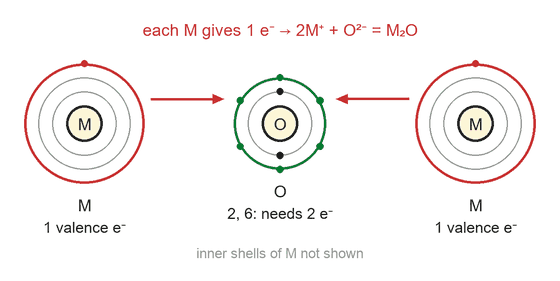
Step 3 — Parts (a) and (b): outer electrons and group.
M has 1 electron in its outermost shell, so it belongs to group 1 (IA), the alkali metals.
Step 4 — Part (c): compare electronegativity.
Oxygen is a non-metal near the top right of the table, while M is a metal on the extreme left; metals have low electronegativity. So oxygen is more electronegative.
Watch out: The subscript 2 in M₂O belongs to M, so M has valency 1, not 2.
Therefore, (a) 1 electron; (b) group 1 (alkali metals); (c) oxygen is more electronegative than M.
- 985 marks
Question 98
The metals of Group 2 from top to bottom are Be, Mg, Ca, Sr and Ba.
(a) Which of these elements will form ions most readily and why ?
(b) State the common feature in the electronic configuration of all these elements.
Solve with AIWritten solution
Solution:
Concept: Down a group the atomic size increases and the ionisation potential decreases, so the valence electrons are lost more easily.
Step 1 — Part (a): pick the element.
Barium is the largest atom of the group (six shells), so its two valence electrons are farthest from the nucleus and held least firmly. Its ionisation potential is the lowest of the five.
Step 2 — Part (a): show the ion formation.
So barium loses its two valence electrons most readily, forming :
Step 3 — Part (b): find the common feature.
All of them have two electrons in their outermost shell (valency 2), for example Be 2, 2; Mg 2, 8, 2; Ca 2, 8, 8, 2.
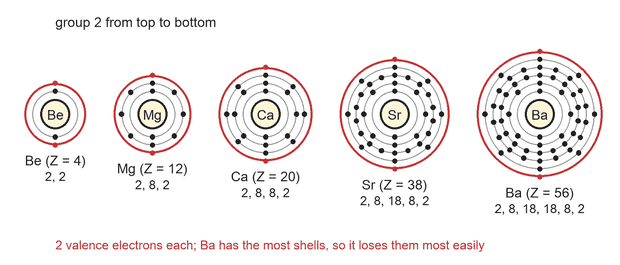
Watch out: 'forms ions most readily' points to the biggest atom (barium), not the smallest (beryllium).
Therefore, (a) barium forms ions most readily, because its large atom holds its valence electrons least firmly; (b) all have two valence electrons.
- 995 marks
Question 99
In the table below, H does not represent hydrogen. Some elements are given in their own symbol and position in the periodic table while others are shown with a letter.
IA IIA IIIA IVA VA VIA VIIA O 1 2 13 14 15 16 17 18 Li D O J Ne A Mg E Si H K B C F G L Answer the following questions.
(i) Identify the most electronegative element.
(ii) Identify the most reactive element of group IA or 1.
(iii) Identify the element from period 3 with the smallest atomic size.
(iv) Identify the element with the highest ionization potential.
(v) How many valence electrons are present in O ?
(vi) Which element from group 2 will have the least ionization energy ?
(vii) Identify the noble gas (L) of the fourth period.
(viii) In the compound between A and H, what type of bond is formed ? Give its molecular formula.
Solve with AIWritten solution
Solution:
Concept: Read each letter's period (row) and group (column) to identify it; then use the trends: electronegativity highest at the top right, reactivity of metals highest at the bottom left, size smallest at the right of a period, ionisation potential highest for the small noble gases.
Step 1 — Identify the letters.
Each letter's row gives its period and its column gives its group, which names the element.
Period Letters and the elements they stand for 2 D: boron; J: fluorine 3 A: sodium; E: aluminium; H: sulphur; K: chlorine 4 B: potassium; C: calcium; F: germanium; G: arsenic; L: krypton 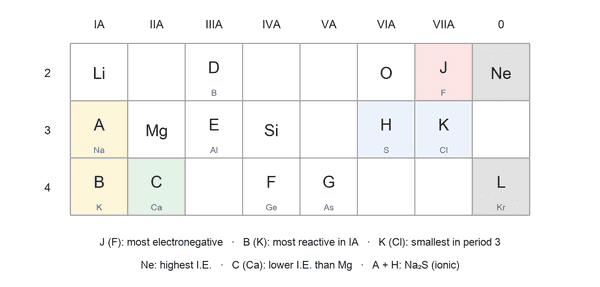
Step 2 — Parts (i) and (ii).
(i) J (fluorine) is the most electronegative: top right, noble gases left out. (ii) B (potassium) is the most reactive element of group 1 shown: it is the lowest, so it loses its electron most easily.
Step 3 — Parts (iii) and (iv).
(iii) K (chlorine) has the smallest atomic size in period 3, because size falls across the period and chlorine is the last element before the noble gas. (iv) Ne (neon) has the highest ionization potential: noble gases have the highest values, and neon, higher up than L (krypton), has the greater value.
Step 4 — Parts (v), (vi) and (vii).
(v) O is oxygen (2, 6), so it has 6 valence electrons. (vi) Of Mg and C in group 2, C (calcium) is lower down, so it has the larger atom and the lower ionization energy. (vii) L is krypton (Kr).
Step 5 — Part (viii).
A (sodium, 2, 8, 1) loses one electron and H (sulphur, 2, 8, 6) gains two, so an ionic (electrovalent) bond is formed. Two A atoms are needed for each H atom, so the formula is ; with the real symbols this is .
Watch out: The letters are not symbols: H here is sulphur and B is potassium, not hydrogen and boron.
Therefore, (i) J; (ii) B; (iii) K; (iv) Ne; (v) 6; (vi) C; (vii) krypton; (viii) ionic bond, A₂H (Na₂S).
What Class 10 Chemistry Ch 1 covers
The sections of the chapter, in the order the book takes them. Every question above comes from one of these.
- 01Salient Features of the Modern Periodic Table
- 02Periodicity
- 03Shells (Orbits) and Valency
- 04Periodic Properties
- 05Comparison of Alkali Metals and Halogens
More ways to study this chapter
The same chapter asked three other ways. Practise it, revise it, and see what the board has set on Ch 1 before.
- Competency-Based Questions (CBQ)Case study questions: a situation, and the part of the chapter that answers it.40questionsOpen
- Previous Year QuestionsQuestions that have actually appeared in board papers, each tagged with its year.54questionsOpen
- Practice QuestionsExtra questions per chapter, for when one attempt at a method is not enough.47questionsOpen
Ch 1 in past ICSE papers
The same chapter as the board has actually asked it. These are worded differently from the textbook exercise, which is the point of reading them.
- 11 mark
Board paper question 1
Fill in the blanks with the choices given in brackets.
Metals are good ............... (oxidizing agents / reducing agents) because they are electron ............... (acceptors/ donors).
Solve with AIWritten solution
Solution:
Concept: A reducing agent is an electron donor (it loses electrons and is itself oxidised); an oxidising agent is an electron acceptor (it gains electrons and is itself reduced).
Step 1 — Recall what a metal atom does in a reaction.
A metal atom has only 1, 2 or 3 electrons in its outermost shell, and it holds them loosely. In a reaction it loses these electrons and becomes a positive ion. Sodium (2, 8, 1) is an example:
Step 2 — Decide what the metal does to the other substance.
The electrons the metal loses are taken up by another substance, and gaining electrons means that substance is reduced. So the metal brings about reduction: it is a reducing agent.
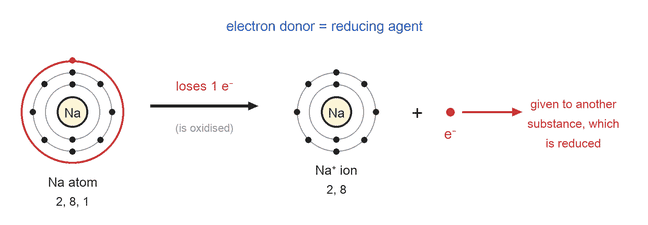
The figure shows a sodium atom (2, 8, 1) giving away its one valence electron to become Na⁺ (2, 8).
Step 3 — Fill both blanks.
Because a metal gives away electrons, it is an electron donor, and an electron donor is a reducing agent.
Watch out: An oxidising agent is an electron ACCEPTOR. Metals give electrons, so they are reducing agents and electron donors; do not put 'acceptors' in the second blank.
Therefore, metals are good reducing agents because they are electron donors.
- 21 mark
Board paper question 2
Identify the term/substance in each of the following:
The tendency of an atom to attract electrons to itself when combined in a compound.
Solve with AIWritten solution
Solution:
Concept: Electronegativity is the tendency of an atom in a molecule to attract the shared pair of electrons towards itself (Pauling scale, fluorine 4.0 the highest). It increases across a period and decreases down a group, for the same reasons as electron affinity.
Step 1 — Read what the statement describes.
The statement describes how strongly an atom pulls electrons towards itself when it is joined to another atom in a compound, that is, its pull on a shared pair of electrons.
Step 2 — Name the property.
This tendency is called electronegativity. It is measured on the Pauling scale, on which fluorine has the highest value (4.0).
Step 3 — See it in an example.
In H–Cl, chlorine (3.0) is more electronegative than hydrogen (2.1). The shared pair therefore lies nearer chlorine, which gets a slight negative charge (δ−), while hydrogen gets a slight positive charge (δ+).
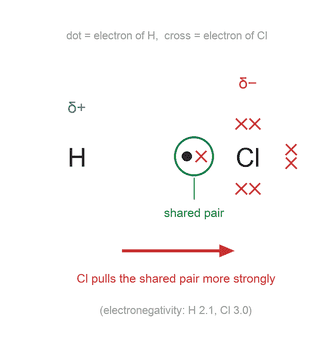
Watch out: Electron affinity is a different property: it is the ENERGY released when an isolated gaseous atom gains an electron. Electronegativity is the pull of an atom in a compound on a SHARED pair, and it has no unit.
Therefore, the term is electronegativity.
- 31 mark
Board paper question 3
Identify the term/substance in each of the following:
The electrons present in the outermost shell of an atom.
Solve with AIWritten solution
Solution:
Concept: The electrons of an atom are arranged in shells (K, L, M, N, …) round the nucleus. The outermost shell is called the valence shell; its electrons take part in bonding and decide the valency of the atom.
Step 1 — Read what the statement describes.
The statement asks for the name of the electrons that sit in the last (outermost) shell of an atom.
Step 2 — Name them.
The outermost shell is the valence shell, so the electrons in it are called valence electrons.
Step 3 — See it in an example.
Sodium has the configuration 2, 8, 1. Its outermost (third) shell holds one electron, so sodium has one valence electron; this is why it lies in group 1 and has valency 1.
Watch out: Count only the electrons of the LAST shell. Sodium has 11 electrons in all, but only 1 valence electron.
Therefore, the electrons present in the outermost shell of an atom are called valence electrons.
- 44 marks
Board paper question 4
Use the letters only written in the Periodic Table given below to answer the questions that follow:
I II III IV V VI VII O 1 L 2 Q E G J Z M 3 R 4 T (i) State the number of valence electrons in atom J.
(ii) Which element shown forms ions with a single negative charge?
(iii) Which metallic element is more reactive than R?
(iv) Which element has its electrons arranged in four shells?
Solve with AIWritten solution
Solution:
Concept: In this table the column gives the group and the row gives the period. For groups I to VII the group number equals the number of valence electrons; group O holds the noble gases, whose outer shell is complete. The period number equals the number of shells.
Step 1 — Place every letter.
We read off the group (column) and period (row) of each letter before answering.
Letter Group Period L O 1 Q I 2 E III 2 G IV 2 J V 2 Z VI 2 M VII 2 R I 3 T I 4 Step 2 — (i) Valence electrons of J.
J is in group V, and the group number gives the number of valence electrons, so J has 5 valence electrons.
Step 3 — (ii) The element forming ions with a single negative charge.
M is in group VII, so it has 7 valence electrons. It gains just one electron to complete its octet and forms the ion M⁻. (Z, in group VI, gains two electrons and forms Z²⁻, a double negative charge.)
Step 4 — (iii) The metal more reactive than R.
R and T are both group I metals, and T lies below R. T's atom has one more shell, so its valence electron is farther from the nucleus, held less firmly and lost more easily. A metal that loses its electron more easily is more reactive, so T is more reactive than R.
Step 5 — (iv) The element with four shells.
The period number equals the number of shells. T is the only letter in period 4, so T has its electrons arranged in four shells.
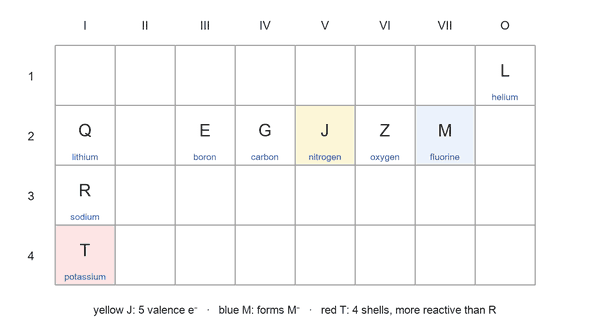
The figure marks J (5 valence electrons), M (forms M⁻) and T (four shells, more reactive than R).
Watch out: Q is also a group I metal, but it lies ABOVE R, so Q is LESS reactive than R; the answer to (iii) is T.
Therefore, (i) J has 5 valence electrons; (ii) M; (iii) T; (iv) T.
- 52 marks
Board paper question 5
Fill in the blanks by selecting the correct word from the brackets:
(i) If an element has a low ionization energy then it is likely to be ............... (metallic/non metallic).
(ii) If an element has seven electrons in its outermost shell then it is likely to have the ............... (largest / smallest) atomic size among all the elements in the same period.
Solve with AIWritten solution
Solution:
Concept: Ionisation energy (ionisation potential) is the energy needed to remove an electron from a neutral isolated gaseous atom. It is higher when the atom is small and the nuclear charge is large, so it increases across a period and decreases down a group. Atomic size (atomic radius) depends on the number of shells and on the nuclear charge. Down a group a new shell is added at each step, so atoms get bigger; across a period the shells stay the same while the nuclear charge rises, so atoms get smaller.
Step 1 — (i) Link a low ionisation energy to the kind of element.
A low ionisation energy means the valence electron can be removed with little energy. Losing electrons easily to form positive ions is the typical property of metals, so the element is likely to be metallic.
Step 2 — (ii) Place an element with seven valence electrons.
An element with seven electrons in its outermost shell is a halogen (group 17). It stands just before the noble gas at the right end of its period.
Step 3 — (ii) Compare its size with the rest of the period.
Across a period the number of shells stays the same while the nuclear charge rises, so the electrons are pulled in more and the atoms get smaller. The halogen has the largest nuclear charge of the elements before it, so it has the smallest atom. Period 3 shows this (book values, pm): Na 186, Mg 160, Al 143, Si 117, P 110, S 104, Cl 99.
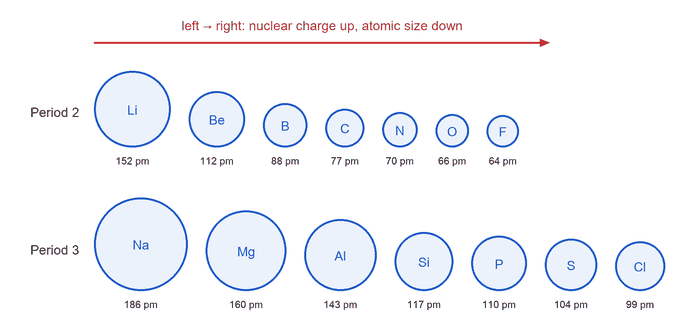
Watch out: Noble gases are not compared here: their radii are measured in a different way (van der Waals radius), so tables list them as larger than the halogen. Among the other elements of a period, the group 17 element is the smallest.
Therefore, (i) the element is likely to be metallic; (ii) it is likely to have the smallest atomic size in its period.
- 61 mark
Board paper question 6
Fill in the blanks from the choices given in brackets:
The energy required to remove an electron from a neutral isolated gaseous atom and convert it into a positively charged gaseous ion is called .............. (electron affinity, ionisation potential, electronegativity)
Solve with AIWritten solution
Solution:
Concept: Ionisation energy (ionisation potential) is the energy needed to remove an electron from a neutral isolated gaseous atom. It is higher when the atom is small and the nuclear charge is large, so it increases across a period and decreases down a group.
Step 1 — Read what the statement describes.
The statement describes the energy needed to pull an electron out of a neutral, isolated gaseous atom, which then becomes a positive ion.
Step 2 — Name the energy.
This energy is called the ionisation potential (ionisation energy). For sodium the change is:
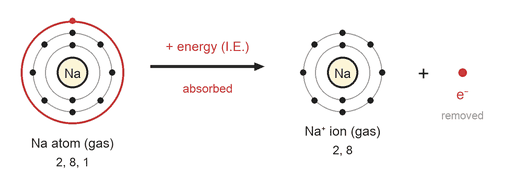
Step 3 — Rule out the other two choices.
Electron affinity is the energy released when an atom gains an electron, and electronegativity is the pull of an atom on a shared pair of electrons in a compound. Neither is the energy needed to remove an electron.
Watch out: Energy is ABSORBED in ionisation (taken in) but RELEASED when electron affinity is measured; do not swap them.
Therefore, the energy is called ionisation potential (ionisation energy).
All 54 board paper questions for this chapter, solved the same way.
Class 10 Chemistry Ch 1 questions students ask
How many questions are there in Class 10 Chemistry Ch 1?
99 questions. Every one is solved step by step on this page.
Are these Class 10 Chemistry solutions free?
Yes. Every question and its full working is free to read, with no account needed.
Can I download the Class 10 Chemistry Ch 1 solutions as a PDF?
There is no PDF to download. Every solution is on this page instead, which means it is searchable, always the current syllabus, and readable on a phone. Use your browser's print option if you want it on paper.