
Question 311 markMCQEasy
Which one of the following has the largest atomic radius ?
Confirming your payment
Sign up now and get 250 free tokens.
Periodic Table, Periodic Properties and Variations of Properties · Question 31 of 99
Which one of the following has the largest atomic radius ?
(A) Sodium
(B) Potassium
(C) Magnesium
(D) Aluminium
Answer: (B) Potassium
Concept: Atomic size (atomic radius) depends on the number of shells and on the nuclear charge. Down a group a new shell is added at each step, so atoms get bigger; across a period the shells stay the same while the nuclear charge rises, so atoms get smaller.
Step 1 — Count the shells.
Potassium (2, 8, 8, 1) is in period 4, so it has four shells. Sodium, magnesium and aluminium are in period 3 and have only three.
Step 2 — Compare the sizes.
The atom with an extra shell is the largest. The book's radii confirm it: K 231 pm, Na 186 pm, Mg 160 pm, Al 143 pm.
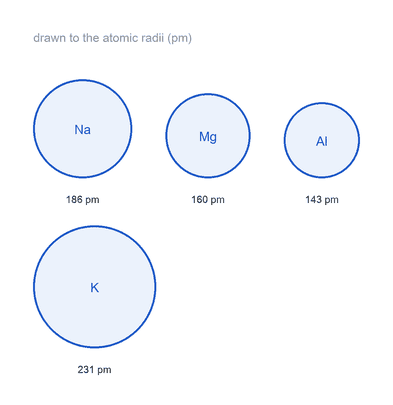
Watch out: Do not pick sodium just because it is the largest atom of period 3; potassium has a whole extra shell.
Why the other options are wrong:
Therefore, potassium has the largest atomic radius, option (B).