Solution:
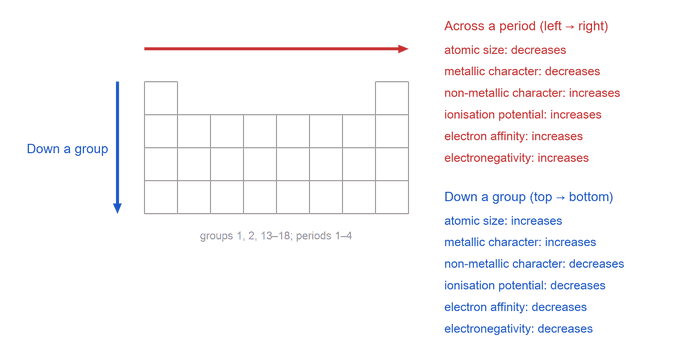
Concept: Across a period, size and metallic character fall while ionisation potential rises. Down a group, size and metallic character rise while ionisation potential, electron affinity and electronegativity fall.
Step 1 — Part (a): decreasing atomic size.
All five are in period 3, where size falls from left to right, so the decreasing order is the table order.
Na > Mg > Si > S > Cl
(186 > 160 > 117 > 104 > 99 pm)
Step 2 — Part (b): increasing metallic character.
All five are in group 1, where metallic character rises down the group as the atoms get bigger.
Li < Na < K < Rb < Cs
Step 3 — Part (c): increasing ionisation potential.
All five are in period 3, where ionisation potential rises from left to right.
Na < Mg < Si < S < Cl
(496 < 737 < 786 < 999 < 1256 kJ mol⁻¹)
Step 4 — Part (d): increasing electron affinity.
Electron affinity falls down group 17, but fluorine is an exception: its atom is so small that the electrons already present repel an incoming electron strongly, so its value (328) is lower than chlorine's (349 kJ mol⁻¹).
I < Br < F < Cl
Step 5 — Part (e): decreasing electronegativity.
Electronegativity falls down group 1 (Li 1.0, Na 0.9, K 0.8, Rb 0.8, Cs 0.7 on the Pauling table; K and Rb round to the same value there).
Li > Na > K > Rb > Cs
Step 6 — Part (f): increasing reactivity.
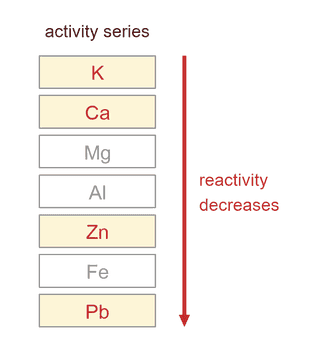
These metals are placed by their order in the metal activity series (K above Ca above Zn above Pb).
Pb < Zn < Ca < K
Step 7 — Part (g): decreasing ionisation potential.
Hydrogen, with the smallest atom, has the highest value (about 1312 kJ mol⁻¹); after it the value falls down group 1 (Li 520, Na 496, K 419).
H > Li > Na > K
Watch out: In (d) do not simply reverse the group order; fluorine sits below chlorine because of its tiny, crowded atom.
Therefore, (a) Na > Mg > Si > S > Cl; (b) Li < Na < K < Rb < Cs; (c) Na < Mg < Si < S < Cl; (d) I < Br < F < Cl; (e) Li > Na > K > Rb > Cs; (f) Pb < Zn < Ca < K; (g) H > Li > Na > K.
