
Question 691 markMCQEasy
Electron affinity is the :
Confirming your payment
Sign up now and get 250 free tokens.
Periodic Table, Periodic Properties and Variations of Properties · Question 69 of 99
Electron affinity is the :
(A) Power of an atom to attract an electron to itself.
(B) Energy released when an electron is added to an isolated atom in the gaseous state.
(C) Energy absorbed when an electron is added to an isolated atom in the gaseous state.
(D) Energy required to remove an electron from an isolated gaseous atom.
Answer: (B) Energy released when an electron is added to an isolated atom in the gaseous state.
Concept: Electron affinity is the energy released when a neutral isolated gaseous atom accepts an electron to form an anion. A small atom with a large nuclear charge attracts the extra electron strongly, so electron affinity increases across a period and decreases down a group.
Step 1 — Recall the definition.
Electron affinity is the energy released when a neutral isolated gaseous atom accepts an electron to form an anion.
Step 2 — Match it with the options.
Option (B) says exactly this: energy released when an electron is added to an isolated gaseous atom.
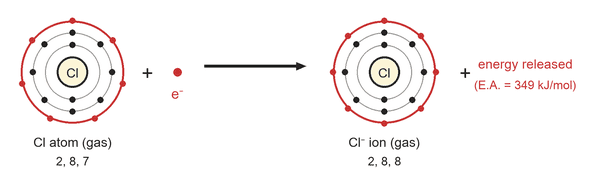
Watch out: Electron affinity is energy given out; the energy taken in to remove an electron is ionisation energy.
Why the other options are wrong:
Therefore, electron affinity is the energy released when an electron is added to an isolated gaseous atom, option (B).