
Question 681 markMCQEasy
In the periodic table while going down in the halogen group :
Confirming your payment
Sign up now and get 250 free tokens.
Periodic Table, Periodic Properties and Variations of Properties · Question 68 of 99
In the periodic table while going down in the halogen group :
(A) reactivity will increase
(B) electronegativity will increase
(C) ionic radius will increase
(D) ionisation potential will increase
Answer: (C) ionic radius will increase
Concept: Atomic size (atomic radius) depends on the number of shells and on the nuclear charge. Down a group a new shell is added at each step, so atoms get bigger; across a period the shells stay the same while the nuclear charge rises, so atoms get smaller. An ion has the same number of protons as its atom. A cation has lost electrons, so the same nuclear pull acts on fewer electrons and the particle is smaller than its atom; an anion has gained electrons, so the repulsion between electrons grows and the particle is larger than its atom.
Step 1 — Follow the atoms down group 17.
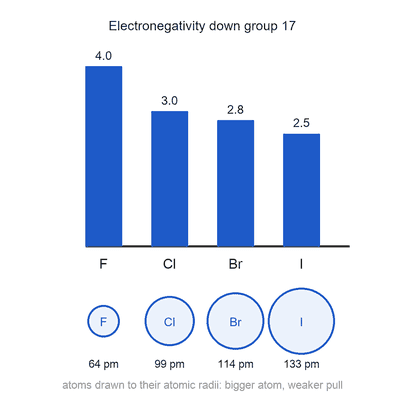
Down the group a new shell is added at each step, so the atoms grow: F 64, Cl 99, Br 114, I 133 pm.
Step 2 — Follow the ions.
Each halide ion is larger than its own atom, and the ions grow in the same order: < < < . So the ionic radius increases.
Watch out: For metals reactivity rises down a group, but for the halogens it falls.
Why the other options are wrong:
Therefore, going down the halogen group the ionic radius increases, option (C).