Solution:
Concept: Ionisation energy (ionisation potential) is the energy needed to remove an electron from a neutral isolated gaseous atom. It is higher when the atom is small and the nuclear charge is large, so it increases across a period and decreases down a group.
Step 1 — Read what the statement describes.
The statement describes the energy needed to pull an electron out of a neutral, isolated gaseous atom, which then becomes a positive ion.
Step 2 — Name the energy.
This energy is called the ionisation potential (ionisation energy). For sodium the change is:
Na(g)+energy→Na+(g)+e−
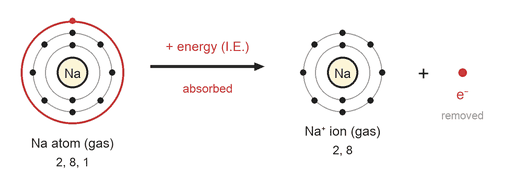
Step 3 — Rule out the other two choices.
Electron affinity is the energy released when an atom gains an electron, and electronegativity is the pull of an atom on a shared pair of electrons in a compound. Neither is the energy needed to remove an electron.
Watch out: Energy is ABSORBED in ionisation (taken in) but RELEASED when electron affinity is measured; do not swap them.
Therefore, the energy is called ionisation potential (ionisation energy).
