Solution:
Concept: Ionisation energy (ionisation potential) is the energy needed to remove an electron from a neutral isolated gaseous atom. It is higher when the atom is small and the nuclear charge is large, so it increases across a period and decreases down a group. Atomic size (atomic radius) depends on the number of shells and on the nuclear charge. Down a group a new shell is added at each step, so atoms get bigger; across a period the shells stay the same while the nuclear charge rises, so atoms get smaller.
Step 1 — (i) Link a low ionisation energy to the kind of element.
A low ionisation energy means the valence electron can be removed with little energy. Losing electrons easily to form positive ions is the typical property of metals, so the element is likely to be metallic.
Step 2 — (ii) Place an element with seven valence electrons.
An element with seven electrons in its outermost shell is a halogen (group 17). It stands just before the noble gas at the right end of its period.
Step 3 — (ii) Compare its size with the rest of the period.
Across a period the number of shells stays the same while the nuclear charge rises, so the electrons are pulled in more and the atoms get smaller. The halogen has the largest nuclear charge of the elements before it, so it has the smallest atom. Period 3 shows this (book values, pm): Na 186, Mg 160, Al 143, Si 117, P 110, S 104, Cl 99.
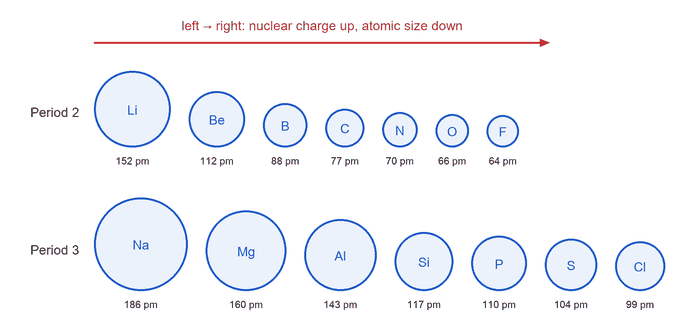
Watch out: Noble gases are not compared here: their radii are measured in a different way (van der Waals radius), so tables list them as larger than the halogen. Among the other elements of a period, the group 17 element is the smallest.
Therefore, (i) the element is likely to be metallic; (ii) it is likely to have the smallest atomic size in its period.
