Solution:
Concept: In this table the column gives the group and the row gives the period. For groups I to VII the group number equals the number of valence electrons; group O holds the noble gases, whose outer shell is complete. The period number equals the number of shells.
Step 1 — Place every letter.
We read off the group (column) and period (row) of each letter before answering.
| Letter | Group | Period |
|---|
| L | O | 1 |
| Q | I | 2 |
| E | III | 2 |
| G | IV | 2 |
| J | V | 2 |
| Z | VI | 2 |
| M | VII | 2 |
| R | I | 3 |
| T | I | 4 |
Step 2 — (i) Valence electrons of J.
J is in group V, and the group number gives the number of valence electrons, so J has 5 valence electrons.
Step 3 — (ii) The element forming ions with a single negative charge.
M is in group VII, so it has 7 valence electrons. It gains just one electron to complete its octet and forms the ion M⁻. (Z, in group VI, gains two electrons and forms Z²⁻, a double negative charge.)
Step 4 — (iii) The metal more reactive than R.
R and T are both group I metals, and T lies below R. T's atom has one more shell, so its valence electron is farther from the nucleus, held less firmly and lost more easily. A metal that loses its electron more easily is more reactive, so T is more reactive than R.
Step 5 — (iv) The element with four shells.
The period number equals the number of shells. T is the only letter in period 4, so T has its electrons arranged in four shells.
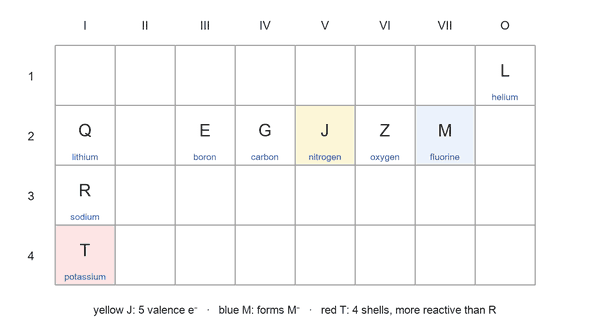
The figure marks J (5 valence electrons), M (forms M⁻) and T (four shells, more reactive than R).
Watch out: Q is also a group I metal, but it lies ABOVE R, so Q is LESS reactive than R; the answer to (iii) is T.
Therefore, (i) J has 5 valence electrons; (ii) M; (iii) T; (iv) T.
