
Opening your dashboard
Class 10 Chemistry Chapter 1 Periodic Table, Periodic Properties and Variations of Properties: Previous Year Questions
54 questions on Chapter 1, each solved step by step. Class 10 Chemistry, ICSE 2026-27.
54 questions with solutions
1–5 marks · Mixed difficulty
- 11 mark
Question 1
Fill in the blanks with the choices given in brackets.
Metals are good ............... (oxidizing agents / reducing agents) because they are electron ............... (acceptors/ donors).
Solve with AIWritten solution
Solution:
Concept: A reducing agent is an electron donor (it loses electrons and is itself oxidised); an oxidising agent is an electron acceptor (it gains electrons and is itself reduced).
Step 1 — Recall what a metal atom does in a reaction.
A metal atom has only 1, 2 or 3 electrons in its outermost shell, and it holds them loosely. In a reaction it loses these electrons and becomes a positive ion. Sodium (2, 8, 1) is an example:
Step 2 — Decide what the metal does to the other substance.
The electrons the metal loses are taken up by another substance, and gaining electrons means that substance is reduced. So the metal brings about reduction: it is a reducing agent.
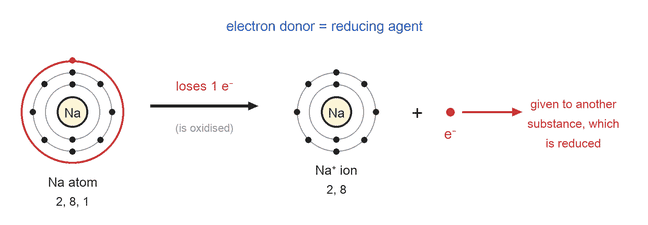
The figure shows a sodium atom (2, 8, 1) giving away its one valence electron to become Na⁺ (2, 8).
Step 3 — Fill both blanks.
Because a metal gives away electrons, it is an electron donor, and an electron donor is a reducing agent.
Watch out: An oxidising agent is an electron ACCEPTOR. Metals give electrons, so they are reducing agents and electron donors; do not put 'acceptors' in the second blank.
Therefore, metals are good reducing agents because they are electron donors.
- 21 mark
Question 2
Identify the term/substance in each of the following:
The tendency of an atom to attract electrons to itself when combined in a compound.
Solve with AIWritten solution
Solution:
Concept: Electronegativity is the tendency of an atom in a molecule to attract the shared pair of electrons towards itself (Pauling scale, fluorine 4.0 the highest). It increases across a period and decreases down a group, for the same reasons as electron affinity.
Step 1 — Read what the statement describes.
The statement describes how strongly an atom pulls electrons towards itself when it is joined to another atom in a compound, that is, its pull on a shared pair of electrons.
Step 2 — Name the property.
This tendency is called electronegativity. It is measured on the Pauling scale, on which fluorine has the highest value (4.0).
Step 3 — See it in an example.
In H–Cl, chlorine (3.0) is more electronegative than hydrogen (2.1). The shared pair therefore lies nearer chlorine, which gets a slight negative charge (δ−), while hydrogen gets a slight positive charge (δ+).
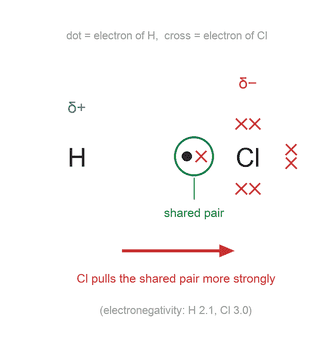
Watch out: Electron affinity is a different property: it is the ENERGY released when an isolated gaseous atom gains an electron. Electronegativity is the pull of an atom in a compound on a SHARED pair, and it has no unit.
Therefore, the term is electronegativity.
- 31 mark
Question 3
Identify the term/substance in each of the following:
The electrons present in the outermost shell of an atom.
Solve with AIWritten solution
Solution:
Concept: The electrons of an atom are arranged in shells (K, L, M, N, …) round the nucleus. The outermost shell is called the valence shell; its electrons take part in bonding and decide the valency of the atom.
Step 1 — Read what the statement describes.
The statement asks for the name of the electrons that sit in the last (outermost) shell of an atom.
Step 2 — Name them.
The outermost shell is the valence shell, so the electrons in it are called valence electrons.
Step 3 — See it in an example.
Sodium has the configuration 2, 8, 1. Its outermost (third) shell holds one electron, so sodium has one valence electron; this is why it lies in group 1 and has valency 1.
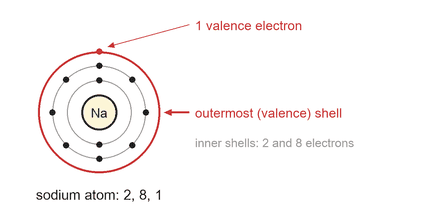
Watch out: Count only the electrons of the LAST shell. Sodium has 11 electrons in all, but only 1 valence electron.
Therefore, the electrons present in the outermost shell of an atom are called valence electrons.
- 44 marks
Question 4
Use the letters only written in the Periodic Table given below to answer the questions that follow:
I II III IV V VI VII O 1 L 2 Q E G J Z M 3 R 4 T (i) State the number of valence electrons in atom J.
(ii) Which element shown forms ions with a single negative charge?
(iii) Which metallic element is more reactive than R?
(iv) Which element has its electrons arranged in four shells?
Solve with AIWritten solution
Solution:
Concept: In this table the column gives the group and the row gives the period. For groups I to VII the group number equals the number of valence electrons; group O holds the noble gases, whose outer shell is complete. The period number equals the number of shells.
Step 1 — Place every letter.
We read off the group (column) and period (row) of each letter before answering.
Letter Group Period L O 1 Q I 2 E III 2 G IV 2 J V 2 Z VI 2 M VII 2 R I 3 T I 4 Step 2 — (i) Valence electrons of J.
J is in group V, and the group number gives the number of valence electrons, so J has 5 valence electrons.
Step 3 — (ii) The element forming ions with a single negative charge.
M is in group VII, so it has 7 valence electrons. It gains just one electron to complete its octet and forms the ion M⁻. (Z, in group VI, gains two electrons and forms Z²⁻, a double negative charge.)
Step 4 — (iii) The metal more reactive than R.
R and T are both group I metals, and T lies below R. T's atom has one more shell, so its valence electron is farther from the nucleus, held less firmly and lost more easily. A metal that loses its electron more easily is more reactive, so T is more reactive than R.
Step 5 — (iv) The element with four shells.
The period number equals the number of shells. T is the only letter in period 4, so T has its electrons arranged in four shells.
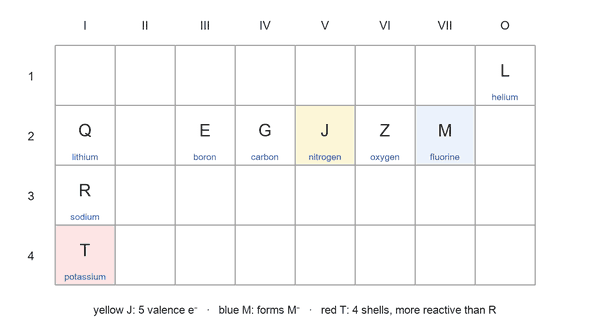
The figure marks J (5 valence electrons), M (forms M⁻) and T (four shells, more reactive than R).
Watch out: Q is also a group I metal, but it lies ABOVE R, so Q is LESS reactive than R; the answer to (iii) is T.
Therefore, (i) J has 5 valence electrons; (ii) M; (iii) T; (iv) T.
- 52 marks
Question 5
Fill in the blanks by selecting the correct word from the brackets:
(i) If an element has a low ionization energy then it is likely to be ............... (metallic/non metallic).
(ii) If an element has seven electrons in its outermost shell then it is likely to have the ............... (largest / smallest) atomic size among all the elements in the same period.
Solve with AIWritten solution
Solution:
Concept: Ionisation energy (ionisation potential) is the energy needed to remove an electron from a neutral isolated gaseous atom. It is higher when the atom is small and the nuclear charge is large, so it increases across a period and decreases down a group. Atomic size (atomic radius) depends on the number of shells and on the nuclear charge. Down a group a new shell is added at each step, so atoms get bigger; across a period the shells stay the same while the nuclear charge rises, so atoms get smaller.
Step 1 — (i) Link a low ionisation energy to the kind of element.
A low ionisation energy means the valence electron can be removed with little energy. Losing electrons easily to form positive ions is the typical property of metals, so the element is likely to be metallic.
Step 2 — (ii) Place an element with seven valence electrons.
An element with seven electrons in its outermost shell is a halogen (group 17). It stands just before the noble gas at the right end of its period.
Step 3 — (ii) Compare its size with the rest of the period.
Across a period the number of shells stays the same while the nuclear charge rises, so the electrons are pulled in more and the atoms get smaller. The halogen has the largest nuclear charge of the elements before it, so it has the smallest atom. Period 3 shows this (book values, pm): Na 186, Mg 160, Al 143, Si 117, P 110, S 104, Cl 99.
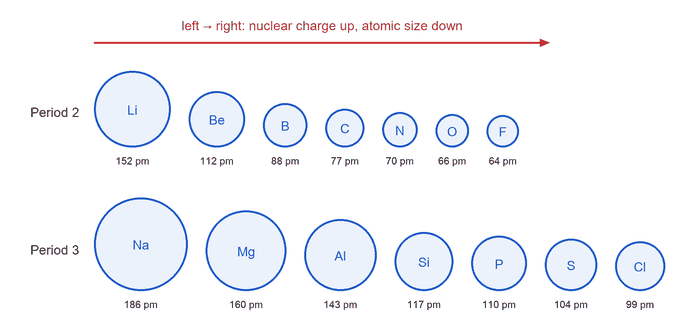
Watch out: Noble gases are not compared here: their radii are measured in a different way (van der Waals radius), so tables list them as larger than the halogen. Among the other elements of a period, the group 17 element is the smallest.
Therefore, (i) the element is likely to be metallic; (ii) it is likely to have the smallest atomic size in its period.
- 61 mark
Question 6
Fill in the blanks from the choices given in brackets:
The energy required to remove an electron from a neutral isolated gaseous atom and convert it into a positively charged gaseous ion is called .............. (electron affinity, ionisation potential, electronegativity)
Solve with AIWritten solution
Solution:
Concept: Ionisation energy (ionisation potential) is the energy needed to remove an electron from a neutral isolated gaseous atom. It is higher when the atom is small and the nuclear charge is large, so it increases across a period and decreases down a group.
Step 1 — Read what the statement describes.
The statement describes the energy needed to pull an electron out of a neutral, isolated gaseous atom, which then becomes a positive ion.
Step 2 — Name the energy.
This energy is called the ionisation potential (ionisation energy). For sodium the change is:
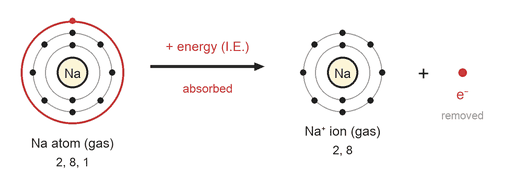
Step 3 — Rule out the other two choices.
Electron affinity is the energy released when an atom gains an electron, and electronegativity is the pull of an atom on a shared pair of electrons in a compound. Neither is the energy needed to remove an electron.
Watch out: Energy is ABSORBED in ionisation (taken in) but RELEASED when electron affinity is measured; do not swap them.
Therefore, the energy is called ionisation potential (ionisation energy).
- 75 marks
Question 7
Match the atomic number 2, 4, 8, 15, and 19 with each of the following:
(i) A solid non metal belonging to the third period.
(ii) A metal of valency 1.
(iii) A gaseous element with valency 2.
(iv) An element belonging to Group 2.
(v) A rare gas.
Solve with AIWritten solution
Solution:
Concept: For the first 20 elements, the number of shells in an atom gives its period, and the number of electrons in its outermost (valence) shell gives its group: 1 or 2 valence electrons → group 1 or 2; 3 to 8 valence electrons → group 13 to 18 (add 10). Valency is the number of electrons an atom loses, gains or shares to reach a stable octet (a duplet for the first shell). Atoms with 1, 2 or 3 valence electrons lose them, so their valency equals the number of valence electrons; atoms with 5, 6 or 7 gain electrons, so their valency is 8 minus that number.
Step 1 — Write each configuration.
We fill the shells 2, 8, 8 in order for each atomic number and read off the period and the group.
Atomic number Configuration Period Group Element 2 2 1 18 helium 4 2, 2 2 2 beryllium 8 2, 6 2 16 oxygen 15 2, 8, 5 3 15 phosphorus 19 2, 8, 8, 1 4 1 potassium Step 2 — (i) A solid non-metal of the third period.
Only atomic number 15 has three shells (period 3). It has five valence electrons, and phosphorus is a solid non-metal, so the answer is 15.
Step 3 — (ii) A metal of valency 1.
Atomic number 19 has one valence electron, which it loses to form K⁺, so its valency is 1. The answer is 19.
Step 4 — (iii) A gaseous element with valency 2.
Atomic number 8 has six valence electrons and gains two more to complete its octet, so its valency is 8 − 6, that is 2. Oxygen is a gas, so the answer is 8.
Step 5 — (iv) An element of group 2.
Atomic number 4 (2, 2) has two valence electrons in its outer shell, so it is in group 2. The answer is 4.
Step 6 — (v) A rare gas.
Atomic number 2 has one shell, and that shell is complete with two electrons (a duplet). Helium is a rare (noble) gas, so the answer is 2.
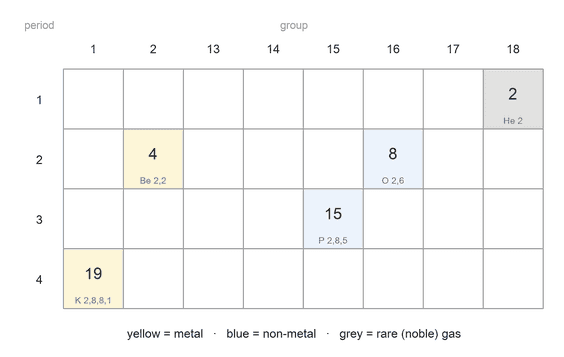
Watch out: Beryllium (4) also has valency 2, but it is a solid metal; the GASEOUS element with valency 2 is oxygen (8).
Therefore, (i) 15, (ii) 19, (iii) 8, (iv) 4, (v) 2.
- 84 marks
Question 8
Arrange the following as per the instruction given in the brackets:
(i) He, Ar, Ne (Increasing order of the number of electron shells)
(ii) Na, Li, K (Increasing Ionisation Energy)
(iii) F, Cl, Br (Increasing electronegativity)
(iv) Na, K, Li (Increasing atomic size)
Solve with AIWritten solution
Solution:
Concept: Down a group a new shell is added at each step, so the atomic size increases. The valence electrons are then farther from the nucleus, so ionisation energy and electronegativity decrease down a group. The number of shells equals the period number.
Step 1 — (i) Count the shells of He, Ar and Ne.
He (2), Ne (2, 8) and Ar (2, 8, 8) are in periods 1, 2 and 3, so they have 1, 2 and 3 shells. In increasing order of shells: He < Ne < Ar.
Step 2 — (ii) Order Na, Li and K by ionisation energy.
These are group 1 metals, Li at the top and K at the bottom. Ionisation energy falls down the group because the valence electron gets farther from the nucleus (Li 520, Na 496, K 419 kJ/mol). In increasing order: K < Na < Li.
Step 3 — (iii) Order F, Cl and Br by electronegativity.
These are group 17 elements, F at the top. Electronegativity decreases down the group because a larger atom pulls a shared pair less strongly (F 4.0, Cl 3.0, Br 2.8). In increasing order: Br < Cl < F.
Step 4 — (iv) Order Na, K and Li by atomic size.
These are group 1 metals; one shell is added at each step down the group (Li 152, Na 186, K 231 pm). In increasing order: Li < Na < K.
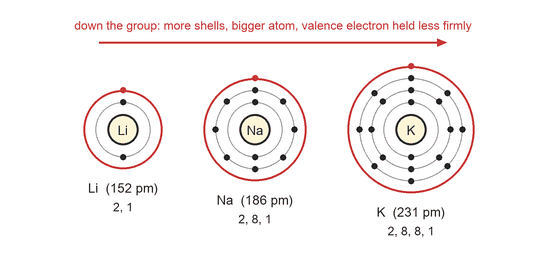
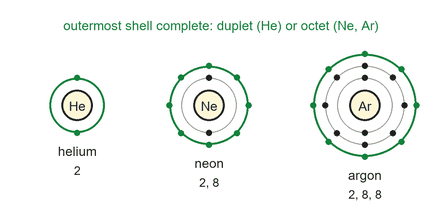
The first figure draws Li, Na and K to their radii; the second shows the 1, 2 and 3 shells of He, Ne and Ar.
Watch out: Parts (ii) and (iv) give OPPOSITE orders for the same group 1 metals: the biggest atom (K) has the smallest ionisation energy.
Therefore, (i) He < Ne < Ar; (ii) K < Na < Li; (iii) Br < Cl < F; (iv) Li < Na < K.
- 91 mark
Question 9
Give one word or a phrase for the following statements:
The energy released when an electron is added to a neutral gaseous isolated atom to form a negatively charged ion.
Solve with AIWritten solution
Solution:
Concept: Electron affinity is the energy released when a neutral isolated gaseous atom accepts an electron to form an anion. A small atom with a large nuclear charge attracts the extra electron strongly, so electron affinity increases across a period and decreases down a group.
Step 1 — Read what the statement describes.
The statement describes the energy given out when a neutral, isolated gaseous atom takes in one extra electron and becomes a negative ion.
Step 2 — Name the energy.
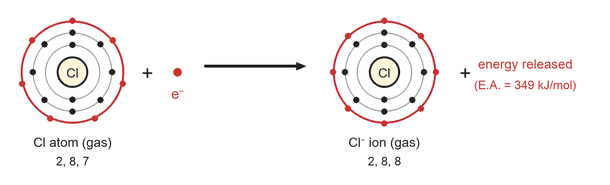
This energy is called electron affinity. For chlorine the change is:
Step 3 — See its size.
For chlorine the energy released is 349 kJ/mol, the highest electron affinity of all the elements.
Watch out: Ionisation potential is the energy needed to REMOVE an electron; electron affinity is the energy RELEASED when an electron is ADDED.
Therefore, the energy is called electron affinity.
- 105 marks
Question 10
Give a reason for each of the following:
(i) Ionic compounds have a high melting point.
(ii) Inert gases do not form ions.
(iii) Ionisation potential increases across a period, from left to right.
(iv) Alkali metals are good reducing agents.
(v) Conductivity of dilute hydrochloric acid is greater than that of acetic acid.
Solve with AIWritten solution
Solution:
Concept: Each reason comes from three things: the size of the atom, its nuclear charge, and how stable its electron arrangement is. For part (v), the more free ions a solution has, the better it conducts electricity.
Step 1 — (i) Ionic compounds have a high melting point.
An ionic compound is a lattice of positive and negative ions held together by strong electrostatic forces of attraction acting in all directions. A large amount of heat energy is needed to break these forces and let the ions move, so the melting point is high (sodium chloride melts at about 801 °C).
Step 2 — (ii) Inert gases do not form ions.
The outermost shell of an inert gas is already complete: a duplet in helium and an octet in the others. This stable arrangement gives them a very high ionisation potential and zero electron affinity, so they have no tendency to lose or gain electrons, and therefore they form no ions.
Step 3 — (iii) Ionisation potential increases across a period.
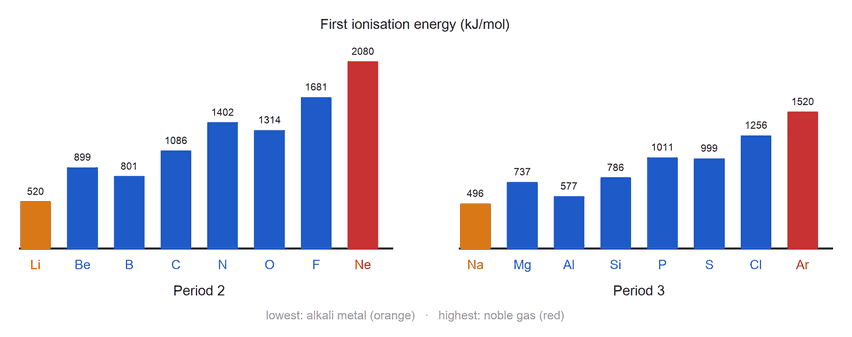
Across a period the number of shells stays the same, but the nuclear charge increases by one at each step. The electrons are pulled closer, the atomic size decreases, and the valence electrons are held more firmly. More energy is therefore needed to remove one (period 3 rises from Na 496 to Ar 1520 kJ/mol).
Step 4 — (iv) Alkali metals are good reducing agents.
An alkali metal has one valence electron, a large atom and a low ionisation potential, so it loses that electron very easily. A substance that readily gives electrons to another substance is a reducing agent:
Step 5 — (v) Dilute hydrochloric acid conducts better than acetic acid.
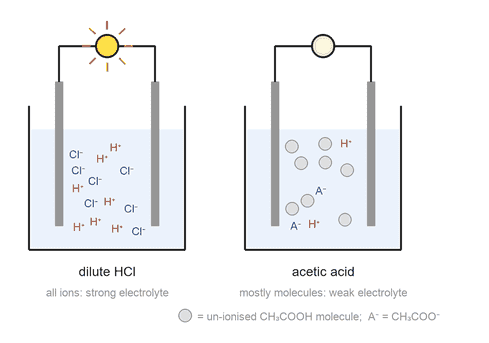
Hydrochloric acid is a strong acid (a strong electrolyte): in dilute solution it is almost completely ionised, so it gives many free ions to carry the current.
Acetic acid is a weak acid (a weak electrolyte): it is only partly ionised, so its solution holds mostly molecules and only a few ions.
More ions carry more current, so dilute hydrochloric acid conducts better (at the same concentration).
Watch out: In (v) both acids are dilute; the difference is the DEGREE of ionisation, not how much water is present.
Therefore, (i) strong electrostatic forces between the ions need much energy to break; (ii) inert gases already have a complete outer shell; (iii) the nuclear charge rises while the size falls; (iv) alkali metals lose their single valence electron very easily; (v) HCl is almost fully ionised, acetic acid only partly.
- 113 marks
Question 11
In Period 3 of the Periodic Table, element B is placed to the left of element A.
On the basis of this information, choose the correct word from the brackets to complete the following statements:
(i) The element B would have (lower / higher) metallic character than A.
(ii) The element A would probably have (lesser / higher) electron affinity than B.
(iii) The element A would have (greater / smaller) atomic size than B.
Solve with AIWritten solution
Solution:
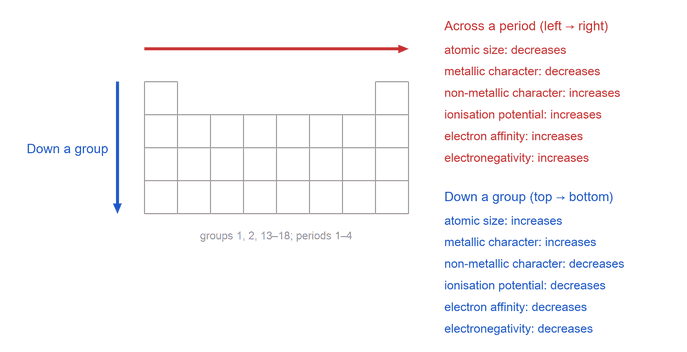
Concept: B is to the left of A in period 3, so both have three shells but A has the larger nuclear charge. Across a period metallic character and atomic size decrease, and electron affinity increases.
Step 1 — (i) Compare metallic character.
Metallic character is the tendency to lose electrons. B, nearer the left of the period, has the smaller nuclear charge and the larger atom, so it loses electrons more easily: B has higher metallic character than A.
Step 2 — (ii) Compare electron affinity.
A has the larger nuclear charge and the smaller atom, so it attracts an extra electron more strongly and releases more energy: A would probably have higher electron affinity than B.
Step 3 — (iii) Compare atomic size.
The larger nuclear charge of A pulls its shells closer to the nucleus, so A has the smaller atomic size.
Watch out: The word 'probably' in (ii) allows for exceptions in the period (for example a noble gas, whose electron affinity is zero); the general trend is what is asked.
Therefore, (i) higher; (ii) higher; (iii) smaller.
- 121 mark
Question 12
The most electronegative element from the following elements is:
Solve with AIAnswer
(A) Magnesium
- Correct
(B) Chlorine
(C) Aluminium
(D) Sulphur
Answer: (B) Chlorine
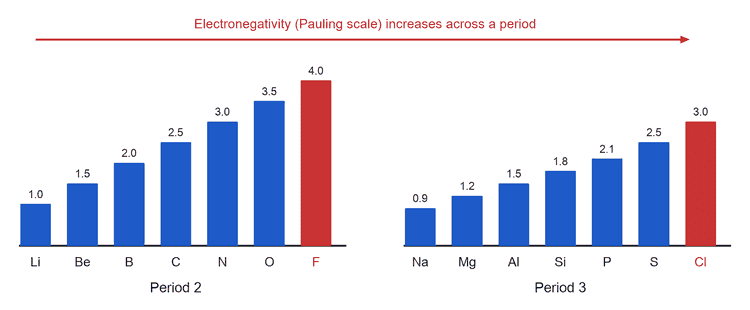
Concept: Electronegativity is the tendency of an atom in a molecule to attract the shared pair of electrons towards itself (Pauling scale, fluorine 4.0 the highest). It increases across a period and decreases down a group, for the same reasons as electron affinity.
Step 1 — Place the four elements.
Magnesium (group 2), aluminium (group 13), sulphur (group 16) and chlorine (group 17) are all in period 3, in that order from left to right.
Step 2 — Apply the trend.
Electronegativity increases from left to right across a period, so the element farthest to the right, chlorine, is the most electronegative. The Pauling values agree: Mg 1.2, Al 1.5, S 2.5, Cl 3.0.
Watch out: Sulphur is also a non-metal with a fairly high value, but chlorine lies to its right and is more electronegative.
Why the other options are wrong:
- (A) Magnesium: magnesium is a group 2 metal near the left of the period; its electronegativity is low (1.2) and it tends to lose electrons.
- (C) Aluminium: aluminium is a metal (1.5) to the left of chlorine, so its pull on a shared pair is weaker.
- (D) Sulphur: sulphur (2.5) is one place to the left of chlorine, so it is less electronegative than chlorine.
Therefore, the most electronegative of these elements is chlorine, option (B).
- 131 mark
Question 13
Fill in the blanks with the choices given in brackets:
In Period 3, the most metallic element is ............... (sodium / magnesium / aluminium)
Solve with AIWritten solution
Solution:
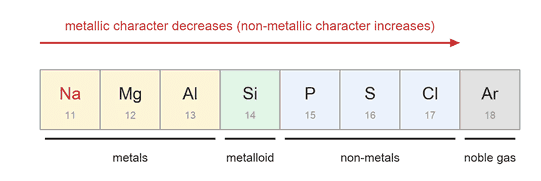
Concept: Metallic character is the tendency of an atom to lose electrons; non-metallic character is the tendency to gain them. Big atoms with few valence electrons lose electrons easily, so metallic character decreases across a period and increases down a group; non-metallic character does the opposite.
Step 1 — Place the three choices.
Sodium (2, 8, 1), magnesium (2, 8, 2) and aluminium (2, 8, 3) are the first three elements of period 3, in that order.
Step 2 — Pick the one that loses electrons most easily.
Sodium has the largest atom of the three (186 pm), only one valence electron and the lowest ionisation energy (496 kJ/mol), so it loses its electron most easily. It is therefore the most metallic.
Watch out: Aluminium has the most valence electrons of the three, but having more valence electrons makes an atom LESS metallic, not more.
Therefore, in Period 3, the most metallic element is sodium.
- 141 mark
Question 14
Give the appropriate term defined by the statements given below:
The tendency of an atom to attract electrons towards itself when combined in a covalent compound.
Solve with AIWritten solution
Solution:
Concept: Electronegativity is the tendency of an atom in a molecule to attract the shared pair of electrons towards itself (Pauling scale, fluorine 4.0 the highest). It increases across a period and decreases down a group, for the same reasons as electron affinity.
Step 1 — Read what the statement describes.
In a covalent compound the bonding electrons are shared, but they need not be shared equally. The statement asks for the name of an atom's pull on these shared electrons.
Step 2 — Name the property.
This tendency is called electronegativity. Fluorine has the highest value (4.0 on the Pauling scale).
Watch out: Do not answer 'electron affinity': that is an energy for an isolated gaseous atom, not a pull inside a compound.
Therefore, the term is electronegativity.
- 151 mark
Question 15
Arrange the following according to the instructions given in brackets:
Li, K, Na, H (In the decreasing order of their ionization potential)
Solve with AIWritten solution
Solution:
Concept: Ionisation energy (ionisation potential) is the energy needed to remove an electron from a neutral isolated gaseous atom. It is higher when the atom is small and the nuclear charge is large, so it increases across a period and decreases down a group.
Step 1 — Place the four elements.
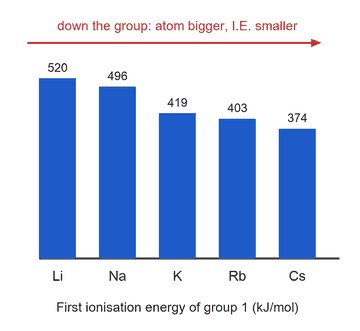
H, Li, Na and K each have one valence electron and are placed in group 1, from top to bottom in that order.
Step 2 — Apply the trend down the group.
Down a group a shell is added at each step, so the single valence electron is farther from the nucleus and easier to remove. Hydrogen has the smallest atom and holds its electron very firmly (about 1312 kJ/mol); then come Li 520, Na 496 and K 419 kJ/mol.
Watch out: The question asks for DECREASING order, so start with the highest value (hydrogen).
Therefore, the decreasing order of ionisation potential is H > Li > Na > K.
- 161 mark
Question 16
Arrange the following according to the instructions given in brackets:
F, B, N, O (In the increasing order of electron affinity)
Solve with AIWritten solution
Solution:
Concept: Electron affinity is the energy released when a neutral isolated gaseous atom accepts an electron to form an anion. A small atom with a large nuclear charge attracts the extra electron strongly, so electron affinity increases across a period and decreases down a group.
Step 1 — Place the elements.
B, N, O and F all lie in period 2, in that order from left to right (groups 13, 15, 16 and 17).
Step 2 — Apply the trend.
Moving from B to F the nuclear charge rises and the atom gets smaller, so each element attracts an extra electron more strongly than the one before it and releases more energy.
Step 3 — Write the order.
Following the trend, the increasing order is B < N < O < F, with fluorine (328 kJ/mol) the highest of the four.
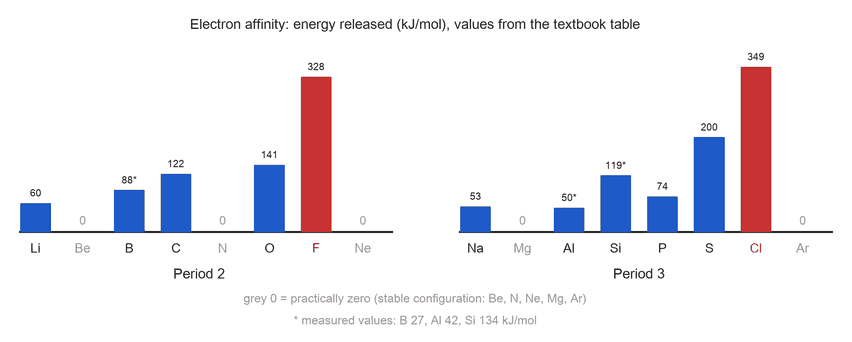
Watch out: Fluorine has the highest electron affinity of these four, but chlorine (349 kJ/mol), not fluorine, has the highest of all elements.
Note: B < N < O < F is the expected board answer, from the general period trend. Nitrogen is a known exception: its half-filled outer shell is stable, so its electron affinity is practically zero (the figure shows N as 0), lower than boron's (about 27 kJ/mol). The order of the actual values is therefore N < B < O < F.
Therefore, the increasing order of electron affinity is B < N < O < F.
- 174 marks
Question 17
Study the extract of the Periodic Table given below and answer the questions that follow.
Give the alphabet corresponding to the element in question. DO NOT repeat an element.
A C D E B G F (i) Which element forms electrovalent compound with G?
(ii) The ion of which element will migrate towards the cathode during electrolysis?
(iii) Which non-metallic element has the valency of 2?
(iv) Which is an inert gas?
Solve with AIWritten solution
Solution:
Concept: The extract has nine columns: groups 1 and 2, a column standing for the transition elements (groups 3–12), then groups 13 to 18. The column gives the group and the row gives the period. Each element may be used only once.
Step 1 — Place every letter.
We read the group and period of each letter before answering.
Letter Group Period A 1 1 B 2 3 C 13 2 D 15 2 E 16 2 G 17 3 F 18 3 Step 2 — (i) The element forming an electrovalent compound with G.
G is a group 17 non-metal that gains one electron. B is a group 2 metal that loses two electrons. Electrons pass from B to G, giving an electrovalent (ionic) compound, BG₂. The answer is B.
Step 3 — (ii) The ion that migrates towards the cathode.
The cathode is the negative electrode, so positive ions (cations) move towards it. A, in period 1 and group 1, is hydrogen; it forms the positive ion A⁺. B also forms a cation, but B is already used in (i), so the answer is A.
Step 4 — (iii) The non-metal with valency 2.
E is in group 16, so it has 6 valence electrons and gains 2 more to complete its octet; its valency is 8 − 6, that is 2. The answer is E.
Step 5 — (iv) The inert gas.
F is in group 18 (the zero group); its outer shell holds a complete octet, so it is an inert gas. The answer is F.
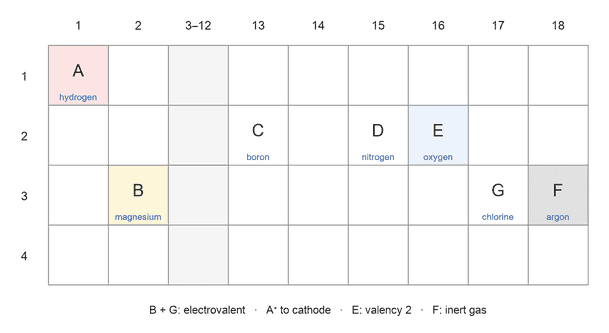
Watch out: The stem says 'DO NOT repeat an element', so B cannot be used again in (ii) even though it also forms a cation.
Therefore, (i) B; (ii) A; (iii) E; (iv) F.
- 181 mark
Question 18
The element with highest ionization potential, is:
Solve with AIAnswer
(A) Hydrogen
(B) Caesium
(C) Radon
- Correct
(D) Helium
Answer: (D) Helium
Concept: Ionisation energy (ionisation potential) is the energy needed to remove an electron from a neutral isolated gaseous atom. It is higher when the atom is small and the nuclear charge is large, so it increases across a period and decreases down a group.
Step 1 — Find where ionisation potential is highest.
Ionisation potential is highest at the top right of the periodic table, where atoms are small and the outer shell is complete.
Step 2 — Look at helium.
Helium is the first noble gas. Its atom is tiny, and its two electrons form a complete, stable duplet very close to the nucleus. Removing one of them needs more energy than for any other element: 2372 kJ/mol.
Watch out: Radon is also a noble gas, but at the BOTTOM of group 18; being a noble gas is not enough, the atom must also be small.
Why the other options are wrong:
- (A) Hydrogen: hydrogen has one electron in the first shell; its ionisation energy (1312 kJ/mol) is high but well below helium's, because helium has twice the nuclear charge pulling on the same shell.
- (B) Caesium: caesium is a large group 1 atom with one loosely held valence electron; its ionisation energy is among the lowest of all elements (374 kJ/mol).
- (C) Radon: radon is a noble gas at the bottom of group 18; its large atom holds its outer electrons far less firmly than helium does.
Therefore, the element with the highest ionisation potential is helium, option (D).
- 191 mark
Question 19
Give one word or a phrase for the following statements:
(iv) The tendency of an atom to attract electrons to itself when combined in a compound.
Solve with AIWritten solution
Solution:
Concept: Electronegativity is the tendency of an atom in a molecule to attract the shared pair of electrons towards itself (Pauling scale, fluorine 4.0 the highest). It increases across a period and decreases down a group, for the same reasons as electron affinity.
Step 1 — Read what the statement describes.
In a compound, atoms that share electrons do not pull on them equally. The statement asks for the name of an atom's pull on those electrons.
Step 2 — Name the property.
This tendency is called electronegativity. It increases across a period and decreases down a group.
Watch out: Electronegativity is a tendency with no unit; electron affinity is an energy in kJ/mol.
Therefore, the term is electronegativity.
- 203 marks
Question 20
The following table represent the elements and the atomic number.
With reference to this, answer the following using only the alphabets given in the table.
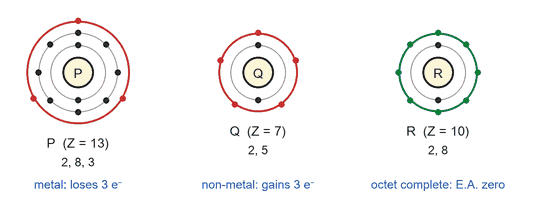
Element Atomic number P 13 Q 7 R 10 (i) Which element combines with hydrogen to form a basic gas?
(ii) Which element has an electron affinity zero?
(iii) Name the element, which forms an ionic compound with chlorine.
Solve with AIWritten solution
Solution:
Concept: Write the electronic configuration of each element first. Elements with 1–3 valence electrons are metals, those with 4–7 are non-metals, and an element with a complete octet is a noble gas.
Step 1 — Write the configurations.
We fill the shells in order: P (13) is 2, 8, 3; Q (7) is 2, 5; R (10) is 2, 8.
Step 2 — (i) The element giving a basic gas with hydrogen.
Q has 5 valence electrons, so it is a non-metal of group 15 (nitrogen). It combines with hydrogen to form ammonia, the only common basic gas. The answer is Q.
Step 3 — (ii) The element with zero electron affinity.
R (2, 8) already has a complete octet (it is the noble gas neon), so it has no tendency to accept an extra electron. Its electron affinity is zero, and the answer is R.
Step 4 — (iii) The element forming an ionic compound with chlorine.
P (2, 8, 3) is a metal (aluminium) that loses its 3 valence electrons, while each chlorine atom gains one. P therefore combines with chlorine to form the chloride AlCl₃, and the answer is P:
Q is a non-metal and R is inert, so neither forms an ionic chloride.
Watch out: Use the letters only in the final answer; the element names are given in the steps just to explain.
Note: Anhydrous aluminium chloride in fact shows considerable covalent character, but P is the only metal in the table and is the expected answer.
Therefore, (i) Q; (ii) R; (iii) P.
- 213 marks
Question 21
Name the following elements:
(i) An alkaline earth metal present in group 2 and period 3.
(ii) A trivalent metal used to make light tools.
(iii) A monovalent non-metal present in fluorspar.
Solve with AIWritten solution
Solution:
Concept: For the first 20 elements, the number of shells in an atom gives its period, and the number of electrons in its outermost (valence) shell gives its group: 1 or 2 valence electrons → group 1 or 2; 3 to 8 valence electrons → group 13 to 18 (add 10).
Step 1 — (i) The alkaline earth metal of group 2, period 3.
Group 2 elements are the alkaline earth metals. Period 3 means three shells, and group 2 means two valence electrons, so the configuration is 2, 8, 2: magnesium.
Step 2 — (ii) The trivalent metal used for light tools.
A trivalent metal has valency 3, that is three valence electrons (2, 8, 3). Aluminium is light and strong, so it and its alloys are used for light tools, utensils and aircraft parts.
Step 3 — (iii) The monovalent non-metal in fluorspar.
Fluorspar is calcium fluoride, . The non-metal in it, fluorine (2, 7), gains one electron, so its valency is 1.
The figure shows magnesium and aluminium among the metals of period 3.
Watch out: Calcium is also an alkaline earth metal, but it is in period 4, not period 3.
Therefore, (i) magnesium; (ii) aluminium; (iii) fluorine.
- 221 mark
Question 22
An element in period 3, whose electron affinity is zero:
Solve with AIAnswer
(A) Neon
(B) Sulphur
(C) Sodium
- Correct
(D) Argon
Answer: (D) Argon
Concept: Electron affinity is the energy released when a neutral isolated gaseous atom accepts an electron to form an anion. A small atom with a large nuclear charge attracts the extra electron strongly, so electron affinity increases across a period and decreases down a group. A noble gas already has a complete outer shell, so it has no tendency to accept an extra electron: its electron affinity is taken as zero.
Step 1 — Use both conditions in the stem.
The element must be in period 3 and must have zero electron affinity.
Step 2 — Find the noble gas of period 3.
Argon (2, 8, 8) is the noble gas of period 3, and its octet is complete. An extra electron would have to go into a new shell, so no energy is released: its electron affinity is zero.
Watch out: Neon also has zero electron affinity, but it is in period 2; check the period as well as the property.
Why the other options are wrong:
- (A) Neon: neon's electron affinity is also zero, but neon (2, 8) is in period 2, not period 3.
- (B) Sulphur: sulphur is a non-metal that readily gains two electrons; its electron affinity is high (200 kJ/mol).
- (C) Sodium: sodium has a small electron affinity (53 kJ/mol), not zero.
Therefore, the period 3 element with zero electron affinity is argon, option (D).
- 231 mark
Question 23
An element with the largest atomic radius among the following is:
Solve with AIAnswer
(A) Carbon
(B) Nitrogen
- Correct
(C) Lithium
(D) Beryllium
Answer: (C) Lithium
Concept: Atomic size (atomic radius) depends on the number of shells and on the nuclear charge. Down a group a new shell is added at each step, so atoms get bigger; across a period the shells stay the same while the nuclear charge rises, so atoms get smaller.
Step 1 — Place the four elements.
Lithium (3), beryllium (4), carbon (6) and nitrogen (7) are all in period 2, so they all have two shells.
Step 2 — Apply the trend across the period.
With the same number of shells, the element with the smallest nuclear charge pulls its electrons in least. Lithium, the first element of the period, is therefore the largest. Book radii: Li 152, Be 112, C 77, N 70 pm.
Watch out: A larger atomic NUMBER does not mean a larger atom within a period; across a period the size falls.
Why the other options are wrong:
- (A) Carbon: carbon's 6 protons pull its two shells in more strongly than lithium's 3 protons do; its radius is 77 pm.
- (B) Nitrogen: nitrogen is farther right still, with an even larger nuclear charge; at 70 pm it is the smallest of the four.
- (D) Beryllium: beryllium is next to lithium, but its 4 protons make it smaller (112 pm).
Therefore, the element with the largest atomic radius is lithium, option (C).
- 241 mark
Question 24
State the terms/process for the following:
(a) The energy released when an atom in the gaseous state accepts an electron to form an anion.
Solve with AIWritten solution
Solution:
Concept: Electron affinity is the energy released when a neutral isolated gaseous atom accepts an electron to form an anion. A small atom with a large nuclear charge attracts the extra electron strongly, so electron affinity increases across a period and decreases down a group.
Step 1 — Read what the statement describes.
The statement describes the energy released when a gaseous atom accepts one electron and becomes an anion (a negative ion).
Step 2 — Name the energy.
This energy is called electron affinity. For chlorine:
Electron affinity increases across a period and decreases down a group.
Watch out: The energy here is RELEASED (given out); the energy needed to remove an electron is the ionisation potential.
Therefore, the term is electron affinity.
- 253 marks
Question 25
Arrange the following as per the instruction given in the brackets:
(a) Al, K, Mg, Ca (decreasing order of its reactivity)
(b) N, Be, O, C (increasing order of non-metallic character)
(c) P, Si, F, Be (decreasing order of valence electrons)
Solve with AIWritten solution
Solution:
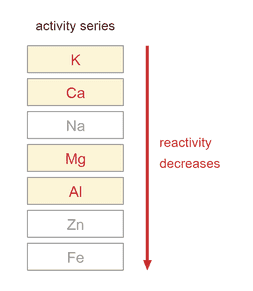
Concept: (a) uses the activity (reactivity) series of metals; (b) uses the trend that non-metallic character increases across a period; (c) needs the number of valence electrons, read from each configuration.
Step 1 — (a) Order the metals by reactivity.
In the activity series potassium comes first, then calcium, then magnesium, then aluminium. A metal higher in the series loses its electrons more easily and reacts more vigorously, so the decreasing order is K > Ca > Mg > Al.
Step 2 — (b) Order by non-metallic character.
Be (4), C (6), N (7) and O (8) are all in period 2. Non-metallic character, the tendency to gain electrons, increases from left to right as the nuclear charge rises and the atom shrinks. The increasing order is Be < C < N < O.
Step 3 — (c) Order by valence electrons.
We read the last shell of each configuration: F (2, 7) has 7, P (2, 8, 5) has 5, Si (2, 8, 4) has 4 and Be (2, 2) has 2 valence electrons. The decreasing order is F > P > Si > Be.
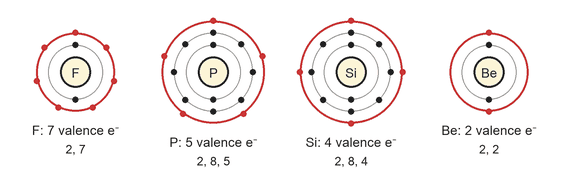
Watch out: In (c) count only the electrons of the OUTERMOST shell, not the total number of electrons (P has 15 electrons but only 5 valence electrons).
Therefore, (a) K > Ca > Mg > Al; (b) Be < C < N < O; (c) F > P > Si > Be.
- 261 mark
Question 26
Define / State:
(a) Electronegativity
Solve with AIWritten solution
Solution:
Concept: When two different atoms share a pair of electrons, the pair is not always shared equally. Electronegativity measures how strongly each atom pulls on it.
Step 1 — State the definition.
Electronegativity is the tendency of an atom in a molecule to attract the shared pair of electrons towards itself.
Step 2 — Add what the definition means.
It is a tendency, not an energy, so it has no unit; it is given as a number on the Pauling scale, on which fluorine has the highest value (4.0). It increases across a period and decreases down a group.
Watch out: Do not define it as an energy (that is electron affinity), and do not leave out 'shared pair' or 'in a molecule'.
Therefore, electronegativity is the tendency of an atom in a molecule to attract the shared pair of electrons towards itself.
- 271 mark
Question 27
Give reason for the following:
(a) Ionisation potential decreases down a group.
Solve with AIWritten solution
Solution:
Concept: Ionisation energy (ionisation potential) is the energy needed to remove an electron from a neutral isolated gaseous atom. It is higher when the atom is small and the nuclear charge is large, so it increases across a period and decreases down a group.
Step 1 — See what changes down a group.
Moving down a group, a new shell is added at each step, so the atomic size increases. The nuclear charge also increases, but the effect of the larger size (and of the extra inner shells screening the nucleus) is greater.
Step 2 — Link the size to the ionisation potential.
The valence electrons are therefore farther from the nucleus and are held less firmly, so less energy is needed to remove one. Group 1 shows this: Li 520, Na 496, K 419, Rb 403, Cs 374 kJ/mol.
Watch out: The nuclear charge DOES increase down a group; the reason is that the growth in size outweighs it.
Therefore, ionisation potential decreases down a group because the atomic size increases, so the valence electrons are farther from the nucleus and held less firmly.
- 281 mark
Question 28
In the 2nd period Neon has maximum Ionization Potential because:
Solve with AIAnswer
(A) It has unstable electronic configuration.
(B) It easily accepts electrons.
(C) It easily loses electrons.
- Correct
(D) The outer most shell is completely filled.
Answer: (D) The outer most shell is completely filled.
Concept: Ionisation energy (ionisation potential) is the energy needed to remove an electron from a neutral isolated gaseous atom. It is higher when the atom is small and the nuclear charge is large, so it increases across a period and decreases down a group. A completely filled (octet) outer shell is the most stable electron arrangement, so it is the hardest to break.
Step 1 — Look at neon's electron arrangement.
Neon (2, 8) is the last element of period 2. It has the largest nuclear charge in its period, and its outer shell holds a complete octet.
Step 2 — Link this to the ionisation potential.
Removing an electron would break this stable, completely filled shell, and the electrons are held tightly by the large nuclear charge. So neon needs the most energy of all period 2 elements: 2080 kJ/mol.
Watch out: Ionisation potential is about LOSING an electron; whether an atom accepts electrons is a different property (electron affinity).
Why the other options are wrong:
- (A) It has unstable electronic configuration: neon's configuration is stable, not unstable; an unstable configuration would make the ionisation potential lower, not the highest.
- (B) It easily accepts electrons: neon does not accept electrons easily (its electron affinity is zero), and accepting electrons is not what ionisation potential measures.
- (C) It easily loses electrons: if neon lost electrons easily, its ionisation potential would be low, not the maximum.
Therefore, neon has the maximum ionisation potential because its outermost shell is completely filled, option (D).
- 291 mark
Question 29
Electron Affinity is maximum in:
Solve with AIAnswer
(A) Mg
(B) Ar
(C) Li
- Correct
(D) Br
Answer: (D) Br
Concept: Electron affinity is the energy released when a neutral isolated gaseous atom accepts an electron to form an anion. A small atom with a large nuclear charge attracts the extra electron strongly, so electron affinity increases across a period and decreases down a group. It is highest for the halogens (group 17), which need just one electron to complete their octet.
Step 1 — Find the halogen.
Bromine (2, 8, 18, 7) is a halogen of group 17. It needs one electron to complete its octet, so it gains one readily and releases a large amount of energy (about 325 kJ/mol).
Step 2 — Compare with the others.
Magnesium and argon have practically zero electron affinity, and lithium's is small (60 kJ/mol), so bromine has the maximum electron affinity of the four.
Watch out: Electron affinity decreases DOWN group 17, but bromine is still far above any metal or noble gas.
Why the other options are wrong:
- (A) Mg: magnesium (2, 8, 2) has a stable, filled pair of outer electrons and is a metal that loses electrons; its electron affinity is practically zero.
- (B) Ar: argon is a noble gas with a complete octet; its electron affinity is zero.
- (C) Li: lithium is an alkali metal, which tends to lose electrons rather than gain them; its electron affinity is small (60 kJ/mol).
Therefore, the electron affinity is maximum in bromine, option (D).
- 301 mark
Question 30
Match the Column A with Column B:
Column A: (b) Alkali metal
Column B:
-
Lithium
-
Iodine
-
Covalent compound
-
Acetic acid
-
Ionic compound
-
Sulphuric acid
Solve with AIWritten solution
Solution:
Concept: Alkali metals are the elements of group 1 apart from hydrogen: lithium, sodium, potassium, rubidium, caesium and francium. Each has one valence electron.
Step 1 — Look for a group 1 metal in Column B.
Of the six entries, only lithium is an element of group 1; iodine is a halogen and the rest are kinds of compounds or acids.
Step 2 — Check that lithium behaves as an alkali metal.
Lithium (2, 1) has one valence electron, which it loses to form Li⁺. Like every alkali metal it reacts with water to form an alkali, lithium hydroxide:
Watch out: Hydrogen is placed in group 1 but is NOT an alkali metal; it is a non-metal.
Therefore, (b) Alkali metal matches with 1. Lithium.
-
- 311 mark
Question 31
Match the Column A with Column B:
Column A: (c) Halogen
Column B:
-
Lithium
-
Iodine
-
Covalent compound
-
Acetic acid
-
Ionic compound
-
Sulphuric acid
Solve with AIWritten solution
Solution:
Concept: Halogens are the elements of group 17: fluorine, chlorine, bromine, iodine and astatine. Each has 7 valence electrons and gains one electron to complete its octet.
Step 1 — Look for a group 17 element in Column B.
Of the six entries, only iodine is an element of group 17; lithium is an alkali metal and the rest are kinds of compounds or acids.
Step 2 — Check that iodine behaves as a halogen.
Iodine (2, 8, 18, 18, 7) has 7 valence electrons, so it gains one electron to form the iodide ion I⁻. It is the halogen of period 5 and is a solid at room temperature.
Watch out: Do not match 'Covalent compound' here: the halogen is an ELEMENT, and iodine is the only halogen listed.
Therefore, (c) Halogen matches with 2. Iodine.
-
- 321 mark
Question 32
State the terms for the following:
(d) The tendency of an atom to pull a shared pair of electrons towards itself in a compound.
Solve with AIWritten solution
Solution:
Concept: Electronegativity is the tendency of an atom in a molecule to attract the shared pair of electrons towards itself (Pauling scale, fluorine 4.0 the highest). It increases across a period and decreases down a group, for the same reasons as electron affinity.
Step 1 — Read what the statement describes.
The statement asks for the name of an atom's pull on a shared pair of electrons when it is part of a compound.
Step 2 — Name the property.
This tendency is called electronegativity. It increases across a period and decreases down a group; fluorine (4.0) is the most electronegative element.
Watch out: Electron affinity is the energy released by an isolated gaseous atom; it is not about a shared pair.
Therefore, the term is electronegativity.
- 333 marks
Question 33
Arrange the following as per the instructions given in the brackets:
(a) Carbon, Fluorine, Beryllium (decreasing order of atomic size)
(b) Sulphuric acid, Phosphoric acid, Acetic acid (increasing order of number of replaceable H atoms per molecule)
(c) Potassium, Lithium, Sodium (increasing order of ionization potential)
Solve with AIWritten solution
Solution:
Concept: (a) and (c) follow periodic trends. (b) asks for the basicity of each acid: the number of replaceable hydrogen atoms (hydrogen ions) one molecule can give.
Step 1 — (a) Order carbon, fluorine and beryllium by size.
Be (4), C (6) and F (9) are all in period 2. Atomic size decreases from left to right as the nuclear charge rises (Be 112, C 77, F 64 pm), so the decreasing order is Beryllium > Carbon > Fluorine.
Step 2 — (b) Count the replaceable hydrogen atoms.
Acetic acid is monobasic: only the H of its –COOH group ionises, not the three H atoms of its CH₃ group.
Sulphuric acid is dibasic: overall, one molecule gives two hydrogen ions.
Phosphoric acid is tribasic: overall, one molecule can give three hydrogen ions.
So the increasing order is Acetic acid < Sulphuric acid < Phosphoric acid (1, 2 and 3).
Step 3 — (c) Order potassium, lithium and sodium by ionisation potential.
All three are group 1 metals. Ionisation potential decreases down the group as the atom gets bigger (Li 520, Na 496, K 419 kJ/mol), so the increasing order is Potassium < Sodium < Lithium.
Watch out: Acetic acid, CH₃COOH, has four hydrogen atoms but only ONE is replaceable; the basicity is not the total number of H atoms. (The equations for H₂SO₄ and H₃PO₄ show the overall change; each H⁺ actually comes off in a separate step.)
Therefore, (a) Beryllium > Carbon > Fluorine; (b) Acetic acid < Sulphuric acid < Phosphoric acid; (c) Potassium < Sodium < Lithium.
- 343 marks
Question 34
Identify the following:
(a) An element in period 1 which can be placed in both group 1 and group 17 of the Periodic Table.
(b) The element having electronic configuration 2, 8, 6.
(c) The most electronegative element of period 3.
Solve with AIWritten solution
Solution:
Concept: For the first 20 elements, the number of shells in an atom gives its period, and the number of electrons in its outermost (valence) shell gives its group: 1 or 2 valence electrons → group 1 or 2; 3 to 8 valence electrons → group 13 to 18 (add 10).
Step 1 — (a) The period 1 element that fits both group 1 and group 17.
Hydrogen (1 electron) is in period 1. Like the group 1 metals it has one valence electron and can lose it to form H⁺; like the group 17 halogens it is one electron short of a stable shell (the duplet of helium) and can gain one to form H⁻. So hydrogen can be placed in both groups: hydrogen.
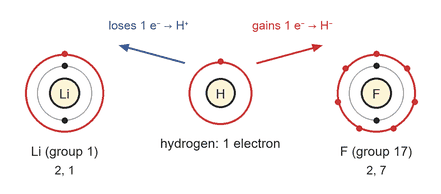
Step 2 — (b) The element with configuration 2, 8, 6.
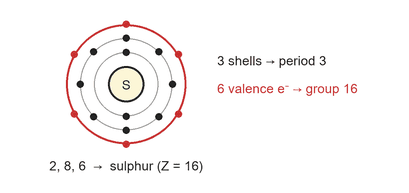
The configuration 2, 8, 6 has three shells (period 3) and six valence electrons (group 16). Adding the electrons gives 2 + 8 + 6, that is 16, so the atomic number is 16: sulphur.
Step 3 — (c) The most electronegative element of period 3.
Electronegativity increases across a period, so the group 17 element at the right of period 3, chlorine (3.0), is the most electronegative. Argon, the noble gas, has a complete octet and is not counted.
Watch out: In (c) do not choose argon just because it is last in the period; noble gases are left out of electronegativity comparisons.
Therefore, (a) hydrogen; (b) sulphur; (c) chlorine.
- 351 mark
Question 35
Assertion (A): The tendency of losing electrons increases down the Group.
Reason (R): The most reactive metal is placed at the top of Group 1.
Solve with AIAnswer
(A) Both (A) and (R) are true, and (R) is the correct explanation of (A).
(B) Both (A) and (R) are true, and (R) is not the correct explanation of (A).
- Correct
(C) (A) is true but (R) is false.
(D) (A) is false but (R) is true.
Answer: (C) (A) is true but (R) is false.
Concept: In an assertion–reason item, judge the assertion (A) and the reason (R) separately as true or false, and only then decide whether R correctly explains A.
Step 1 — Judge the Assertion.
Down a group the atomic size increases, so the valence electrons are farther from the nucleus and held less firmly. The tendency to lose electrons therefore increases down a group. The Assertion is true.
Step 2 — Judge the Reason.
Since metals react by losing electrons, the reactivity of metals increases down a group. The most reactive metal of group 1 is therefore at the bottom, not at the top; lithium, at the top, is the least reactive alkali metal. The Reason is false.
Watch out: The Reason sounds like the Assertion, but it puts the most reactive metal at the wrong end of the group.
Why the other options are wrong:
- (A) Both (A) and (R) are true, and (R) is the correct explanation of (A): this says the Reason is true, but the most reactive metal is at the bottom of group 1, not the top.
- (B) Both (A) and (R) are true, and (R) is not the correct explanation of (A): this also says the Reason is true, which it is not.
- (D) (A) is false but (R) is true: this says the Assertion is false, but the tendency to lose electrons really does increase down a group.
Therefore, the Assertion is true and the Reason is false, option (C).
- 361 mark
Question 36
X, Y & Z are three metallic atoms in successive order belonging to the same group such that atomic radii of ‘X’ is the smallest. Which of the three atoms is the best reducing agent?
Solve with AIAnswer
(A) X
(B) Y
- Correct
(C) Z
(D) All three have the same reducing power.
Answer: (C) Z
Concept: A reducing agent is an electron donor (it loses electrons and is itself oxidised); an oxidising agent is an electron acceptor (it gains electrons and is itself reduced). The more easily a metal atom loses its valence electrons, the stronger a reducing agent it is.
Step 1 — Work out which atom is largest.
X, Y and Z are in successive order in one group, and X has the smallest radius, so X is at the top. Y has one more shell than X, and Z one more shell than Y, so Z is the largest atom.
Step 2 — Link size to reducing power.
In the largest atom the valence electrons are farthest from the nucleus and held least firmly, so they are lost most easily (lowest ionisation potential). Losing electrons most easily makes Z the best reducing agent.
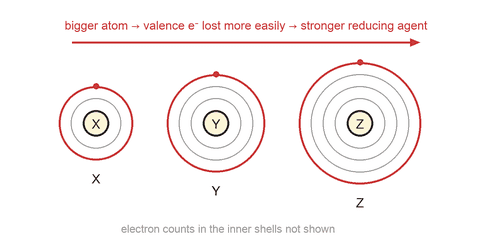
Watch out: A smaller radius means a STRONGER hold on the electrons, so the smallest atom (X) is the WEAKEST reducing agent.
Why the other options are wrong:
- (A) X: X is the smallest atom and holds its valence electrons most firmly, so it is the weakest reducing agent of the three.
- (B) Y: Y lies between X and Z, so it is a better reducing agent than X but not as good as Z.
- (D) All three have the same reducing power: the reducing power changes down a group because the atomic size changes, so the three are not equal.
Therefore, the best reducing agent is Z, option (C).
- 371 mark
Question 37
State the terms for the following:
The tendency of an atom to attract the shared pair of electrons towards itself when combined in a compound.
Solve with AIWritten solution
Solution:
Concept: Electronegativity is the tendency of an atom in a molecule to attract the shared pair of electrons towards itself (Pauling scale, fluorine 4.0 the highest). It increases across a period and decreases down a group, for the same reasons as electron affinity.
Step 1 — Read what the statement describes.
In a compound the shared pair of electrons is pulled more towards one atom than the other. The statement asks for the name of this pull.
Step 2 — Name the property.
It is called electronegativity. The more electronegative atom pulls the shared pair closer to itself and gets a slight negative charge (δ−).
Watch out: Electronegativity is a tendency with no unit; do not confuse it with electron affinity, which is an energy.
Therefore, the term is electronegativity.
- 382 marks
Question 38
The atomic number of two atoms ‘X’ and ‘Y’ are 14 and 8 respectively.
State:
(a) the period to which ‘X’ belongs.
(b) the formula of the compound formed between ‘X’ and ‘Y’. (Do not identify X and Y)
Solve with AIWritten solution
Solution:
Concept: For the first 20 elements, the number of shells in an atom gives its period, and the number of electrons in its outermost (valence) shell gives its group: 1 or 2 valence electrons → group 1 or 2; 3 to 8 valence electrons → group 13 to 18 (add 10). Valency is the number of electrons an atom loses, gains or shares to reach a stable octet (a duplet for the first shell). Atoms with 1, 2 or 3 valence electrons lose them, so their valency equals the number of valence electrons; atoms with 5, 6 or 7 gain electrons, so their valency is 8 minus that number.
Step 1 — Write the configurations.
We fill the shells in order: X (14) is 2, 8, 4 and Y (8) is 2, 6.
Step 2 — (a) Find the period of X.
X has electrons in three shells, and the number of shells gives the period, so X belongs to period 3.
Step 3 — (b) Find the two valencies.
X has 4 valence electrons, so its valency is 4. Y has 6 valence electrons and needs 2 more to complete its octet, so its valency is 8 − 6, that is 2.
Step 4 — (b) Write the formula.
Crossing over the valencies gives X₂Y₄. Dividing both numbers by their common factor 2 gives the simplest ratio, one X to two Y, so the formula is XY₂.
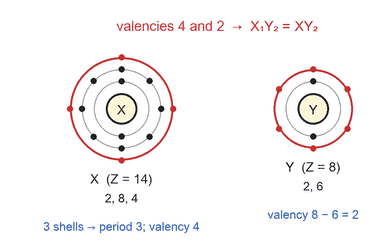
One atom of X shares its four valence electrons with two atoms of Y, so that every atom reaches an octet.
Watch out: After crossing over, always reduce to the simplest ratio: X₂Y₄ is written as XY₂.
Therefore, (a) X belongs to period 3; (b) the formula of the compound is XY₂.
- 393 marks
Question 39
Study the table given below. Use only the letters given in the table to answer the questions. Do not identify the elements.
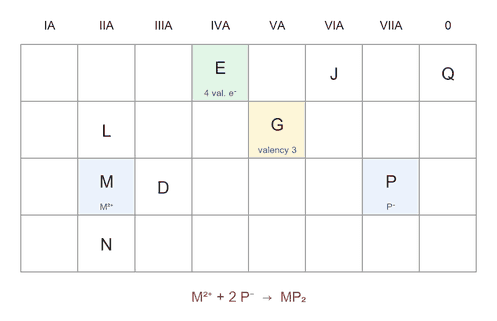
IA IIA IIIA IVA VA VIA VIIA 0 E J Q L G M D P N (a) State the valency of element ‘G’.
(b) Which element can exhibit catenation?
(c) Write the formula of the compound formed between ‘M’ and ‘P’.
Solve with AIWritten solution
Solution:
Concept: The column headings give each letter's group, and the group decides the number of valence electrons: IA has 1, IIA 2, … VIIA 7, and group 0 has a complete outer shell.
Step 1 — (a) Find the valency of G.
G is in group VA, so it has 5 valence electrons. It gains 3 more (8 − 5) to complete its octet, so the valency of G is 3.
Step 2 — (b) Find the element that shows catenation.
Catenation is the joining of atoms of the same element into long chains or rings by covalent bonds. E is at the top of group IVA: it has 4 valence electrons and forms four strong covalent bonds, including bonds with other atoms of its own kind, so E shows catenation.
Step 3 — (c) Work out the ions of M and P.
M is in group IIA, so it loses 2 electrons to form M²⁺. P is in group VIIA, so it gains 1 electron to form P⁻.
Step 4 — (c) Balance the charges.
Two P⁻ ions are needed to balance the charge of one M²⁺ ion, so the formula is MP₂:
Watch out: Use only the letters given, as the stem asks; do not name the elements.
Therefore, (a) the valency of G is 3; (b) E; (c) MP₂.
- 402 marks
Question 40
Given below are two sets of elements from two different periods. Name the element with the highest ionisation potential in each of the following sets.
(a) Al, Cl, Mg
(b) Ne, O, F
Solve with AIWritten solution
Solution:
Concept: Ionisation energy (ionisation potential) is the energy needed to remove an electron from a neutral isolated gaseous atom. It is higher when the atom is small and the nuclear charge is large, so it increases across a period and decreases down a group. The noble gas has the highest value of its period.
Step 1 — (a) Compare Al, Cl and Mg.
Al, Cl and Mg are all in period 3. Chlorine (group 17) is farthest to the right, so its atom is the smallest and its nuclear charge the largest. Book values: Mg 737, Al 577, Cl 1256 kJ/mol. The highest is Cl.
Step 2 — (b) Compare Ne, O and F.
Ne, O and F are all in period 2. Neon (group 18) is farthest to the right and has a complete octet. Book values: O 1314, F 1681, Ne 2080 kJ/mol. The highest is Ne.
Watch out: In (a) aluminium's value is LOWER than magnesium's, a small exception to the trend; it does not change the answer, since chlorine is far higher than both.
Therefore, (a) Cl; (b) Ne.
- 411 mark
Question 41
If an element has a low ionisation potential, it is most likely to be a:
Solve with AIAnswer
- Correct
(A) metal
(B) non-metal
(C) metalloid
(D) inert gas
Answer: (A) metal
Concept: Ionisation energy (ionisation potential) is the energy needed to remove an electron from a neutral isolated gaseous atom. It is higher when the atom is small and the nuclear charge is large, so it increases across a period and decreases down a group. Metallic character is the tendency of an atom to lose electrons; non-metallic character is the tendency to gain them. Big atoms with few valence electrons lose electrons easily, so metallic character decreases across a period and increases down a group; non-metallic character does the opposite.
Step 1 — Read what a low ionisation potential means.
A low ionisation potential means the valence electrons can be removed with little energy.
Step 2 — Match it to a kind of element.
Metals have large atoms and only 1, 2 or 3 valence electrons, which are held loosely, so their ionisation potentials are low. Losing electrons to form positive ions is the typical property of metals; the alkali metals have the lowest values (caesium 374 kJ/mol).
Watch out: A LOW ionisation potential goes with metals; noble gases have the HIGHEST values.
Why the other options are wrong:
- (B) non-metal: non-metals have small atoms and hold their electrons firmly; their ionisation potentials are high, and they tend to gain electrons.
- (C) metalloid: metalloids such as silicon (786 kJ/mol) have intermediate values, higher than typical metals.
- (D) inert gas: inert gases have the highest ionisation potentials, because their complete shells are very stable.
Therefore, an element with a low ionisation potential is most likely a metal, option (A).
- 421 mark
Question 42
Justify the following statements:
As one moves down a group, the reducing property of elements increases.
Solve with AIWritten solution
Solution:
Concept: A reducing agent is an electron donor (it loses electrons and is itself oxidised); an oxidising agent is an electron acceptor (it gains electrons and is itself reduced). The more easily an atom loses electrons, the stronger its reducing property.
Step 1 — See what happens to the size down a group.
Moving down a group, one new shell is added at each step, so the atomic size increases.
Step 2 — Link the size to losing electrons.
The valence electrons are therefore farther from the nucleus and held less firmly, so the ionisation potential decreases. The atoms lose electrons more easily.
Step 3 — Link losing electrons to reducing property.
An atom that loses electrons more easily is a better electron donor, that is a stronger reducing agent. So the reducing property increases down the group. In group 1, potassium is a stronger reducing agent than sodium, which is stronger than lithium:
Watch out: A reducing agent LOSES electrons (it is itself oxidised); do not say it gains them.
Therefore, the reducing property increases down a group because the atoms get bigger, their ionisation potential falls and they lose electrons more easily.
- 433 marks
Question 43
Arrange the following as per the instructions given in the brackets:
(a) Mg, S, Si, P [decreasing order of atomic size]
(b) Cl, I, Br, F [increasing electronegativity]
(c) K, Na, Rb, Li [decreasing metallic character]
Solve with AIWritten solution
Solution:
Concept: Across a period atomic size decreases. Down a group electronegativity decreases and metallic character increases.
Step 1 — (a) Order Mg, S, Si and P by atomic size.
Mg (12), Si (14), P (15) and S (16) are all in period 3. Atomic size decreases from left to right as the nuclear charge rises (Mg 160, Si 117, P 110, S 104 pm), so the decreasing order is Mg > Si > P > S.
Step 2 — (b) Order Cl, I, Br and F by electronegativity.
All four are halogens of group 17, with F at the top and I at the bottom. Electronegativity decreases down the group (F 4.0, Cl 3.0, Br 2.8, I 2.5), so the increasing order is I < Br < Cl < F.
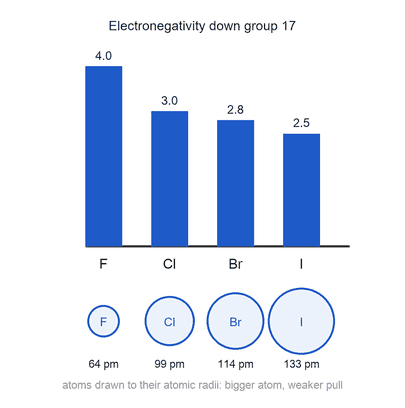
Step 3 — (c) Order K, Na, Rb and Li by metallic character.
All four are alkali metals of group 1, from Li at the top to Rb at the bottom. Metallic character increases down the group as the atom gets bigger and loses its valence electron more easily, so the decreasing order is Rb > K > Na > Li.
Watch out: (a) and (c) ask for DECREASING order and (b) for INCREASING order; read each bracket before writing.
Therefore, (a) Mg > Si > P > S; (b) I < Br < Cl < F; (c) Rb > K > Na > Li.
- 443 marks
Question 44
Elements P, Q, and R are in the same period of the modern periodic table.
-
P readily loses its one valence electron to form a stable ion.
-
Q shares its electrons in bonding but does not form ions easily.
-
R has high electronegativity.
Answer the following questions based on the above information:
(a) Which element would be most difficult to reduce among P, Q and R?
(b) Which element is expected to have the smallest atomic radius among P, Q and R?
(c) Arrange P, Q and R in order of decreasing ionisation potential.
Solve with AIWritten solution
Solution:
Concept: First decide where each element sits in the period. P loses one electron easily, so it is a group 1 metal at the left end. R has high electronegativity, so it is a non-metal near the right end. Q shares electrons and does not form ions easily, so it lies in the middle of the period. Across a period atomic size decreases while ionisation potential increases.
Step 1 — (a) Find the element hardest to reduce.
Reduction means gain of electrons. P readily loses its valence electron, so it has the least tendency of the three to gain electrons; it is itself a strong reducing agent. P is therefore the most difficult to reduce. (Read the other way, reducing the ion P⁺ back to the element is also hardest, because P is a highly reactive metal.)
Step 2 — (b) Find the smallest atom.
Across a period the nuclear charge increases while the number of shells stays the same, so atomic size decreases. R is farthest to the right, so it has the smallest atomic radius.
Step 3 — (c) Order by ionisation potential.
Ionisation potential increases from left to right across a period, so R (right) has the highest value and P (left) the lowest.
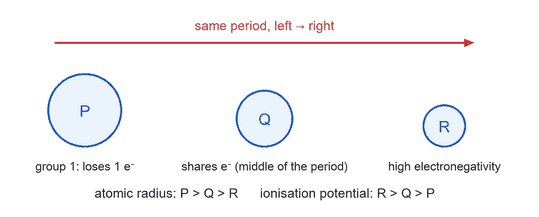
Watch out: R, which attracts electrons strongly, is the EASIEST to reduce, not the hardest.
Therefore, (a) P; (b) R; (c) R > Q > P.
-
- 451 mark
Question 45
Give reasons why:
Electronegativity increases across a period.
Solve with AIWritten solution
Solution:
Concept: Electronegativity is the tendency of an atom in a molecule to attract the shared pair of electrons towards itself (Pauling scale, fluorine 4.0 the highest). It increases across a period and decreases down a group, for the same reasons as electron affinity.
Step 1 — See what changes across a period.
Across a period the number of shells stays the same, but the nuclear charge increases by one at each step. The electrons are pulled closer, so the atomic size decreases.
Step 2 — Link this to electronegativity.
A smaller atom with a larger nuclear charge attracts a shared pair of electrons more strongly, so electronegativity increases from left to right. Period 2 shows this: Li 1.0, Be 1.5, B 2.0, C 2.5, N 3.0, O 3.5, F 4.0.
Watch out: The number of shells does NOT change across a period; only the nuclear charge rises.
Therefore, electronegativity increases across a period because the nuclear charge increases and the atomic size decreases, so the shared pair is attracted more strongly.
- 462 marks
Question 46
Name the following:
(a) The most electronegative element of Period 2.
(b) The largest atom of Period 3.
Solve with AIWritten solution
Solution:
Concept: Electronegativity is the tendency of an atom in a molecule to attract the shared pair of electrons towards itself (Pauling scale, fluorine 4.0 the highest). It increases across a period and decreases down a group, for the same reasons as electron affinity. Atomic size (atomic radius) depends on the number of shells and on the nuclear charge. Down a group a new shell is added at each step, so atoms get bigger; across a period the shells stay the same while the nuclear charge rises, so atoms get smaller.
Step 1 — (a) The most electronegative element of period 2.
Electronegativity increases across a period, so the group 17 element of period 2 is the most electronegative: fluorine, which at 4.0 is the most electronegative of all elements. Neon, the noble gas, has a complete octet and is not compared.
Step 2 — (b) The largest atom of period 3.
Atomic size decreases across a period, so the first element of period 3, sodium (186 pm), has the largest atom; the size falls from sodium to chlorine (99 pm).
Watch out: Noble-gas radii are measured in a different way (van der Waals radius), so argon is not compared with the other period 3 atoms.
Therefore, (a) fluorine; (b) sodium.
- 473 marks
Question 47
Given below are a few elements.
Identify the element which:
(a) has the least atomic radius.
(b) has two valence electrons.
(c) is the most electropositive.
Solve with AIWritten solution
Solution:
Concept: For the first 20 elements, the number of shells in an atom gives its period, and the number of electrons in its outermost (valence) shell gives its group: 1 or 2 valence electrons → group 1 or 2; 3 to 8 valence electrons → group 13 to 18 (add 10). Metallic character is the tendency of an atom to lose electrons; non-metallic character is the tendency to gain them. Big atoms with few valence electrons lose electrons easily, so metallic character decreases across a period and increases down a group; non-metallic character does the opposite.
Step 1 — Place the four elements.
Li (2, 1) is in period 2, group 1; F (2, 7) is in period 2, group 17; K (2, 8, 8, 1) is in period 4, group 1; Ca (2, 8, 8, 2) is in period 4, group 2.
Step 2 — (a) The least atomic radius.
F has only two shells, like Li, but a much larger nuclear charge, so it is the smallest atom (64 pm against Li 152 pm); K and Ca have four shells and are larger still. The answer is F.
Step 3 — (b) Two valence electrons.
The configuration of Ca, 2, 8, 8, 2, ends in two electrons, so Ca has two valence electrons. The answer is Ca.
Step 4 — (c) The most electropositive element.
Electropositive character, the tendency to lose electrons, is greatest at the bottom left of the table. K is a group 1 metal in period 4: its single valence electron is far from the nucleus and is lost most easily, more easily than lithium's (smaller atom) or calcium's (which has to lose two). The answer is K.
Watch out: 'Most electropositive' means the one that LOSES electrons most easily, the opposite of most electronegative.
Therefore, (a) F; (b) Ca; (c) K.
- 481 mark
Question 48
Identify the statement(s) that is/are NOT true for Group 1 elements:
-
They are good conductors of heat.
-
They are good conductors of electricity.
-
They are strong oxidising agents.
-
They form covalent compounds with non-metals.
Solve with AIAnswer
(A) Only 1
(B) Only 3
- Correct
(C) Both 3 and 4
(D) Both 2 and 3
Answer: (C) Both 3 and 4
Concept: Group 1 elements (the alkali metals) are typical metals: they conduct heat and electricity, and they react by giving away their one valence electron.
Step 1 — Check statements 1 and 2.
Like all metals, the alkali metals are good conductors of heat and of electricity. Statements 1 and 2 are true.
Step 2 — Check statement 3.
An alkali metal loses its electron very easily, so it is a strong reducing agent, not an oxidising agent. Statement 3 is not true.
Step 3 — Check statement 4.
With non-metals the alkali metals transfer their valence electron and form ionic (electrovalent) compounds such as NaCl, not covalent ones. Statement 4 is not true.
Step 4 — Pick the option.
The statements that are NOT true are 3 and 4, which is option (C).
Watch out: The stem asks for the statements that are NOT true; do not pick the true ones.
Why the other options are wrong:
- (A) Only 1: statement 1 is true: the alkali metals conduct heat well.
- (B) Only 3: statement 3 is not true, but statement 4 is not true either, so 'only 3' misses one.
- (D) Both 2 and 3: statement 2 is true: the alkali metals conduct electricity well.
Therefore, the statements not true for group 1 elements are 3 and 4, option (C).
-
- 491 mark
Question 49
Assertion (A): Noble gases are unreactive under standard conditions.
Reason (R): Noble gases have complete valence shells making them stable and less likely to gain or lose electrons.
Solve with AIAnswer
(A) (A) is true but (R) is false.
(B) (A) is false but (R) is true.
- Correct
(C) Both (A) and (R) are true and (R) is the correct explanation of (A).
(D) Both (A) and (R) are true but (R) is not the correct explanation of (A).
Answer: (C) Both (A) and (R) are true and (R) is the correct explanation of (A).
Concept: In an assertion–reason item, judge the assertion (A) and the reason (R) separately as true or false, and only then decide whether R correctly explains A.
Step 1 — Judge the Assertion.
Noble gases hardly react under standard conditions. The Assertion is true.
Step 2 — Judge the Reason.
Their outermost shells are complete (a duplet in helium, an octet in the others), so they have very high ionisation potentials and zero electron affinity. The Reason is true.
Step 3 — Decide whether R explains A.
An element reacts by losing, gaining or sharing electrons to reach a stable arrangement. Because a noble gas already has a complete valence shell, it has no tendency to lose or gain electrons, which is exactly why it is unreactive. The Reason explains the Assertion.
Watch out: A few heavier noble gases (such as xenon) do form compounds under special conditions, but 'under standard conditions' keeps the Assertion true.
Why the other options are wrong:
- (A) (A) is true but (R) is false: this says the Reason is false, but noble gases do have complete valence shells.
- (B) (A) is false but (R) is true: this says the Assertion is false, but noble gases are unreactive under standard conditions.
- (D) Both (A) and (R) are true but (R) is not the correct explanation of (A): this says the Reason does not explain the Assertion, but the complete shell is the very cause of their unreactivity.
Therefore, both are true and the Reason correctly explains the Assertion, option (C).
- 501 mark
Question 50
If an element A belongs to Period 3 and Group 2, then it will have:
Solve with AIAnswer
- Correct
(A) 3 shells and 2 valence electrons
(B) 2 shells and 3 valence electrons
(C) 3 shells and 3 valence electrons
(D) 2 shells and 2 valence electrons
Answer: (A) 3 shells and 2 valence electrons
Concept: The period number equals the number of shells. For groups 1 and 2 the group number equals the number of valence electrons.
Step 1 — Use the period.
A is in period 3, so its electrons are arranged in 3 shells.
Step 2 — Use the group.
A is in group 2, so it has 2 valence electrons. Its configuration is 2, 8, 2 (atomic number 12).
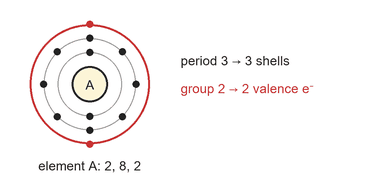
Watch out: Do not swap the two numbers: the PERIOD gives the shells and the GROUP gives the valence electrons.
Why the other options are wrong:
- (B) 2 shells and 3 valence electrons: 2 shells and 3 valence electrons (2, 3) is period 2, group 13.
- (C) 3 shells and 3 valence electrons: 3 shells and 3 valence electrons (2, 8, 3) is period 3, group 13.
- (D) 2 shells and 2 valence electrons: 2 shells and 2 valence electrons (2, 2) is period 2, group 2.
Therefore, element A has 3 shells and 2 valence electrons, option (A).
- 511 mark
Question 51
Elements A, B, C & D have the following electronic configurations:
[A = 2, 8, 7 B = 1 C = 2, 5 D = 2, 8, 1]
Answer the following questions:
Identify the element that will form an alkali when reacted with water.
Solve with AIWritten solution
Solution:
Concept: An alkali is formed when a reactive metal, such as a group 1 metal, reacts with water. A group 1 metal has one valence electron in a shell beyond the first.
Step 1 — Read the configurations.
A (2, 8, 7) has 7 valence electrons: a non-metal of group 17. B (1) is hydrogen, a non-metal. C (2, 5) has 5 valence electrons: a non-metal of group 15. D (2, 8, 1) has one valence electron in its third shell: a group 1 metal (sodium).
Step 2 — Pick the element that gives an alkali.
D loses its single valence electron easily and reacts with water to form the alkali sodium hydroxide:
Watch out: B also has one electron, but hydrogen is a non-metal and does not form an alkali with water.
Therefore, the element that forms an alkali with water is D.
- 524 marks
Question 52
Answer the following questions based on the information provided for the elements P, Q and R.
-
P : atomic number = 19
-
Q : electronic configuration = 2, 6
-
R : has a tendency to gain one electron
(a) Write the electronic configuration of element P.
(b) What is the valency of element Q?
(c) Is element R a metal or a non-metal?
(d) Which period does P belong to?
Solve with AIWritten solution
Solution:
Concept: Fill the shells 2, 8, 8, … in order. The last shell holds the valence electrons, and the number of shells gives the period. Metals lose electrons; non-metals gain them.
Step 1 — (a) Configuration of P.
P has 19 electrons. We place 2 in the first shell, 8 in the second, 8 in the third and the last 1 in the fourth, so P is 2, 8, 8, 1.
Step 2 — (b) Valency of Q.
Q (2, 6) has 6 valence electrons and gains 2 more to complete its octet, so its valency is 8 − 6, that is 2.
Step 3 — (c) Metal or non-metal: R.
R tends to gain one electron. Gaining electrons is the property of non-metals (a group 17 element behaves like this), so R is a non-metal.
Step 4 — (d) Period of P.
P has electrons in four shells, so P belongs to period 4.
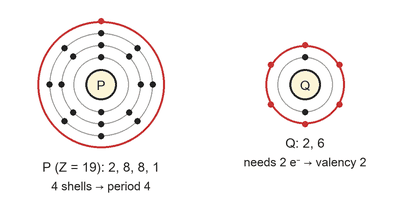
Watch out: For Z = 19 the last electron goes into the FOURTH shell (2, 8, 8, 1), not into the third shell as 2, 8, 9.
Therefore, (a) 2, 8, 8, 1; (b) 2; (c) a non-metal; (d) period 4.
-
- 533 marks
Question 53
Arrange the following as per the instructions given in the bracket.
(a) Na, Al, P, Si, Mg (increasing order of metallic character)
(b) Cl, F, Br, I (increasing order of electronegativity)
(c) He, Ar, Ne, Ca (increasing order of the number of shells)
Solve with AIWritten solution
Solution:
Concept: Metallic character is the tendency of an atom to lose electrons; non-metallic character is the tendency to gain them. Big atoms with few valence electrons lose electrons easily, so metallic character decreases across a period and increases down a group; non-metallic character does the opposite. The number of shells equals the period number.
Step 1 — (a) Order Na, Al, P, Si and Mg by metallic character.
Na (11), Mg (12), Al (13), Si (14) and P (15) are all in period 3. Metallic character decreases from left to right, so phosphorus (a non-metal) is the least metallic and sodium the most. The increasing order is P < Si < Al < Mg < Na.
Step 2 — (b) Order Cl, F, Br and I by electronegativity.
All four are halogens; electronegativity decreases down group 17 (F 4.0, Cl 3.0, Br 2.8, I 2.5). The increasing order is I < Br < Cl < F.
Step 3 — (c) Order He, Ar, Ne and Ca by number of shells.
He (2) has 1 shell, Ne (2, 8) has 2, Ar (2, 8, 8) has 3 and Ca (2, 8, 8, 2) has 4. The increasing order is He < Ne < Ar < Ca.
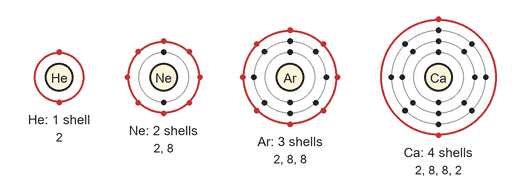
Watch out: In (a) the order asked is INCREASING metallic character, so it starts from the right of the period (P).
Therefore, (a) P < Si < Al < Mg < Na; (b) I < Br < Cl < F; (c) He < Ne < Ar < Ca.
- 543 marks
Question 54
Study the part of the Periodic Table given below and answer the questions that follow: (Do not identify the elements)
1 2 13 14 15 16 17 18 J Q L M O P N G (a) Draw the dot (.) and cross (×) structure of the compound formed between elements L and P.
(b) Which element has the highest ionization potential?
(c) Element N is more reactive than M. Justify.
Solve with AIWritten solution
Solution:
Concept: Read each letter's group from the column headings. L is in group 2 (2 valence electrons) and P in group 17 (7 valence electrons). Q is at the top of group 18 and G below it. M and N are in group 1, with N below M.
Step 1 — (a) Work out the electron transfer between L and P.
L loses its 2 valence electrons to form L²⁺, and each P atom gains 1 electron to form P⁻. One L atom therefore gives one electron to each of two P atoms:
Step 2 — (a) Draw the dot and cross structure.
The compound is electrovalent, with formula LP₂. In the structure the two electrons of L are shown as crosses (×), each passing to one P atom, so every P ion ends with a complete octet and L²⁺ is left with a stable shell.
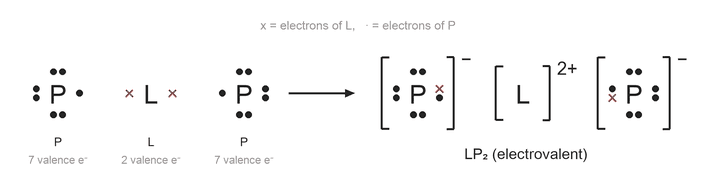
Step 3 — (b) The highest ionisation potential.
Ionisation potential is highest for the noble gases (group 18) and decreases down a group. Q and G are both in group 18, and Q is above G, so Q has the highest ionisation potential.
Step 4 — (c) Why N is more reactive than M.
M and N are both in group 1 and have one valence electron each. N lies below M, so it has one more shell: its atom is larger, and its valence electron is farther from the nucleus and held less firmly. N therefore has a lower ionisation potential, loses its electron more easily and is more reactive than M.
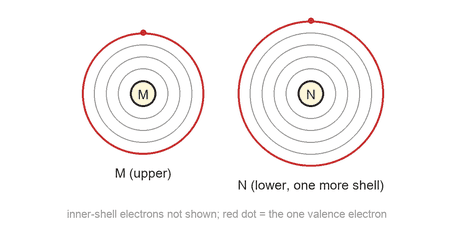
Watch out: In the structure, put square brackets and charges on the ions (L²⁺ and two P⁻); do not draw a shared pair, because no electrons are shared in an electrovalent compound.
Therefore, (a) LP₂, an electrovalent compound in which L gives one electron to each of two P atoms; (b) Q; (c) N has one more shell, so its valence electron is lost more easily.