
Question 231 markMCQAsked 2023Easy
An element with the largest atomic radius among the following is:
Confirming your payment
Sign up now and get 250 free tokens.
Previous Year Questions · Question 23 of 54
An element with the largest atomic radius among the following is:
(A) Carbon
(B) Nitrogen
(C) Lithium
(D) Beryllium
Answer: (C) Lithium
Concept: Atomic size (atomic radius) depends on the number of shells and on the nuclear charge. Down a group a new shell is added at each step, so atoms get bigger; across a period the shells stay the same while the nuclear charge rises, so atoms get smaller.
Step 1 — Place the four elements.
Lithium (3), beryllium (4), carbon (6) and nitrogen (7) are all in period 2, so they all have two shells.
Step 2 — Apply the trend across the period.
With the same number of shells, the element with the smallest nuclear charge pulls its electrons in least. Lithium, the first element of the period, is therefore the largest. Book radii: Li 152, Be 112, C 77, N 70 pm.
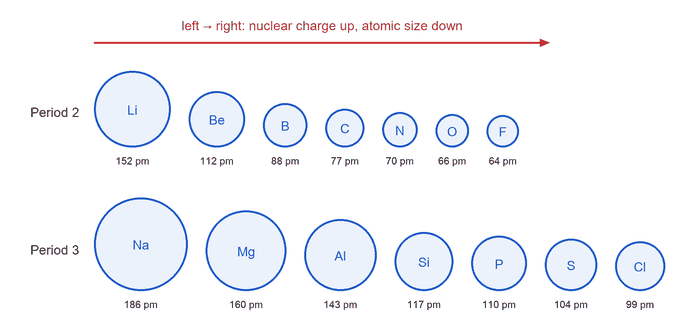
Watch out: A larger atomic NUMBER does not mean a larger atom within a period; across a period the size falls.
Why the other options are wrong:
Therefore, the element with the largest atomic radius is lithium, option (C).