
Question 221 markMCQAsked 2023Easy
An element in period 3, whose electron affinity is zero:
Confirming your payment
Sign up now and get 250 free tokens.
Previous Year Questions · Question 22 of 54
An element in period 3, whose electron affinity is zero:
(A) Neon
(B) Sulphur
(C) Sodium
(D) Argon
Answer: (D) Argon
Concept: Electron affinity is the energy released when a neutral isolated gaseous atom accepts an electron to form an anion. A small atom with a large nuclear charge attracts the extra electron strongly, so electron affinity increases across a period and decreases down a group. A noble gas already has a complete outer shell, so it has no tendency to accept an extra electron: its electron affinity is taken as zero.
Step 1 — Use both conditions in the stem.
The element must be in period 3 and must have zero electron affinity.
Step 2 — Find the noble gas of period 3.
Argon (2, 8, 8) is the noble gas of period 3, and its octet is complete. An extra electron would have to go into a new shell, so no energy is released: its electron affinity is zero.
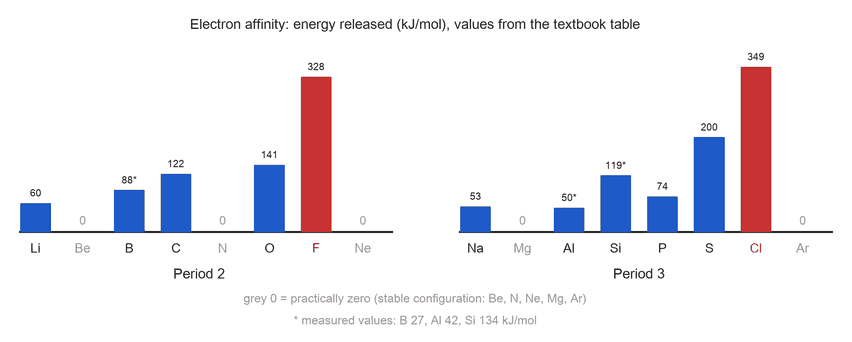
Watch out: Neon also has zero electron affinity, but it is in period 2; check the period as well as the property.
Why the other options are wrong:
Therefore, the period 3 element with zero electron affinity is argon, option (D).