Solution:
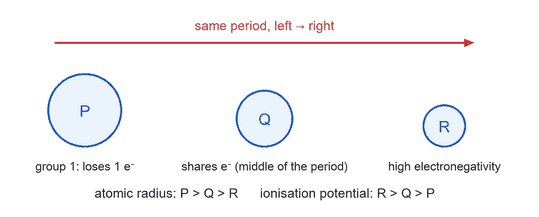
Concept: First decide where each element sits in the period. P loses one electron easily, so it is a group 1 metal at the left end. R has high electronegativity, so it is a non-metal near the right end. Q shares electrons and does not form ions easily, so it lies in the middle of the period. Across a period atomic size decreases while ionisation potential increases.
Step 1 — (a) Find the element hardest to reduce.
Reduction means gain of electrons. P readily loses its valence electron, so it has the least tendency of the three to gain electrons; it is itself a strong reducing agent. P is therefore the most difficult to reduce. (Read the other way, reducing the ion P⁺ back to the element is also hardest, because P is a highly reactive metal.)
Step 2 — (b) Find the smallest atom.
Across a period the nuclear charge increases while the number of shells stays the same, so atomic size decreases. R is farthest to the right, so it has the smallest atomic radius.
Step 3 — (c) Order by ionisation potential.
Ionisation potential increases from left to right across a period, so R (right) has the highest value and P (left) the lowest.
Watch out: R, which attracts electrons strongly, is the EASIEST to reduce, not the hardest.
Therefore, (a) P; (b) R; (c) R > Q > P.
