
Question 451 markAsked 2026Easy
Give reasons why:
Electronegativity increases across a period.
Confirming your payment
Sign up now and get 250 free tokens.
Previous Year Questions · Question 45 of 54
Give reasons why:
Electronegativity increases across a period.
Solution:
Concept: Electronegativity is the tendency of an atom in a molecule to attract the shared pair of electrons towards itself (Pauling scale, fluorine 4.0 the highest). It increases across a period and decreases down a group, for the same reasons as electron affinity.
Step 1 — See what changes across a period.
Across a period the number of shells stays the same, but the nuclear charge increases by one at each step. The electrons are pulled closer, so the atomic size decreases.
Step 2 — Link this to electronegativity.
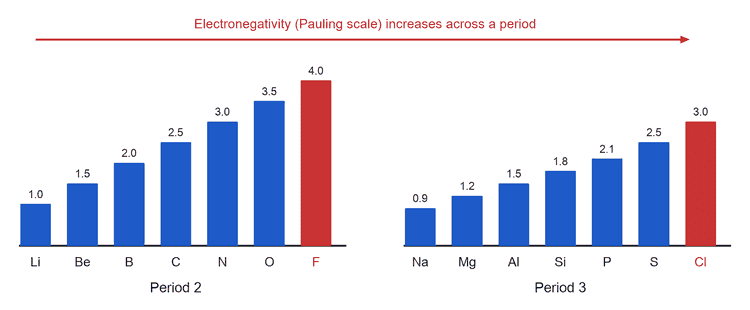
A smaller atom with a larger nuclear charge attracts a shared pair of electrons more strongly, so electronegativity increases from left to right. Period 2 shows this: Li 1.0, Be 1.5, B 2.0, C 2.5, N 3.0, O 3.5, F 4.0.
Watch out: The number of shells does NOT change across a period; only the nuclear charge rises.
Therefore, electronegativity increases across a period because the nuclear charge increases and the atomic size decreases, so the shared pair is attracted more strongly.