
Question 462 marksAsked 2026Easy
Name the following:
(a) The most electronegative element of Period 2.
(b) The largest atom of Period 3.
Confirming your payment
Sign up now and get 250 free tokens.
Previous Year Questions · Question 46 of 54
Name the following:
(a) The most electronegative element of Period 2.
(b) The largest atom of Period 3.
Solution:
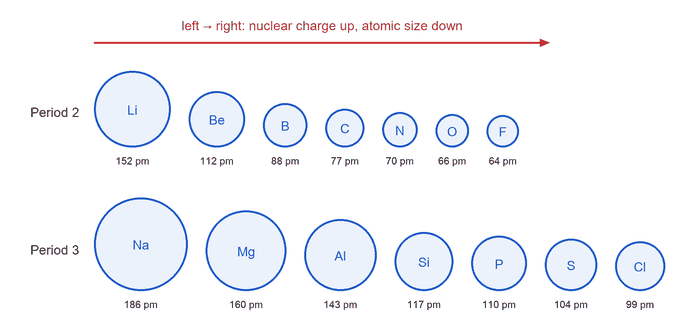
Concept: Electronegativity is the tendency of an atom in a molecule to attract the shared pair of electrons towards itself (Pauling scale, fluorine 4.0 the highest). It increases across a period and decreases down a group, for the same reasons as electron affinity. Atomic size (atomic radius) depends on the number of shells and on the nuclear charge. Down a group a new shell is added at each step, so atoms get bigger; across a period the shells stay the same while the nuclear charge rises, so atoms get smaller.
Step 1 — (a) The most electronegative element of period 2.
Electronegativity increases across a period, so the group 17 element of period 2 is the most electronegative: fluorine, which at 4.0 is the most electronegative of all elements. Neon, the noble gas, has a complete octet and is not compared.
Step 2 — (b) The largest atom of period 3.
Atomic size decreases across a period, so the first element of period 3, sodium (186 pm), has the largest atom; the size falls from sodium to chlorine (99 pm).
Watch out: Noble-gas radii are measured in a different way (van der Waals radius), so argon is not compared with the other period 3 atoms.
Therefore, (a) fluorine; (b) sodium.