Solution:
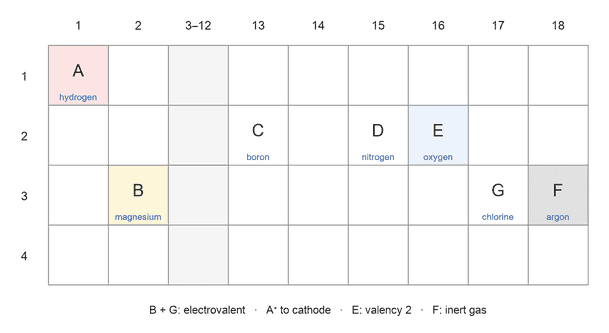
Concept: The extract has nine columns: groups 1 and 2, a column standing for the transition elements (groups 3–12), then groups 13 to 18. The column gives the group and the row gives the period. Each element may be used only once.
Step 1 — Place every letter.
We read the group and period of each letter before answering.
| Letter | Group | Period |
|---|
| A | 1 | 1 |
| B | 2 | 3 |
| C | 13 | 2 |
| D | 15 | 2 |
| E | 16 | 2 |
| G | 17 | 3 |
| F | 18 | 3 |
Step 2 — (i) The element forming an electrovalent compound with G.
G is a group 17 non-metal that gains one electron. B is a group 2 metal that loses two electrons. Electrons pass from B to G, giving an electrovalent (ionic) compound, BG₂. The answer is B.
Step 3 — (ii) The ion that migrates towards the cathode.
The cathode is the negative electrode, so positive ions (cations) move towards it. A, in period 1 and group 1, is hydrogen; it forms the positive ion A⁺. B also forms a cation, but B is already used in (i), so the answer is A.
Step 4 — (iii) The non-metal with valency 2.
E is in group 16, so it has 6 valence electrons and gains 2 more to complete its octet; its valency is 8 − 6, that is 2. The answer is E.
Step 5 — (iv) The inert gas.
F is in group 18 (the zero group); its outer shell holds a complete octet, so it is an inert gas. The answer is F.
Watch out: The stem says 'DO NOT repeat an element', so B cannot be used again in (ii) even though it also forms a cation.
Therefore, (i) B; (ii) A; (iii) E; (iv) F.
