
Question 161 markAsked 2019Easy
Arrange the following according to the instructions given in brackets:
F, B, N, O (In the increasing order of electron affinity)
Confirming your payment
Sign up now and get 250 free tokens.
Previous Year Questions · Question 16 of 54
Arrange the following according to the instructions given in brackets:
F, B, N, O (In the increasing order of electron affinity)
Solution:
Concept: Electron affinity is the energy released when a neutral isolated gaseous atom accepts an electron to form an anion. A small atom with a large nuclear charge attracts the extra electron strongly, so electron affinity increases across a period and decreases down a group.
Step 1 — Place the elements.
B, N, O and F all lie in period 2, in that order from left to right (groups 13, 15, 16 and 17).
Step 2 — Apply the trend.
Moving from B to F the nuclear charge rises and the atom gets smaller, so each element attracts an extra electron more strongly than the one before it and releases more energy.
Step 3 — Write the order.
Following the trend, the increasing order is B < N < O < F, with fluorine (328 kJ/mol) the highest of the four.
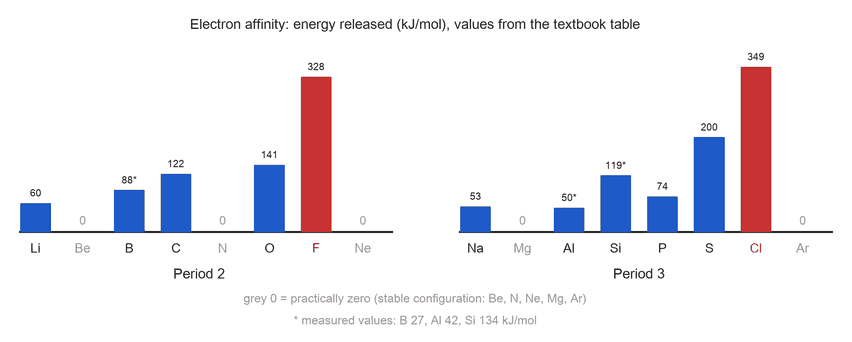
Watch out: Fluorine has the highest electron affinity of these four, but chlorine (349 kJ/mol), not fluorine, has the highest of all elements.
Note: B < N < O < F is the expected board answer, from the general period trend. Nitrogen is a known exception: its half-filled outer shell is stable, so its electron affinity is practically zero (the figure shows N as 0), lower than boron's (about 27 kJ/mol). The order of the actual values is therefore N < B < O < F.
Therefore, the increasing order of electron affinity is B < N < O < F.