Solution:
Concept: For the first 20 elements, the number of shells in an atom gives its period, and the number of electrons in its outermost (valence) shell gives its group: 1 or 2 valence electrons → group 1 or 2; 3 to 8 valence electrons → group 13 to 18 (add 10). Valency is the number of electrons an atom loses, gains or shares to reach a stable octet (a duplet for the first shell). Atoms with 1, 2 or 3 valence electrons lose them, so their valency equals the number of valence electrons; atoms with 5, 6 or 7 gain electrons, so their valency is 8 minus that number.
Step 1 — Write each configuration.
We fill the shells 2, 8, 8 in order for each atomic number and read off the period and the group.
| Atomic number | Configuration | Period | Group | Element |
|---|
| 2 | 2 | 1 | 18 | helium |
| 4 | 2, 2 | 2 | 2 | beryllium |
| 8 | 2, 6 | 2 | 16 | oxygen |
| 15 | 2, 8, 5 | 3 | 15 | phosphorus |
| 19 | 2, 8, 8, 1 | 4 | 1 | potassium |
Step 2 — (i) A solid non-metal of the third period.
Only atomic number 15 has three shells (period 3). It has five valence electrons, and phosphorus is a solid non-metal, so the answer is 15.
Step 3 — (ii) A metal of valency 1.
Atomic number 19 has one valence electron, which it loses to form K⁺, so its valency is 1. The answer is 19.
Step 4 — (iii) A gaseous element with valency 2.
Atomic number 8 has six valence electrons and gains two more to complete its octet, so its valency is 8 − 6, that is 2. Oxygen is a gas, so the answer is 8.
Step 5 — (iv) An element of group 2.
Atomic number 4 (2, 2) has two valence electrons in its outer shell, so it is in group 2. The answer is 4.
Step 6 — (v) A rare gas.
Atomic number 2 has one shell, and that shell is complete with two electrons (a duplet). Helium is a rare (noble) gas, so the answer is 2.
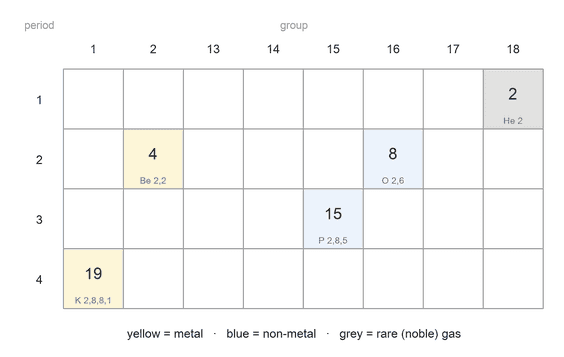
Watch out: Beryllium (4) also has valency 2, but it is a solid metal; the GASEOUS element with valency 2 is oxygen (8).
Therefore, (i) 15, (ii) 19, (iii) 8, (iv) 4, (v) 2.
