Solution:
Concept: Down a group a new shell is added at each step, so the atomic size increases. The valence electrons are then farther from the nucleus, so ionisation energy and electronegativity decrease down a group. The number of shells equals the period number.
Step 1 — (i) Count the shells of He, Ar and Ne.
He (2), Ne (2, 8) and Ar (2, 8, 8) are in periods 1, 2 and 3, so they have 1, 2 and 3 shells. In increasing order of shells: He < Ne < Ar.
Step 2 — (ii) Order Na, Li and K by ionisation energy.
These are group 1 metals, Li at the top and K at the bottom. Ionisation energy falls down the group because the valence electron gets farther from the nucleus (Li 520, Na 496, K 419 kJ/mol). In increasing order: K < Na < Li.
Step 3 — (iii) Order F, Cl and Br by electronegativity.
These are group 17 elements, F at the top. Electronegativity decreases down the group because a larger atom pulls a shared pair less strongly (F 4.0, Cl 3.0, Br 2.8). In increasing order: Br < Cl < F.
Step 4 — (iv) Order Na, K and Li by atomic size.
These are group 1 metals; one shell is added at each step down the group (Li 152, Na 186, K 231 pm). In increasing order: Li < Na < K.
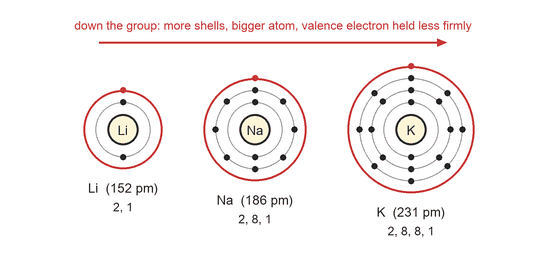
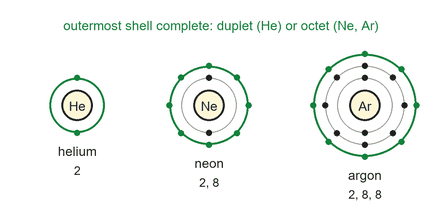
The first figure draws Li, Na and K to their radii; the second shows the 1, 2 and 3 shells of He, Ne and Ar.
Watch out: Parts (ii) and (iv) give OPPOSITE orders for the same group 1 metals: the biggest atom (K) has the smallest ionisation energy.
Therefore, (i) He < Ne < Ar; (ii) K < Na < Li; (iii) Br < Cl < F; (iv) Li < Na < K.
