
Question 281 markMCQAsked 2024Easy
In the 2nd period Neon has maximum Ionization Potential because:
Confirming your payment
Sign up now and get 250 free tokens.
Previous Year Questions · Question 28 of 54
In the 2nd period Neon has maximum Ionization Potential because:
(A) It has unstable electronic configuration.
(B) It easily accepts electrons.
(C) It easily loses electrons.
(D) The outer most shell is completely filled.
Answer: (D) The outer most shell is completely filled.
Concept: Ionisation energy (ionisation potential) is the energy needed to remove an electron from a neutral isolated gaseous atom. It is higher when the atom is small and the nuclear charge is large, so it increases across a period and decreases down a group. A completely filled (octet) outer shell is the most stable electron arrangement, so it is the hardest to break.
Step 1 — Look at neon's electron arrangement.
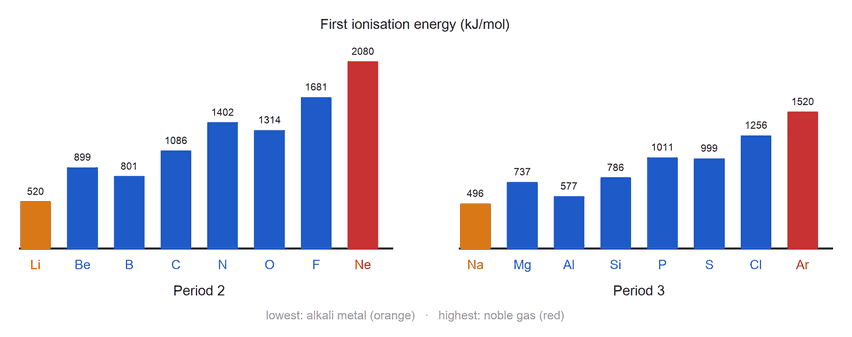
Neon (2, 8) is the last element of period 2. It has the largest nuclear charge in its period, and its outer shell holds a complete octet.
Step 2 — Link this to the ionisation potential.
Removing an electron would break this stable, completely filled shell, and the electrons are held tightly by the large nuclear charge. So neon needs the most energy of all period 2 elements: 2080 kJ/mol.
Watch out: Ionisation potential is about LOSING an electron; whether an atom accepts electrons is a different property (electron affinity).
Why the other options are wrong:
Therefore, neon has the maximum ionisation potential because its outermost shell is completely filled, option (D).