
Question 361 markMCQAsked 2025Easy
X, Y & Z are three metallic atoms in successive order belonging to the same group such that atomic radii of ‘X’ is the smallest. Which of the three atoms is the best reducing agent?
Confirming your payment
Sign up now and get 250 free tokens.
Previous Year Questions · Question 36 of 54
X, Y & Z are three metallic atoms in successive order belonging to the same group such that atomic radii of ‘X’ is the smallest. Which of the three atoms is the best reducing agent?
(A) X
(B) Y
(C) Z
(D) All three have the same reducing power.
Answer: (C) Z
Concept: A reducing agent is an electron donor (it loses electrons and is itself oxidised); an oxidising agent is an electron acceptor (it gains electrons and is itself reduced). The more easily a metal atom loses its valence electrons, the stronger a reducing agent it is.
Step 1 — Work out which atom is largest.
X, Y and Z are in successive order in one group, and X has the smallest radius, so X is at the top. Y has one more shell than X, and Z one more shell than Y, so Z is the largest atom.
Step 2 — Link size to reducing power.
In the largest atom the valence electrons are farthest from the nucleus and held least firmly, so they are lost most easily (lowest ionisation potential). Losing electrons most easily makes Z the best reducing agent.
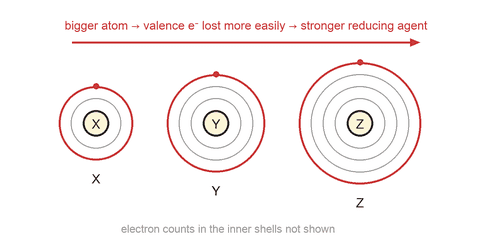
Watch out: A smaller radius means a STRONGER hold on the electrons, so the smallest atom (X) is the WEAKEST reducing agent.
Why the other options are wrong:
Therefore, the best reducing agent is Z, option (C).