
Question 351 markMCQAsked 2025Easy
Assertion (A): The tendency of losing electrons increases down the Group.
Reason (R): The most reactive metal is placed at the top of Group 1.
Confirming your payment
Sign up now and get 250 free tokens.
Previous Year Questions · Question 35 of 54
Assertion (A): The tendency of losing electrons increases down the Group.
Reason (R): The most reactive metal is placed at the top of Group 1.
(A) Both (A) and (R) are true, and (R) is the correct explanation of (A).
(B) Both (A) and (R) are true, and (R) is not the correct explanation of (A).
(C) (A) is true but (R) is false.
(D) (A) is false but (R) is true.
Answer: (C) (A) is true but (R) is false.
Concept: In an assertion–reason item, judge the assertion (A) and the reason (R) separately as true or false, and only then decide whether R correctly explains A.
Step 1 — Judge the Assertion.
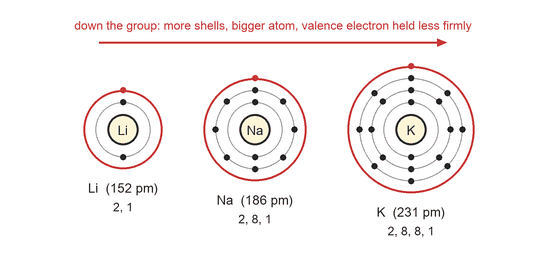
Down a group the atomic size increases, so the valence electrons are farther from the nucleus and held less firmly. The tendency to lose electrons therefore increases down a group. The Assertion is true.
Step 2 — Judge the Reason.
Since metals react by losing electrons, the reactivity of metals increases down a group. The most reactive metal of group 1 is therefore at the bottom, not at the top; lithium, at the top, is the least reactive alkali metal. The Reason is false.
Watch out: The Reason sounds like the Assertion, but it puts the most reactive metal at the wrong end of the group.
Why the other options are wrong:
Therefore, the Assertion is true and the Reason is false, option (C).