Solution:
Concept: For the first 20 elements, the number of shells in an atom gives its period, and the number of electrons in its outermost (valence) shell gives its group: 1 or 2 valence electrons → group 1 or 2; 3 to 8 valence electrons → group 13 to 18 (add 10).
Step 1 — (a) The period 1 element that fits both group 1 and group 17.
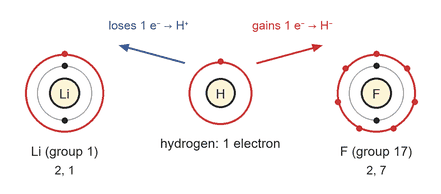
Hydrogen (1 electron) is in period 1. Like the group 1 metals it has one valence electron and can lose it to form H⁺; like the group 17 halogens it is one electron short of a stable shell (the duplet of helium) and can gain one to form H⁻. So hydrogen can be placed in both groups: hydrogen.
Step 2 — (b) The element with configuration 2, 8, 6.
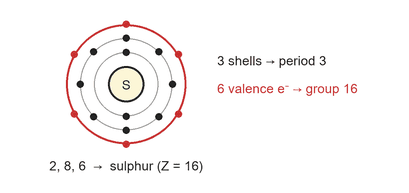
The configuration 2, 8, 6 has three shells (period 3) and six valence electrons (group 16). Adding the electrons gives 2 + 8 + 6, that is 16, so the atomic number is 16: sulphur.
Step 3 — (c) The most electronegative element of period 3.
Electronegativity increases across a period, so the group 17 element at the right of period 3, chlorine (3.0), is the most electronegative. Argon, the noble gas, has a complete octet and is not counted.
Watch out: In (c) do not choose argon just because it is last in the period; noble gases are left out of electronegativity comparisons.
Therefore, (a) hydrogen; (b) sulphur; (c) chlorine.
