Solution:
Concept: (a) and (c) follow periodic trends. (b) asks for the basicity of each acid: the number of replaceable hydrogen atoms (hydrogen ions) one molecule can give.
Step 1 — (a) Order carbon, fluorine and beryllium by size.
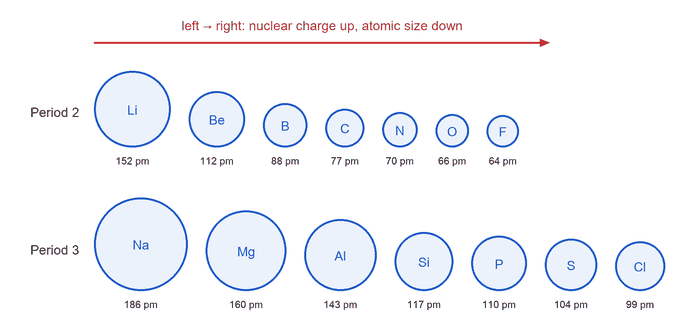
Be (4), C (6) and F (9) are all in period 2. Atomic size decreases from left to right as the nuclear charge rises (Be 112, C 77, F 64 pm), so the decreasing order is Beryllium > Carbon > Fluorine.
Step 2 — (b) Count the replaceable hydrogen atoms.
Acetic acid is monobasic: only the H of its –COOH group ionises, not the three H atoms of its CH₃ group.
CH3COOH⇌CH3COO−+H+
Sulphuric acid is dibasic: overall, one molecule gives two hydrogen ions.
H2SO4→2H++SO42−
Phosphoric acid is tribasic: overall, one molecule can give three hydrogen ions.
H3PO4⇌3H++PO43−
So the increasing order is Acetic acid < Sulphuric acid < Phosphoric acid (1, 2 and 3).
Step 3 — (c) Order potassium, lithium and sodium by ionisation potential.
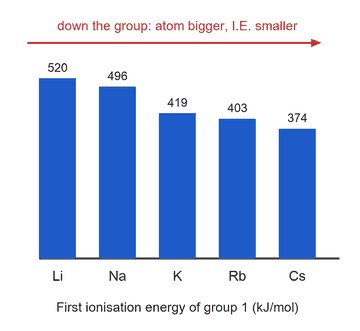
All three are group 1 metals. Ionisation potential decreases down the group as the atom gets bigger (Li 520, Na 496, K 419 kJ/mol), so the increasing order is Potassium < Sodium < Lithium.
Watch out: Acetic acid, CH₃COOH, has four hydrogen atoms but only ONE is replaceable; the basicity is not the total number of H atoms. (The equations for H₂SO₄ and H₃PO₄ show the overall change; each H⁺ actually comes off in a separate step.)
Therefore, (a) Beryllium > Carbon > Fluorine; (b) Acetic acid < Sulphuric acid < Phosphoric acid; (c) Potassium < Sodium < Lithium.
