Solution:
Concept: The column headings give each letter's group, and the group decides the number of valence electrons: IA has 1, IIA 2, … VIIA 7, and group 0 has a complete outer shell.
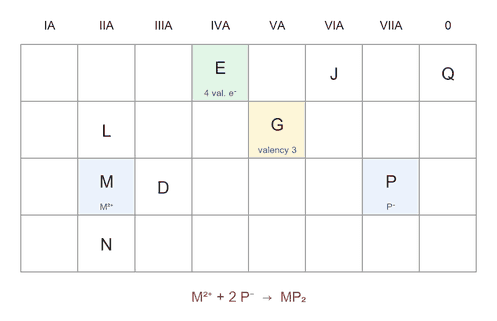
Step 1 — (a) Find the valency of G.
G is in group VA, so it has 5 valence electrons. It gains 3 more (8 − 5) to complete its octet, so the valency of G is 3.
Step 2 — (b) Find the element that shows catenation.
Catenation is the joining of atoms of the same element into long chains or rings by covalent bonds. E is at the top of group IVA: it has 4 valence electrons and forms four strong covalent bonds, including bonds with other atoms of its own kind, so E shows catenation.
Step 3 — (c) Work out the ions of M and P.
M is in group IIA, so it loses 2 electrons to form M²⁺. P is in group VIIA, so it gains 1 electron to form P⁻.
Step 4 — (c) Balance the charges.
Two P⁻ ions are needed to balance the charge of one M²⁺ ion, so the formula is MP₂:
M2++2P−→MP2
Watch out: Use only the letters given, as the stem asks; do not name the elements.
Therefore, (a) the valency of G is 3; (b) E; (c) MP₂.
