
Question 382 marksAsked 2025Easy
The atomic number of two atoms ‘X’ and ‘Y’ are 14 and 8 respectively.
State:
(a) the period to which ‘X’ belongs.
(b) the formula of the compound formed between ‘X’ and ‘Y’. (Do not identify X and Y)
Confirming your payment
Sign up now and get 250 free tokens.
Previous Year Questions · Question 38 of 54
The atomic number of two atoms ‘X’ and ‘Y’ are 14 and 8 respectively.
State:
(a) the period to which ‘X’ belongs.
(b) the formula of the compound formed between ‘X’ and ‘Y’. (Do not identify X and Y)
Solution:
Concept: For the first 20 elements, the number of shells in an atom gives its period, and the number of electrons in its outermost (valence) shell gives its group: 1 or 2 valence electrons → group 1 or 2; 3 to 8 valence electrons → group 13 to 18 (add 10). Valency is the number of electrons an atom loses, gains or shares to reach a stable octet (a duplet for the first shell). Atoms with 1, 2 or 3 valence electrons lose them, so their valency equals the number of valence electrons; atoms with 5, 6 or 7 gain electrons, so their valency is 8 minus that number.
Step 1 — Write the configurations.
We fill the shells in order: X (14) is 2, 8, 4 and Y (8) is 2, 6.
Step 2 — (a) Find the period of X.
X has electrons in three shells, and the number of shells gives the period, so X belongs to period 3.
Step 3 — (b) Find the two valencies.
X has 4 valence electrons, so its valency is 4. Y has 6 valence electrons and needs 2 more to complete its octet, so its valency is 8 − 6, that is 2.
Step 4 — (b) Write the formula.
Crossing over the valencies gives X₂Y₄. Dividing both numbers by their common factor 2 gives the simplest ratio, one X to two Y, so the formula is XY₂.
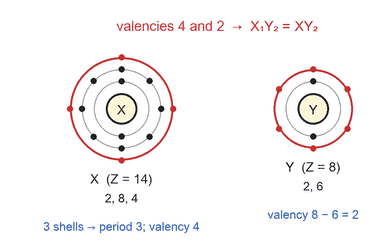
One atom of X shares its four valence electrons with two atoms of Y, so that every atom reaches an octet.
Watch out: After crossing over, always reduce to the simplest ratio: X₂Y₄ is written as XY₂.
Therefore, (a) X belongs to period 3; (b) the formula of the compound is XY₂.