Solution:
Concept: Fill the shells 2, 8, 8, … in order. The last shell holds the valence electrons, and the number of shells gives the period. Metals lose electrons; non-metals gain them.
Step 1 — (a) Configuration of P.
P has 19 electrons. We place 2 in the first shell, 8 in the second, 8 in the third and the last 1 in the fourth, so P is 2, 8, 8, 1.
Step 2 — (b) Valency of Q.
Q (2, 6) has 6 valence electrons and gains 2 more to complete its octet, so its valency is 8 − 6, that is 2.
Step 3 — (c) Metal or non-metal: R.
R tends to gain one electron. Gaining electrons is the property of non-metals (a group 17 element behaves like this), so R is a non-metal.
Step 4 — (d) Period of P.
P has electrons in four shells, so P belongs to period 4.
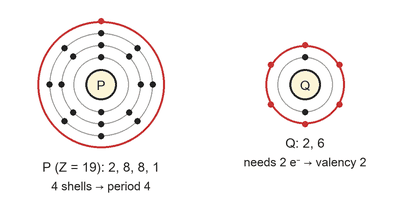
Watch out: For Z = 19 the last electron goes into the FOURTH shell (2, 8, 8, 1), not into the third shell as 2, 8, 9.
Therefore, (a) 2, 8, 8, 1; (b) 2; (c) a non-metal; (d) period 4.
