Solution:
Concept: Metallic character is the tendency of an atom to lose electrons; non-metallic character is the tendency to gain them. Big atoms with few valence electrons lose electrons easily, so metallic character decreases across a period and increases down a group; non-metallic character does the opposite. The number of shells equals the period number.
Step 1 — (a) Order Na, Al, P, Si and Mg by metallic character.
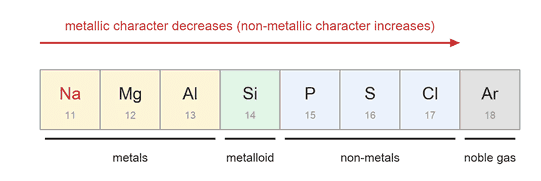
Na (11), Mg (12), Al (13), Si (14) and P (15) are all in period 3. Metallic character decreases from left to right, so phosphorus (a non-metal) is the least metallic and sodium the most. The increasing order is P < Si < Al < Mg < Na.
Step 2 — (b) Order Cl, F, Br and I by electronegativity.
All four are halogens; electronegativity decreases down group 17 (F 4.0, Cl 3.0, Br 2.8, I 2.5). The increasing order is I < Br < Cl < F.
Step 3 — (c) Order He, Ar, Ne and Ca by number of shells.
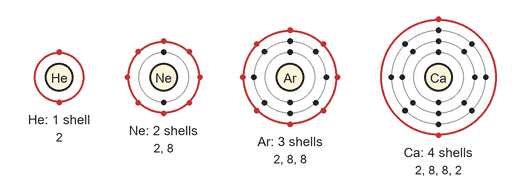
He (2) has 1 shell, Ne (2, 8) has 2, Ar (2, 8, 8) has 3 and Ca (2, 8, 8, 2) has 4. The increasing order is He < Ne < Ar < Ca.
Watch out: In (a) the order asked is INCREASING metallic character, so it starts from the right of the period (P).
Therefore, (a) P < Si < Al < Mg < Na; (b) I < Br < Cl < F; (c) He < Ne < Ar < Ca.
