Solution:
Concept: Read each letter's group from the column headings. L is in group 2 (2 valence electrons) and P in group 17 (7 valence electrons). Q is at the top of group 18 and G below it. M and N are in group 1, with N below M.
Step 1 — (a) Work out the electron transfer between L and P.
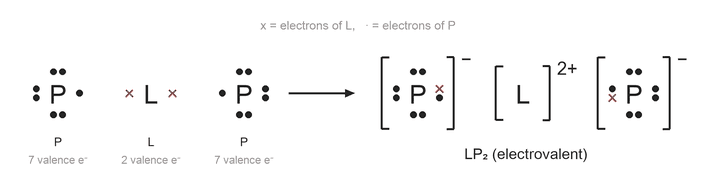
L loses its 2 valence electrons to form L²⁺, and each P atom gains 1 electron to form P⁻. One L atom therefore gives one electron to each of two P atoms:
L+2P→L2++2P−
Step 2 — (a) Draw the dot and cross structure.
The compound is electrovalent, with formula LP₂. In the structure the two electrons of L are shown as crosses (×), each passing to one P atom, so every P ion ends with a complete octet and L²⁺ is left with a stable shell.
Step 3 — (b) The highest ionisation potential.
Ionisation potential is highest for the noble gases (group 18) and decreases down a group. Q and G are both in group 18, and Q is above G, so Q has the highest ionisation potential.
Step 4 — (c) Why N is more reactive than M.
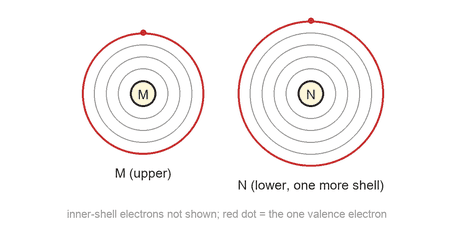
M and N are both in group 1 and have one valence electron each. N lies below M, so it has one more shell: its atom is larger, and its valence electron is farther from the nucleus and held less firmly. N therefore has a lower ionisation potential, loses its electron more easily and is more reactive than M.
Watch out: In the structure, put square brackets and charges on the ions (L²⁺ and two P⁻); do not draw a shared pair, because no electrons are shared in an electrovalent compound.
Therefore, (a) LP₂, an electrovalent compound in which L gives one electron to each of two P atoms; (b) Q; (c) N has one more shell, so its valence electron is lost more easily.
