Solution:
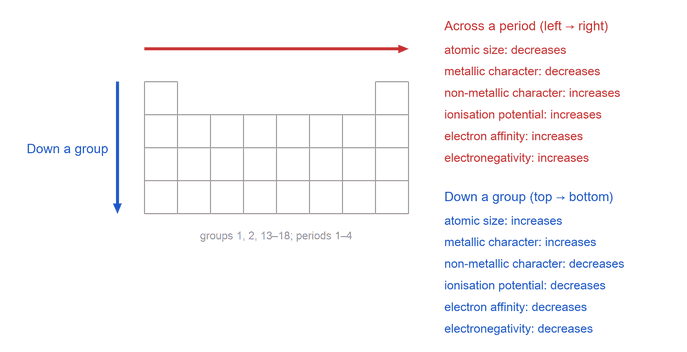
Concept: B is to the left of A in period 3, so both have three shells but A has the larger nuclear charge. Across a period metallic character and atomic size decrease, and electron affinity increases.
Step 1 — (i) Compare metallic character.
Metallic character is the tendency to lose electrons. B, nearer the left of the period, has the smaller nuclear charge and the larger atom, so it loses electrons more easily: B has higher metallic character than A.
Step 2 — (ii) Compare electron affinity.
A has the larger nuclear charge and the smaller atom, so it attracts an extra electron more strongly and releases more energy: A would probably have higher electron affinity than B.
Step 3 — (iii) Compare atomic size.
The larger nuclear charge of A pulls its shells closer to the nucleus, so A has the smaller atomic size.
Watch out: The word 'probably' in (ii) allows for exceptions in the period (for example a noble gas, whose electron affinity is zero); the general trend is what is asked.
Therefore, (i) higher; (ii) higher; (iii) smaller.
