Solution:
Concept: Each reason comes from three things: the size of the atom, its nuclear charge, and how stable its electron arrangement is. For part (v), the more free ions a solution has, the better it conducts electricity.
Step 1 — (i) Ionic compounds have a high melting point.
An ionic compound is a lattice of positive and negative ions held together by strong electrostatic forces of attraction acting in all directions. A large amount of heat energy is needed to break these forces and let the ions move, so the melting point is high (sodium chloride melts at about 801 °C).
Step 2 — (ii) Inert gases do not form ions.
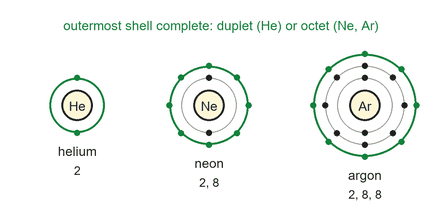
The outermost shell of an inert gas is already complete: a duplet in helium and an octet in the others. This stable arrangement gives them a very high ionisation potential and zero electron affinity, so they have no tendency to lose or gain electrons, and therefore they form no ions.
Step 3 — (iii) Ionisation potential increases across a period.
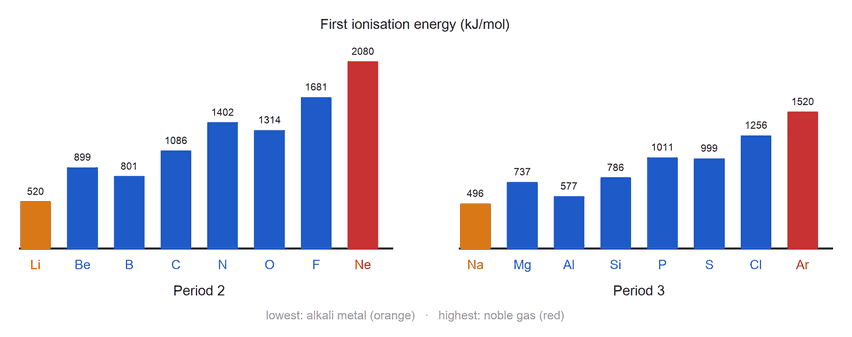
Across a period the number of shells stays the same, but the nuclear charge increases by one at each step. The electrons are pulled closer, the atomic size decreases, and the valence electrons are held more firmly. More energy is therefore needed to remove one (period 3 rises from Na 496 to Ar 1520 kJ/mol).
Step 4 — (iv) Alkali metals are good reducing agents.
An alkali metal has one valence electron, a large atom and a low ionisation potential, so it loses that electron very easily. A substance that readily gives electrons to another substance is a reducing agent:
Na→Na++e−
Step 5 — (v) Dilute hydrochloric acid conducts better than acetic acid.
Hydrochloric acid is a strong acid (a strong electrolyte): in dilute solution it is almost completely ionised, so it gives many free ions to carry the current.
HCl(aq)→H+(aq)+Cl−(aq)
Acetic acid is a weak acid (a weak electrolyte): it is only partly ionised, so its solution holds mostly molecules and only a few ions.
CH3COOH(aq)⇌CH3COO−(aq)+H+(aq)
More ions carry more current, so dilute hydrochloric acid conducts better (at the same concentration).
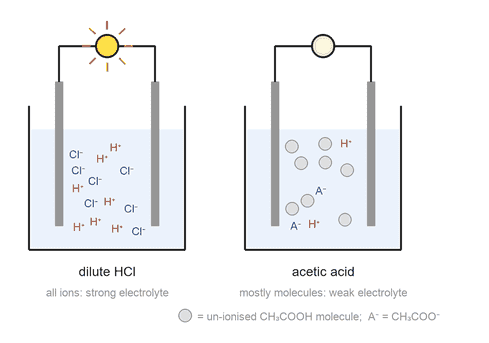
Watch out: In (v) both acids are dilute; the difference is the DEGREE of ionisation, not how much water is present.
Therefore, (i) strong electrostatic forces between the ions need much energy to break; (ii) inert gases already have a complete outer shell; (iii) the nuclear charge rises while the size falls; (iv) alkali metals lose their single valence electron very easily; (v) HCl is almost fully ionised, acetic acid only partly.
