
Question 121 markMCQAsked 2019Easy
The most electronegative element from the following elements is:
Confirming your payment
Sign up now and get 250 free tokens.
Previous Year Questions · Question 12 of 54
The most electronegative element from the following elements is:
(A) Magnesium
(B) Chlorine
(C) Aluminium
(D) Sulphur
Answer: (B) Chlorine
Concept: Electronegativity is the tendency of an atom in a molecule to attract the shared pair of electrons towards itself (Pauling scale, fluorine 4.0 the highest). It increases across a period and decreases down a group, for the same reasons as electron affinity.
Step 1 — Place the four elements.
Magnesium (group 2), aluminium (group 13), sulphur (group 16) and chlorine (group 17) are all in period 3, in that order from left to right.
Step 2 — Apply the trend.
Electronegativity increases from left to right across a period, so the element farthest to the right, chlorine, is the most electronegative. The Pauling values agree: Mg 1.2, Al 1.5, S 2.5, Cl 3.0.
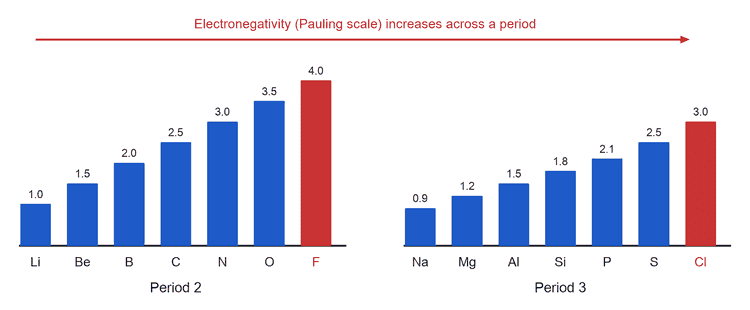
Watch out: Sulphur is also a non-metal with a fairly high value, but chlorine lies to its right and is more electronegative.
Why the other options are wrong:
Therefore, the most electronegative of these elements is chlorine, option (B).