Solution:
Concept: (a) uses the activity (reactivity) series of metals; (b) uses the trend that non-metallic character increases across a period; (c) needs the number of valence electrons, read from each configuration.
Step 1 — (a) Order the metals by reactivity.
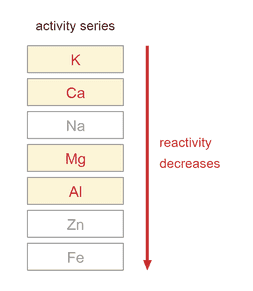
In the activity series potassium comes first, then calcium, then magnesium, then aluminium. A metal higher in the series loses its electrons more easily and reacts more vigorously, so the decreasing order is K > Ca > Mg > Al.
Step 2 — (b) Order by non-metallic character.
Be (4), C (6), N (7) and O (8) are all in period 2. Non-metallic character, the tendency to gain electrons, increases from left to right as the nuclear charge rises and the atom shrinks. The increasing order is Be < C < N < O.
Step 3 — (c) Order by valence electrons.
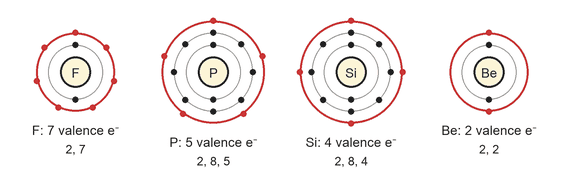
We read the last shell of each configuration: F (2, 7) has 7, P (2, 8, 5) has 5, Si (2, 8, 4) has 4 and Be (2, 2) has 2 valence electrons. The decreasing order is F > P > Si > Be.
Watch out: In (c) count only the electrons of the OUTERMOST shell, not the total number of electrons (P has 15 electrons but only 5 valence electrons).
Therefore, (a) K > Ca > Mg > Al; (b) Be < C < N < O; (c) F > P > Si > Be.
