Answer: (B) (2)
Concept: In an assertion–reason item, judge the assertion (A) and the reason (R) separately as true or false, and only then decide whether R correctly explains A.
Step 1 — Judge the assertion.
Hydrogen (1 electron) is placed in group 1 because, like the alkali metals, it has one valence electron and valency 1, and it can lose that electron to form H+. A is true.
Step 2 — Judge the reason.
Hydrogen can also gain an electron to reach the helium configuration, so R is true.
H+e−→H−
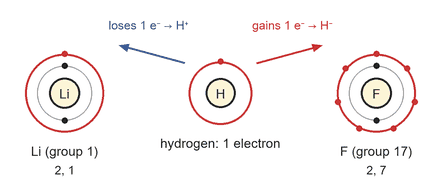
Step 3 — Decide whether R explains A.
Gaining an electron is a halogen-like property; it is not the reason hydrogen is placed in group I. So R does not explain A, and the answer is code (2).
Watch out: R is true but describes how hydrogen resembles the halogens of group 17, not group 1.
Why the other options are wrong:
- (A) (1): R explains a resemblance to the halogens, not the placing in group I.
- (C) (3): R is a true statement: hydrogen does form the hydride ion H⁻.
- (D) (4): A is true: hydrogen is placed in group 1 for its single valence electron.
Therefore, both A and R are true but R does not explain A, code (2), option (B).
