Solution:
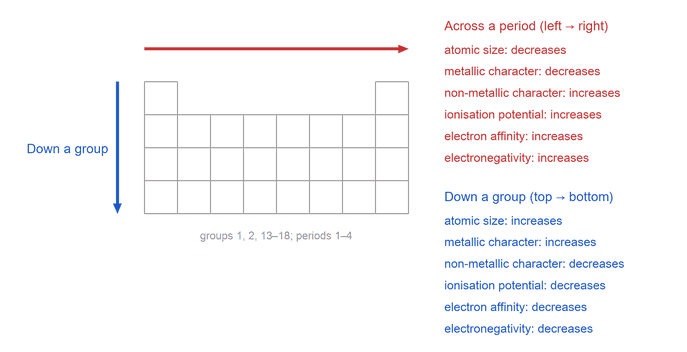
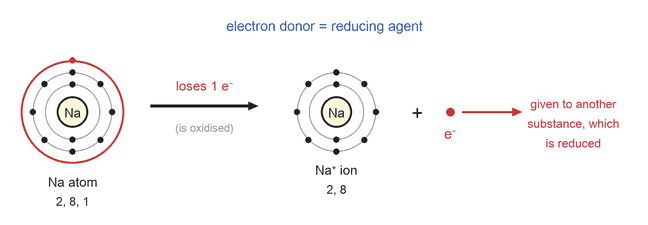
Concept: Metallic character is the tendency of an atom to lose electrons; non-metallic character is the tendency to gain them. Big atoms with few valence electrons lose electrons easily, so metallic character decreases across a period and increases down a group; non-metallic character does the opposite. A reducing agent is an electron donor (it loses electrons and is itself oxidised); an oxidising agent is an electron acceptor (it gains electrons and is itself reduced).
Step 1 — Part (a): group 17 strong non-metals, group 1 strong metals.
Group 17 elements have 7 valence electrons and small atoms, so they very readily gain one electron to complete the octet: they are strong non-metals. Group 1 elements have 1 valence electron and large atoms, so they very readily lose it: they are strong metals.
Step 2 — Part (b): metallic character across a period and down a group.
From left to right the nuclear charge increases and the size decreases, so electrons are held more firmly and lost less easily: metallic character falls. Down a group a new shell is added, the size increases and the outer electrons are lost more easily: metallic character rises.
Step 3 — Part (c): halogens have a high electron affinity.
Halogens are small atoms that need only one electron to reach a stable octet. An extra electron is strongly attracted by the nucleus, so a large amount of energy is released (Cl 349, F 328 kJ mol⁻¹).
Step 4 — Part (d): reducing power down a group and along a period.
Reducing power is the tendency to lose electrons. Down a group the size increases and the ionisation potential decreases, so electrons are lost more easily and reducing power increases. Along a period the size decreases and the nuclear charge increases, so reducing power decreases.
Step 5 — Part (e): atoms get smaller from Na to Cl.
From Na to Cl the number of shells stays three, while the nuclear charge rises from +11 to +17. The greater pull draws the outer shell closer to the nucleus, so the atoms get smaller (Na 186 pm to Cl 99 pm).
Watch out: A strong reducing agent is a substance that loses electrons easily, so it is a metal, not a non-metal.
Therefore, each property follows from atomic size and nuclear charge: big atoms with few valence electrons lose electrons (metallic, reducing), and small atoms with many valence electrons gain them (non-metallic, high electron affinity).
