Solution:
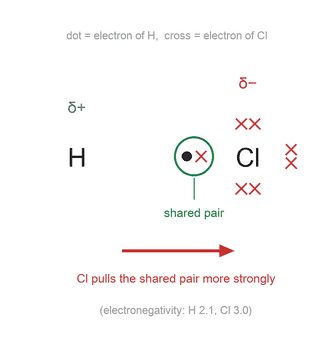
Concept: Electronegativity is the tendency of an atom in a molecule to attract the shared pair of electrons towards itself (Pauling scale, fluorine 4.0 the highest). It increases across a period and decreases down a group, for the same reasons as electron affinity.
Step 1 — Part (a): define the term and state its unit.
Electronegativity is the tendency of an atom in a molecule to attract the shared pair of electrons towards itself.
It is only a tendency, compared on a scale (Pauling, fluorine 4.0 the highest), so it is a dimensionless quantity and has no unit.
Step 2 — Part (b): least electronegative of Li, B, C, F.
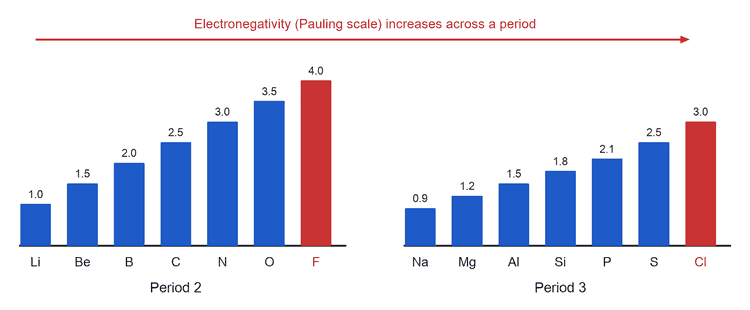
All four are period 2 elements, and electronegativity increases from left to right (Li 1.0, B 2.0, C 2.5, F 4.0). Lithium is the left-most, so it is the least electronegative: (i) Lithium.
Step 3 — Part (c): most electronegative of Mg, Cl, Al, S.
All four are period 3 elements (Mg 1.2, Al 1.5, S 2.5, Cl 3.0). Chlorine is the right-most, so it is the most electronegative: (ii) Chlorine.
Watch out: Electronegativity is about a shared pair in a molecule; electron affinity is about a free atom gaining an electron. They are different properties.
Therefore, (a) electronegativity is the tendency of an atom in a molecule to attract the shared pair; it has no unit; (b) (i) lithium; (c) (ii) chlorine.
