Solution:
Concept: The shells from the nucleus outwards are K, L, M and N. In the first twenty elements the K shell holds 2 electrons and the L and M shells hold 8 each before the N shell starts. For the first 20 elements, the number of shells in an atom gives its period, and the number of electrons in its outermost (valence) shell gives its group: 1 or 2 valence electrons → group 1 or 2; 3 to 8 valence electrons → group 13 to 18 (add 10).
Step 1 — Write the configuration.
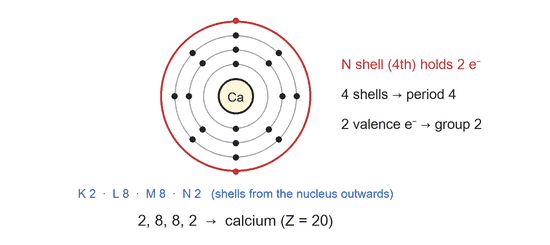
The N shell is the fourth shell. If it has 2 electrons, the K, L and M shells before it are full for this element, so the configuration is 2, 8, 8, 2.
Step 2 — Part (i): add the electrons.
The atomic number equals the total number of electrons in the neutral atom.
Atomic number=2+8+8+2=20
So the element is calcium.
Step 3 — Part (ii): find its position.
It has four shells, so it is in period 4; it has two valence electrons, so it is in group 2 (IIA).
Step 4 — Parts (iii) and (iv): metal or non-metal, and the group name.
It loses its 2 valence electrons easily, so it is a metal. Group 2 is called the alkaline earth metals.
Step 5 — Part (v): valency.
It loses 2 electrons to form Ca2+, so its valency is 2.
Watch out: The N shell is the fourth shell (K, L, M, N), not the third.
Therefore, (i) 20; (ii) period 4, group 2; (iii) metal; (iv) alkaline earth metals; (v) valency 2.
