Solution:
Concept: In the symbol 1632S the lower number, 16, is the atomic number and the upper number, 32, is the mass number. A neutral atom has as many electrons as its atomic number. For the first 20 elements, the number of shells in an atom gives its period, and the number of electrons in its outermost (valence) shell gives its group: 1 or 2 valence electrons → group 1 or 2; 3 to 8 valence electrons → group 13 to 18 (add 10).
Step 1 — Part (i): write the configuration.
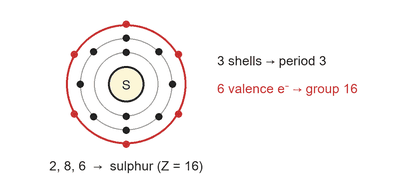
Sixteen electrons fill the shells as K 2, L 8, M 6, so the configuration is 2, 8, 6.
Step 2 — Part (ii): find the group and period.
It has six valence electrons, so it is in group 16 (VIA); it has three shells, so it is in period 3.
Step 3 — Part (iii): find the valency.
It needs 2 more electrons to complete its octet, so its valency is 8 − 6 = 2.
Step 4 — Parts (iv) and (v): metal or non-metal, oxidising or reducing.
It gains electrons to complete its octet, so it is a non-metal. A substance that accepts electrons from others is an oxidising agent.
Step 5 — Part (vi): write the formula with hydrogen.
Sulphur has valency 2 and hydrogen valency 1, so two hydrogen atoms join one sulphur atom: H2S (hydrogen sulphide).
Watch out: The upper number, 32, is the mass number; it is not used for the configuration.
Therefore, (i) 2, 8, 6; (ii) group 16, period 3; (iii) valency 2; (iv) non-metal; (v) oxidising agent; (vi) H₂S.
