Solution:
Concept: Period 2 runs from lithium to neon and period 3 from sodium to argon. Write each configuration and use its position in the table.
Step 1 — Part (a): alkali metal in period 3 and halogen in period 2.
The alkali metal of period 3 is sodium (2, 8, 1). The halogen of period 2 is fluorine (2, 7).
Step 2 — Part (b): noble gas with 3 shells.
The noble gas with three shells is argon (2, 8, 8).
Step 3 — Part (c): non-metals of period 2 and metals of period 3.
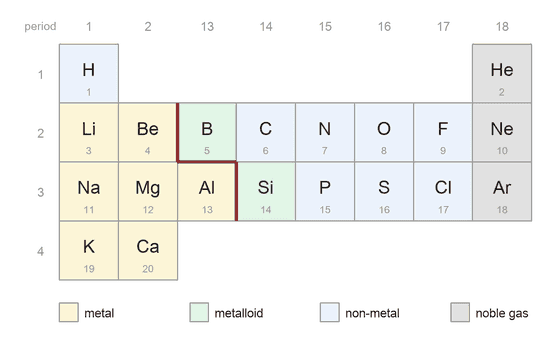
The non-metals of period 2 are carbon, nitrogen, oxygen and fluorine (neon, a noble gas, is also a non-metal; boron is a metalloid). The metals of period 3 are sodium, magnesium and aluminium.
Step 4 — Part (d): element of period 3 with valency 4.
Silicon (2, 8, 4) has 4 valence electrons, which it shares, so its valency is 4.
Step 5 — Part (e): element of period 3 that does not form an oxide.
Argon has a complete octet and does not combine with oxygen.
Step 6 — Part (f): lower nuclear charge out of Be and Mg.
Nuclear charge equals the atomic number: Be is +4 and Mg is +12. So beryllium has the lower nuclear charge.
Watch out: Boron in period 2 is a metalloid, not a non-metal, and silicon in period 3 is a metalloid, not a metal.
Therefore, (a) sodium, fluorine; (b) argon; (c) C, N, O, F and Na, Mg, Al; (d) silicon; (e) argon; (f) beryllium.
