Solution:
Concept: For the first 20 elements, the number of shells in an atom gives its period, and the number of electrons in its outermost (valence) shell gives its group: 1 or 2 valence electrons → group 1 or 2; 3 to 8 valence electrons → group 13 to 18 (add 10).
Step 1 — Read the configuration.
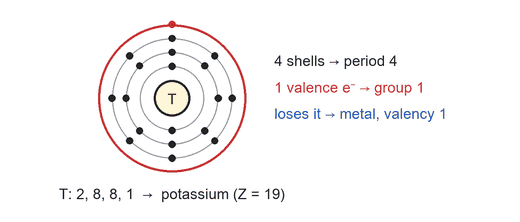
T has 2 + 8 + 8 + 1 = 19 electrons arranged in four shells, with one electron in the outermost shell. So T is potassium (atomic number 19).
Step 2 — Parts (i) and (ii): group and period.
One valence electron puts T in group 1 (IA). Four shells put it in period 4.
Step 3 — Parts (iii) and (iv): valence electrons and valency.
T has 1 valence electron. It loses this electron to form T+, so its valency is 1.
Step 4 — Part (v): metal or non-metal.
It loses an electron easily, so it is a metal.
Watch out: The period is the number of shells (4), not the number of valence electrons.
Therefore, (i) group 1; (ii) period 4; (iii) 1 valence electron; (iv) valency 1; (v) metal.
