Solution:
Concept: Test each statement against the facts of the periodic table and its trends, and give a counter-example.
Step 1 — Statement (i): all groups contain metals and non-metals.
This is not correct. Group 1 (apart from hydrogen) and group 2 contain only metals, and groups 17 and 18 contain only non-metals. Only some groups, such as 14 and 15, contain both.
Step 2 — Statement (ii): same group, same number of electrons.
This is not correct. Atoms of one group have the same number of valence electrons, not the same total. Li has 3 electrons (2, 1) and Na has 11 (2, 8, 1), but each has 1 valence electron.
Step 3 — Statement (iii): non-metallic character decreases across a period.
This is not correct. Non-metallic character increases across a period, because the atoms get smaller and gain electrons more easily: sodium is a metal, chlorine a strong non-metal.
Step 4 — Statement (iv): reactivity increases with atomic number in a group and a period.
This is not correct. In a group, reactivity increases only for metals (Li to Cs); for non-metals it decreases (F to I). In a period it first decreases (Na to Si) and then increases (P to Cl).
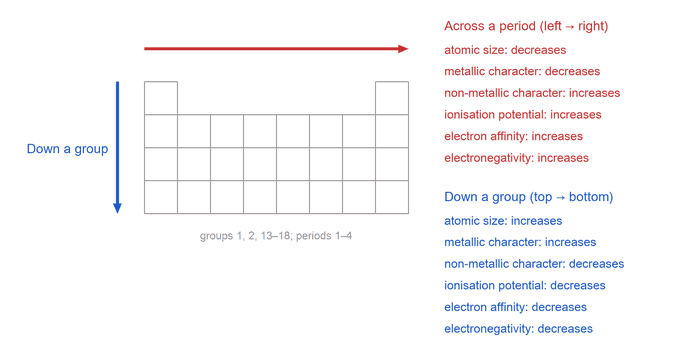
Therefore, each statement fails: groups 1, 2, 17, 18 are not mixed; only valence electrons are equal; non-metallic character increases across a period; reactivity does not simply rise with atomic number.
