Solution:
Concept: Periods 1, 2 and 3 fill the K, L and M shells (the M shell up to 8 electrons here), so they hold 2, 8 and 8 elements.
Step 1 — Part (i): count and name the elements.
- Period 1, 2 elements: hydrogen, helium.
- Period 2, 8 elements: lithium, beryllium, boron, carbon, nitrogen, oxygen, fluorine, neon.
- Period 3, 8 elements: sodium, magnesium, aluminium, silicon, phosphorus, sulphur, chlorine, argon.
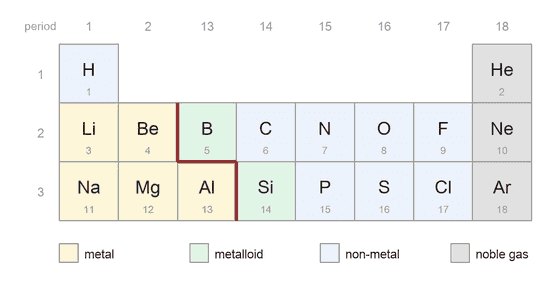
Step 2 — Part (ii): the end of periods 2 and 3.
Neon (2, 8) and argon (2, 8, 8) both have a completely filled outermost shell with 8 electrons (a stable octet).
Step 3 — Part (iii): fill the blanks.
A group 17 element has 7 valence electrons and gains one, so it is likely to be non-metallic. An element with one electron in its outermost shell loses it, so it is likely to be metallic.
Step 4 — Part (iv): most metallic element of period 3.
Sodium is the largest atom of the period and loses its single valence electron most easily, so the most metallic element is sodium.
Watch out: Period 1 has only 2 elements, because its single shell holds only 2 electrons.
Therefore, (i) 2, 8 and 8 elements as listed; (ii) a complete octet in the outermost shell; (iii) non-metallic, metallic; (iv) sodium.
