
Question 372 marksEasy
In group I of the Periodic Table, three elements X, Y and Z have ionic radii 1.33 Å, 0.95 Å and 0.60 Å respectively. Giving a reason, arrange them in the order of increasing atomic numbers in the group.
Confirming your payment
Sign up now and get 250 free tokens.
Periodic Table, Periodic Properties and Variations of Properties · Question 37 of 99
In group I of the Periodic Table, three elements X, Y and Z have ionic radii 1.33 Å, 0.95 Å and 0.60 Å respectively. Giving a reason, arrange them in the order of increasing atomic numbers in the group.
Solution:
Concept: Down a group a new shell is added at each step, so atoms, and the ions they form, get bigger as the atomic number increases.
Step 1 — Compare like with like.
All three are group I elements forming ions, each with one shell fewer than its atom. So the ion sizes follow the same order as their places in the group.
Step 2 — Order the ions.
The smallest ion (Z, 0.60 Å) belongs to the element of lowest atomic number, and the largest (X, 1.33 Å) to the element of highest atomic number.
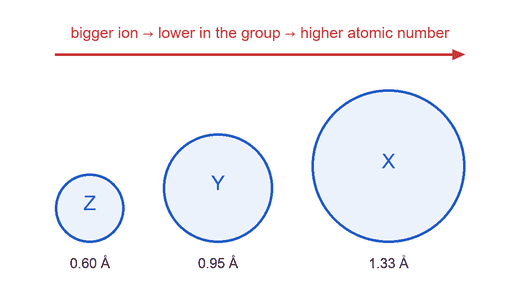
These radii match , and .
Watch out: A bigger ion means a higher atomic number here, so X comes last, not first.
Therefore, the order of increasing atomic number is Z < Y < X, because ionic size increases down the group.