Solution:
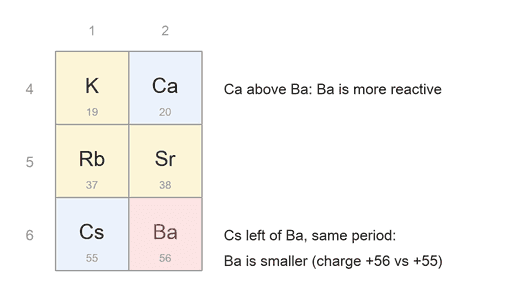
Concept: Barium (Z = 56) is in group 2, period 6: below calcium in its group, and just to the right of caesium (group 1) in its period.
Step 1 — Parts (i) and (iii): metal or non-metal, and valency.
Barium (2, 8, 18, 18, 8, 2) is an alkaline earth element with two valence electrons to lose, so it is a metal with valency 2 (it forms Ba2+).
Step 2 — Part (ii): compare with calcium.
Barium is lower in group 2, so its atom is larger and it loses its valence electrons more easily. It is more reactive than calcium.
Step 3 — Part (iv): write the phosphate formula.
The phosphate ion is PO43− (valency 3) and barium has valency 2. Cross the valencies: three Ba2+ ions carry +6 and two PO43− ions carry −6, so the charges balance.
3×(+2)+2×(−3)=6−6=0
The formula is Ba3(PO4)2.
Step 4 — Part (v): compare with caesium.
Cs and Ba are in the same period, with the same number of shells. Barium has the greater nuclear charge (+56 against +55), which pulls its shells closer, so barium is smaller than caesium.
Watch out: In the phosphate, write the brackets: Ba₃(PO₄)₂, not Ba₃PO₄₂.
Therefore, (i) metal; (ii) more reactive than calcium; (iii) valency 2; (iv) Ba₃(PO₄)₂; (v) smaller than caesium.
