Solution:
Concept: Build each configuration shell by shell (K holds 2, L holds 8, and M holds 8 before the N shell starts in these elements). The total number of electrons is the atomic number, which names the element.
Step 1 — Parts (i) and (ii).
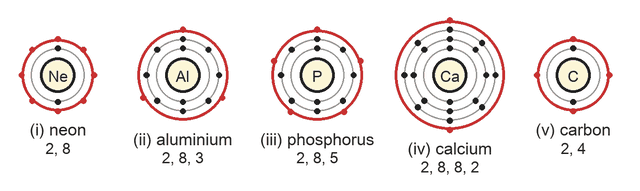
(i) Two shells, both full, is 2, 8: 10 electrons, so the element is neon. (ii) 2, 8, 3 has 13 electrons, so the element is aluminium.
Step 2 — Parts (iii) and (iv).
(iii) Three shells with five valence electrons is 2, 8, 5: 15 electrons, so the element is phosphorus. (iv) Four shells with two valence electrons is 2, 8, 8, 2: 20 electrons, so the element is calcium.
Step 3 — Part (v).
The first shell holds 2 electrons, so twice as many in the second shell means 4: the configuration is 2, 4 with 6 electrons, so the element is carbon.
Watch out: In part (v) the second shell is not full, so the element has only two shells.
Therefore, (i) neon; (ii) aluminium; (iii) phosphorus; (iv) calcium; (v) carbon.
