
Question 342 marksEasy
Write the number of protons, neutrons and electronic configuration of , . Also state their position in the periodic table.
Confirming your payment
Sign up now and get 250 free tokens.
Periodic Table, Periodic Properties and Variations of Properties · Question 34 of 99
Write the number of protons, neutrons and electronic configuration of , . Also state their position in the periodic table.
Solution:
Concept: In , the lower number Z is the atomic number, which equals the number of protons (and of electrons in the neutral atom); the upper number A is the mass number. Neutrons = mass number − atomic number. For the first 20 elements, the number of shells in an atom gives its period, and the number of electrons in its outermost (valence) shell gives its group: 1 or 2 valence electrons → group 1 or 2; 3 to 8 valence electrons → group 13 to 18 (add 10).
Step 1 — Count the particles in potassium.
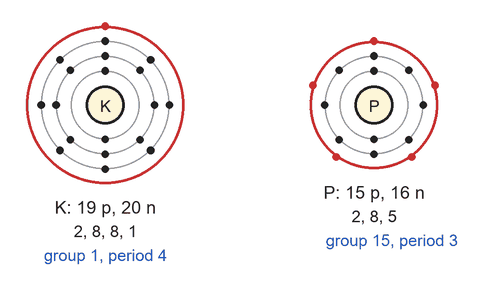
For there are 19 protons, and the neutrons are found by subtraction.
Its 19 electrons are arranged 2, 8, 8, 1: four shells and one valence electron, so K is in group 1, period 4.
Step 2 — Count the particles in phosphorus.
For there are 15 protons.
Its 15 electrons are arranged 2, 8, 5: three shells and five valence electrons, so P is in group 15, period 3.
Step 3 — Summarise.
| Protons | 19 | 15 |
| Neutrons | 20 | 16 |
| Electronic configuration | 2, 8, 8, 1 | 2, 8, 5 |
| Position | group 1, period 4 | group 15, period 3 |
Watch out: For 5 valence electrons the group is 15 (5 + 10), not group 5.
Therefore, K: 19 protons, 20 neutrons, 2, 8, 8, 1, group 1, period 4; P: 15 protons, 16 neutrons, 2, 8, 5, group 15, period 3.