Solution:
Concept: For the first 20 elements, the number of shells in an atom gives its period, and the number of electrons in its outermost (valence) shell gives its group: 1 or 2 valence electrons → group 1 or 2; 3 to 8 valence electrons → group 13 to 18 (add 10). Valency is the number of electrons an atom loses, gains or shares to reach a stable octet (a duplet for the first shell). Atoms with 1, 2 or 3 valence electrons lose them, so their valency equals the number of valence electrons; atoms with 5, 6 or 7 gain electrons, so their valency is 8 minus that number.
Step 1 — Write the configuration.
Atomic number 16 means 16 electrons: 2, 8, 6, which is sulphur.
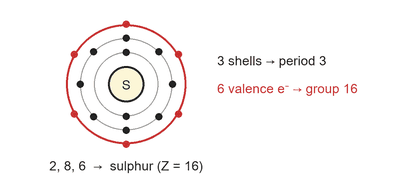
Step 2 — Parts (a) and (b): period and valence electrons.
It has three shells, so it is in period 3, and it has 6 valence electrons (in the M shell).
Step 3 — Part (c): metal or non-metal.
It needs only 2 more electrons to complete its octet, so it gains electrons: it is a non-metal.
Step 4 — Part (d): formula with hydrogen.
The valency of Z is 8 − 6 = 2 and hydrogen has valency 1, so two hydrogen atoms join one Z atom: H2Z (with the real symbol, H2S, hydrogen sulphide).
Watch out: The letter Z here names the element; it is not the atomic number symbol.
Therefore, (a) period 3; (b) 6 valence electrons; (c) non-metal; (d) H₂Z (H₂S).
