Solution:
Concept: In a formula the total valencies must balance; oxygen has valency 2. An oxide that dissolves in water to give a strongly ionised hydroxide is the oxide of an alkali metal.
Step 1 — Find the valency of M.
In M2O, two M atoms balance one O atom of valency 2.
2×(valency of M)=1×2=2
valency of M=1
Step 2 — Use the reaction with water.
The oxide dissolves to form the hydroxide MOH:
M2O+H2O→2MOH
MOH is a strong alkali, fully dissociated into M+ and OH− ions, so its solution conducts electricity well. A metal of valency 1 with such a hydroxide is an alkali metal.
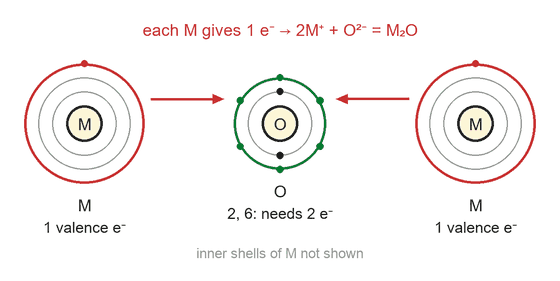
Step 3 — Parts (a) and (b): outer electrons and group.
M has 1 electron in its outermost shell, so it belongs to group 1 (IA), the alkali metals.
Step 4 — Part (c): compare electronegativity.
Oxygen is a non-metal near the top right of the table, while M is a metal on the extreme left; metals have low electronegativity. So oxygen is more electronegative.
Watch out: The subscript 2 in M₂O belongs to M, so M has valency 1, not 2.
Therefore, (a) 1 electron; (b) group 1 (alkali metals); (c) oxygen is more electronegative than M.
