
Question 651 markMCQEasy
Parts (i) to (iv) refer to changes in the properties of elements on moving from left to right across a period of the Periodic Table. For each property, choose the correct answer.
(ii) The electronegativity :
Confirming your payment
Sign up now and get 250 free tokens.
Periodic Table, Periodic Properties and Variations of Properties · Question 65 of 99
Parts (i) to (iv) refer to changes in the properties of elements on moving from left to right across a period of the Periodic Table. For each property, choose the correct answer.
(ii) The electronegativity :
(A) depends on the number of valence electrons,
(B) remains the same,
(C) decreases,
(D) increases
Answer: (D) increases
Concept: Electronegativity is the tendency of an atom in a molecule to attract the shared pair of electrons towards itself (Pauling scale, fluorine 4.0 the highest). It increases across a period and decreases down a group, for the same reasons as electron affinity.
Step 1 — Apply the trend.
A smaller atom with a larger nuclear charge attracts the shared pair of electrons more strongly, so electronegativity increases across a period.
Step 2 — Check with period 2.
The Pauling values rise steadily: Li 1.0, Be 1.5, B 2.0, C 2.5, N 3.0, O 3.5, F 4.0.
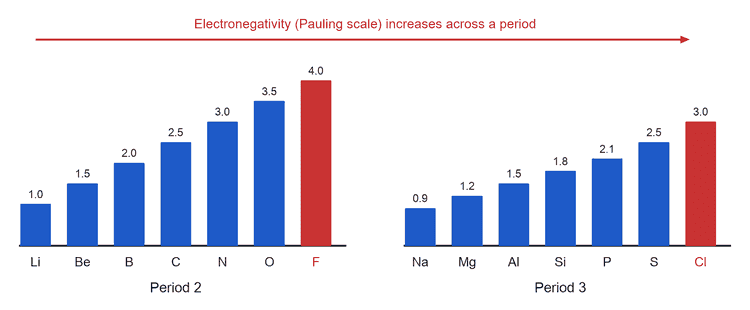
Watch out: Electronegativity decreases down a group but increases across a period.
Why the other options are wrong:
Therefore, the electronegativity increases across a period, option (D).