
Question 661 markMCQEasy
Parts (i) to (iv) refer to changes in the properties of elements on moving from left to right across a period of the Periodic Table. For each property, choose the correct answer.
(iii) The ionization potential :
Confirming your payment
Sign up now and get 250 free tokens.
Periodic Table, Periodic Properties and Variations of Properties · Question 66 of 99
Parts (i) to (iv) refer to changes in the properties of elements on moving from left to right across a period of the Periodic Table. For each property, choose the correct answer.
(iii) The ionization potential :
(A) goes up and down
(B) decreases
(C) increases
(D) remains the same
Answer: (C) increases
Concept: Ionisation energy (ionisation potential) is the energy needed to remove an electron from a neutral isolated gaseous atom. It is higher when the atom is small and the nuclear charge is large, so it increases across a period and decreases down a group.
Step 1 — Apply the trend.
Across a period the atoms get smaller and the nuclear charge increases, so the outer electrons are held more firmly and more energy is needed to remove one.
Step 2 — Check with period 2.
The value rises from Li 520 to Ne 2080 kJ mol⁻¹. The small dips at B and O (and Al and S in period 3) are exceptions to an overall rise.
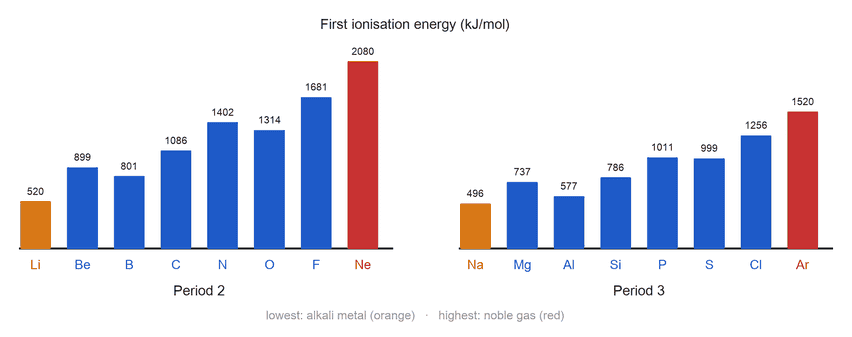
Watch out: The small dips do not change the answer; the general trend is an increase.
Why the other options are wrong:
Therefore, the ionisation potential increases across a period, option (C).