Solution:
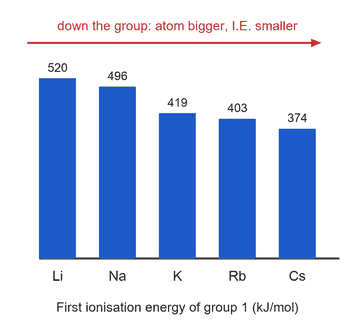
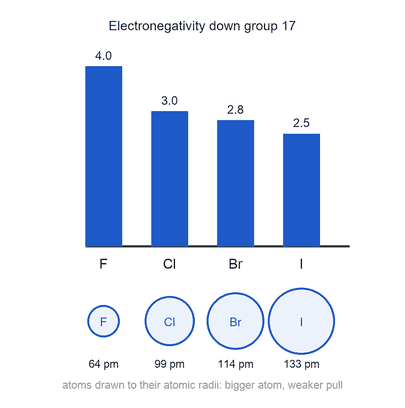
Concept: Both pairs lie in the same group, and both ionization potential and electronegativity decrease down a group as the atoms get bigger.
Step 1 — Part (a): potassium and sodium.
Potassium is below sodium in group 1, so its valence electron is farther from the nucleus and easier to remove (K 419, Na 496 kJ mol⁻¹). The ionization potential of potassium is < that of sodium.
Step 2 — Part (b): iodine and chlorine.
Iodine is below chlorine in group 17; its bigger atom pulls the shared pair less strongly (I 2.5, Cl 3.0). The electronegativity of iodine is < that of chlorine.
Watch out: Both blanks take '<' because in both pairs the first element is the lower one in its group.
Therefore, (a) the ionization potential of potassium is < that of sodium; (b) the electronegativity of iodine is < that of chlorine.
